
dYdX's Strategic Expansion into Solana Spot Markets and U.S. Access: A Game Changer for DeFi Liquidity and Adoption
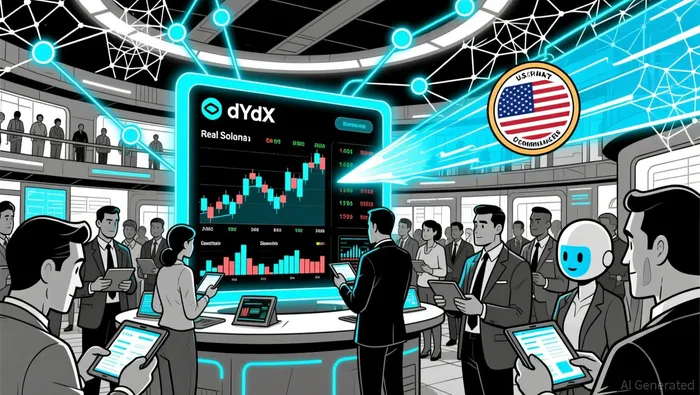
The decentralized finance (DeFi) landscape is undergoing a seismic shift as dYdXDYDX--, one of the most prominent derivatives platforms, strategically expands into SolanaSOL-- spot markets and U.S. access. This move, announced in late 2025, marks a pivotal moment in the evolution of institutional-grade DeFi infrastructure and retail/institutional onboarding. By leveraging Solana's high-throughput blockchain and addressing U.S. regulatory constraints, dYdX is positioning itself to redefine liquidity dynamics and user adoption in the crypto ecosystem.
A New Era for dYdX: From Derivatives to Spot Markets
For years, dYdX has dominated the perpetual derivatives space, processing over $1.5 trillion in cumulative trading volume. However, its recent foray into Solana spot markets represents a strategic pivot toward broader accessibility. By offering zero trading fees for the month of December 2025, dYdX is incentivizing U.S. users to engage with on-chain trading for the first time in the platform's history. This shift is not merely tactical-it reflects a fundamental reimagining of DeFi's value proposition, blending institutional-grade tools with retail-friendly features.
The integration of Solana's ecosystem is particularly noteworthy. Solana's 65,000 TPS throughput and sub-150ms latency provide the technical backbone for high-frequency trading and seamless user experiences. For dYdX, this means the ability to handle surging volumes while maintaining low costs-a critical factor for both retail traders and institutional players. As dYdX President Eddie Zhang emphasized, the platform is committed to "delivering institutional-grade tools while maintaining transparency and decentralization".
Institutional Infrastructure: Bridging DeFi and Traditional Finance
dYdX's institutional-grade infrastructure is being fortified through partnerships and product innovations. The launch of the 21Shares DYDX ETP in 2025 exemplifies this trend. This exchange-traded product allows institutional investors to access the dYdX Chain via a regulated on-ramp, reducing custody risks and aligning with traditional financial infrastructure. Such integrations are part of a broader industry shift where DeFi protocols like dYdX are no longer operating in isolation but are instead interfacing with legacy systems to meet institutional demands for compliance and scalability.
Moreover, dYdX's infrastructure upgrades-such as a 98% reduction in API latency and block times of 750ms-underscore its commitment to handling increased trading volumes. These improvements are critical for attracting institutional capital, which demands low-latency execution and robust security. The platform's $8M ecosystem grants program further reinforces its infrastructure, funding projects like the Order Entry Gateway Service (OEGS) and data analytics tools from Numia.
U.S. Onboarding: Navigating Regulatory Constraints and Retail Demand
The U.S. market entry by late 2025 is a calculated response to both regulatory clarity and surging retail demand. While perpetual contracts remain unavailable in the U.S. due to regulatory restrictions, dYdX is capitalizing on spot trading to onboard a new cohort of users. By slashing fees to 50–65 basis points, the platform is directly competing with centralized exchanges like CoinbaseCOIN-- and Kraken, offering a decentralized alternative with lower costs and self-custody benefits.
User onboarding strategies have also evolved to meet this demand. dYdX's Q2 2025 user support report revealed 5,500 Discord interactions and a 93% satisfaction rate, highlighting the platform's focus on frictionless onboarding. The introduction of an AI support bot, which resolved 52% of user issues automatically and the "Wallet Connections Guide" video demonstrate a commitment to reducing barriers for new users. These efforts are paying off: DYDX token holders grew by 84% year-over-year, and active traders increased by 52% from Q1 to Q4 2024.
Long-Term Implications: Scalability, Liquidity, and DeFi's Mainstream Ascent
The long-term implications of dYdX's expansion are profound. By anchoring itself to Solana's institutional-grade infrastructure, dYdX is addressing a critical pain point in DeFi: scalability. Solana's partnerships with Visa, Stripe, and Apollo, coupled with its $1.72 billion in institutional capital inflows, position it as a viable backbone for global financial applications. For dYdX, this means the potential to process cross-border transactions and institutional-grade trades at scale, bridging the gap between DeFi and traditional finance.
However, challenges remain. Solana's stablecoin liquidity fell by 8.16% in a single week, signaling potential constraints in on-chain demand. dYdX's success will depend on its ability to sustain liquidity through initiatives like the Partner Revenue Share Program, which could see BONK-a Solana memecoin-generate $50 million in protocol fees. Additionally, regulatory shifts will play a decisive role. While the SEC and CFTC have shown openness to decentralized platforms, dYdX must navigate a complex landscape to reintroduce perpetual contracts in the U.S.
Conclusion: A Catalyst for DeFi's Next Phase
dYdX's expansion into Solana spot markets and U.S. access is more than a product launch-it is a catalyst for DeFi's next phase. By combining institutional-grade infrastructure with retail-friendly onboarding, the platform is addressing the dual challenges of scalability and accessibility. As Solana's ecosystem matures and U.S. regulatory clarity improves, dYdX is well-positioned to become a cornerstone of the decentralized financial infrastructure. For investors, this represents a compelling opportunity to bet on a platform that is not just adapting to the future of finance but actively shaping it.





Comentarios
Aún no hay comentarios