
dYdX's Institutional Adoption and Token Value Accrual: A New Era for Blockchain Derivatives
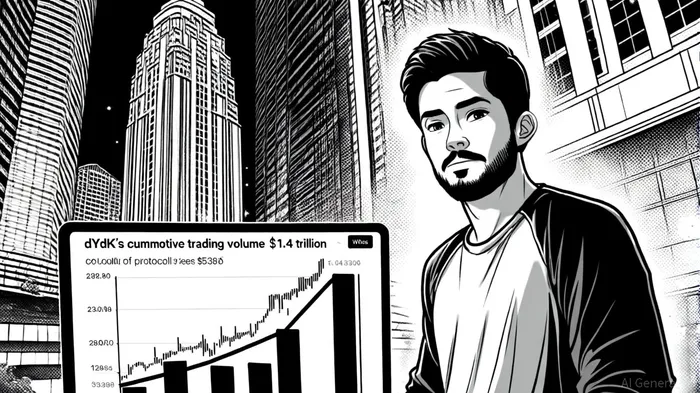
The blockchain derivatives market has long been a frontier for innovation, but 2025 marks a pivotal shift as institutional capital begins to coalesce around protocols that bridge decentralized infrastructure with traditional financial systems. At the forefront of this movement is dYdX, a decentralized exchange (DEX) that has notNOT-- only solidified its position as a leader in on-chain perpetual trading but also redefined how institutional investors access DeFi. With over $1.4 trillion in cumulative trading volume across 230+ perpetual markets, dYdX's operational maturity and strategic roadmap position it as a critical player in the next phase of DeFi adoption[2].
Institutional On-Ramps: The 21Shares ETP and Beyond
Institutional adoption of dYdXDYDX-- reached a milestone in September 2025 with the launch of the 21Shares DYDX Exchange-Traded Product (ETP), a physically-backed, regulated vehicle that allows institutional investors to gain exposure to the DYDX token without navigating the complexities of on-chain operations[1]. This product, developed in collaboration with the dYdX Treasury subDAO operator kpk, underscores a broader trend: the integration of DeFi with traditional finance through compliant, familiar infrastructure[3].
The ETP's significance extends beyond mere accessibility. By aligning with dYdX's ecosystem incentives—such as the dYdX Treasury subDAO's contributions to protocol governance—it reinforces a symbiotic relationship between institutional capital and decentralized infrastructure. As noted in a report by CoinLaw, this development reflects a growing demand for regulated access to DeFi assets, enabling institutions to participate in high-growth markets while mitigating operational risks[3].
Moreover, dYdX's 2025 roadmap includes further institutional bridges, such as Telegram-based trading and Solana integration, which aim to reduce friction for both retail and institutional users[4]. These upgrades, coupled with the ETP, signal a deliberate effort to scale the protocol's user base and liquidity pools, creating a flywheel effect that benefits token holders.
Tokenomics: Buybacks, Staking, and Value Accrual
The DYDX token's value proposition has evolved significantly in 2025, driven by a restructured revenue model and infrastructure-focused initiatives. A key development is the DYDX Buyback Program, which allocates 25% of net protocol fees to open-market token purchases, reducing supply and reinforcing token value[5]. This mechanism, combined with 40% of fees directed to staking rewards and 25% to the MegaVault liquidity program, creates a multi-pronged approach to aligning token holder incentives with protocol growth[5].
Data from Cointelegraph highlights that this buyback strategyMSTR-- has already driven a 10% price increase in DYDX since its March 2025 launch[1]. The program's potential for expansion—community discussions suggest increasing buyback allocations to 100% of fees—further underscores its strategic importance[5]. Meanwhile, staking remains a cornerstone of dYdX's tokenomics, with validators securing the dYdX Chain (a CosmosATOM-- SDK-based Layer 1 blockchain) and earning rewards in proportion to their contributions[4].
The token's utility is also expanding. The dYdX Foundation's Surge program, a $20 million trading competition, and the reimagined iOS app with instant deposits and faster API response times, are designed to boost user engagement and liquidity[2]. These initiatives, paired with the Kaito Yapper Leaderboard's SocialFi incentives, create a robust ecosystem where token value accrual is tied to both infrastructure growth and user activity[2].
Infrastructure Growth: Scaling for the Future
dYdX's infrastructure upgrades in 2025 have been pivotal in supporting its institutional and retail ambitions. The Operations subDAO secured $11.5 million in community funding to enhance scalability, while the Foundation raised an additional $8 million (in DYDX) for a grants program targeting infrastructure, tooling, and security[3]. These investments are critical for maintaining the protocol's performance as it transitions to a sovereign blockchain, enabling cross-chain transfers via IBC Eureka and planning for RWA perpetuals (e.g., synthetic TeslaTSLA-- equity exposures)[2].
The dYdX Chain's architecture—optimized for high-performance trading with an off-chain orderbook and on-chain settlement—ensures that the protocol can handle increasing volumes without compromising decentralization[4]. This technical foundation, combined with strategic partnerships and tokenomics, positions dYdX to capture a larger share of the derivatives market, which is projected to grow as institutional demand for programmable, transparent trading environments rises.
The Investment Thesis
For investors, dYdX's 2025 trajectory presents a compelling case. The protocol's institutional adoption, driven by products like the 21Shares ETP, is not just a short-term win but a structural shift in how DeFi assets are accessed and traded. Meanwhile, its tokenomics model—combining buybacks, staking, and governance—creates a self-reinforcing cycle of value accrual. As dYdX continues to execute its roadmap (including spot trading and RWA perpetuals), the DYDX token's utility and scarcity will likely strengthen, making it a key asset in the blockchain derivatives ecosystem.






Comentarios
Aún no hay comentarios