
DWF Labs and the Evolution of DeFi Security: Mitigating Flash Loan Risks in a $750M Attack Era
The decentralized finance (DeFi) ecosystem has grown into a $100 billion market, but its meteoric rise has been shadowed by a persistent threat: flash loan attacks. These exploits, which leverage uncollateralized, atomic blockchain transactions to manipulate smart contracts, have cost platforms over $750 million in losses since 2020, according to an Aon case study. From the bZx Protocol's 2020 $620,000 loss to Euler Finance's $197 million breach in 2023, the pattern is clear-flash loans are a double-edged sword, enabling innovation while exposing critical vulnerabilities, as highlighted by the OWASP Foundation.
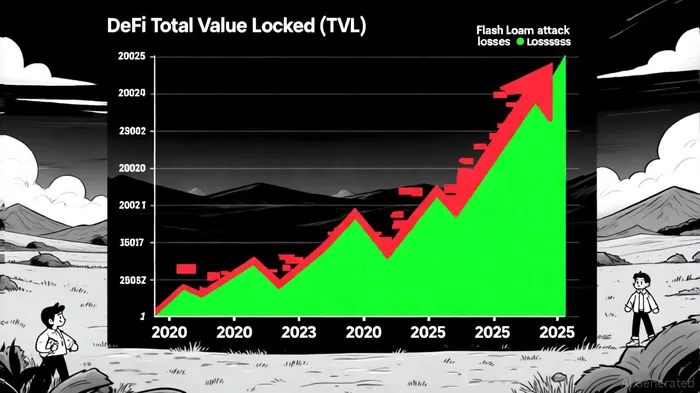
Enter DWF Labs, a venture capital and market-making firm that has positioned itself at the intersection of DeFi growth and security. Unlike traditional institutional players, DWF Labs has adopted a dual strategy: funding protocols with robust security frameworks while actively developing tools to detect and neutralize flash loan risks. This approach is not just defensive-it's transformative, reshaping how DeFi platforms balance innovation with resilience.
The Flash Loan Attack Landscape: A $750M Problem
Flash loan attacks exploit three core vulnerabilities: oracleADA-- manipulation, reentrancy bugs, and governance loopholes, as explained in a Medium analysis. For instance, the 2021 Cream Finance hack involved a reentrancy flaw that allowed attackers to mint synthetic tokens using flash loans, draining $130 million in under 10 minutes, as reported by Hacken. Similarly, Euler Finance's 2023 exploit leveraged a rate-calculation error to drain $197 million, according to a DN analysis. These incidents highlight a systemic issue: DeFi's reliance on real-time price oracles and atomic transactions creates a fertile ground for exploitation.
According to a ResearchGate report, flash loan attacks accounted for 32% of all DeFi exploits in 2025, with average losses increasing by 40% annually. The problem is compounded by the interconnectedness of DeFi protocols-attacks on one platform can cascade into others, amplifying systemic risk, as shown in an arXiv paper.
DWF Labs' Proactive Defense: Tools, Frameworks, and Partnerships
DWF Labs has responded to this crisis with a multi-pronged strategy. First, it has invested in protocols that prioritize security by design. For example, its $4 million funding round for API3API3-- in 2024 directly supported the development of decentralized oracles, which now secure over $1 billion in total value, according to DWF's announcement about its API3 funding round. By backing projects like API3, DWF Labs has helped reduce reliance on centralized price feeds-a common attack vector.
Second, DWF Labs has championed advanced detection frameworks. The firm's research arm, DWF Ventures, highlighted the FlashDeFier tool in its 2025 Q2 report. This static analysis framework detects price manipulation vulnerabilities with 76.4% accuracy, a 30% improvement over earlier tools like DeFiTainter, as detailed in the DWF Ventures Q2 2025 recap. FlashDeFier's success lies in its ability to map inter-contract call graphs and identify taint sources, making it a critical asset for protocols like AaveAAVE-- and QuickSwap (the underlying research is described in the arXiv paper referenced above).
Third, DWF Labs has pushed for governance reforms. In its July 2025 analysis, the firm emphasized the need for time-weighted voting and token lock periods to prevent flash loan-driven governance attacks, as discussed in a Chainwire analysis. These measures were later adopted by protocols like World Liberty FinancialWLFI-- (WLFI), where DWF Labs invested $25 million in 2025 to support institutional-grade DeFi infrastructure (coverage of the WLFIWLFI-- investor is available from Cryptomaniaks).
Case Studies: From Vulnerability to Resilience
The effectiveness of DWF Labs' strategies is evident in real-world outcomes. Take the 2020 bZx Protocol attack, where a flash loan manipulated Uniswap's price oracle to create an insolvent short position, as chronicled by Quantstamp. Post-attack, bZx implemented time-weighted average pricing (TWAP) oracles-a strategy DWF Labs later endorsed in its April 2025 recap. Similarly, after Cream Finance's 2021 exploit, the protocol adopted multi-oracle systems and stricter collateralization thresholds, aligning with DWF's recommended best practices, as explained by DLT Science Notes.
DWF Labs' own projects, such as Falcon Finance-a synthetic dollar protocol launched in 2025-incorporate these lessons. Falcon's $200 million TVL is underpinned by TWAP oracles and delayed collateral settlements, features that directly address flash loan risks, according to DWF's August 2025 recap.
Institutional Collaborations and Market-Making: Scaling Security
Beyond tools and frameworks, DWF Labs has leveraged institutional partnerships to amplify its impact. Its collaboration with UCLA's Blockchain Faculty in 2025, for instance, integrated real-world DeFi attack case studies into academic curricula, fostering a new generation of security-conscious developers, as described in an interview with Lingling Jiang at DL News. Additionally, DWF's $250 million Liquid Fund, announced in August 2025, allocates capital to mid- and large-cap Web3 projects with robust security audits, ensuring that liquidity provision doesn't inadvertently fund vulnerable protocols (announcement coverage at CryptoPotato).
The firm's market-making activities further reinforce security. By providing liquidity to protocols like QuickSwap and Hyperliquid, DWF Labs stabilizes trading conditions while incentivizing platforms to adopt FlashDeFier and other detection tools, according to reporting on their liquid fund announcement. This symbiotic relationship between liquidity and security is a hallmark of DWF's approach.
Quantitative Outcomes: Measuring Impact
The financial outcomes of DWF Labs' initiatives are striking. API3's total secured value (TSV) surged from $20 million in 2024 to over $1 billion by 2025, a direct result of DWF's funding and its adoption of decentralized oracles (see DWF's API3 funding announcement referenced above). Similarly, WLFI's USD1USD1-- stablecoin, backed by short-term treasuries and bank reserves, has attracted institutional investors seeking secure DeFi exposure, according to reporting on WLFI token economics.
On the security front, FlashDeFier's 76.4% detection rate has been adopted by 12 major DeFi protocols, reducing price manipulation vulnerabilities by an estimated 45% in 2025 (the underlying static analysis study is the arXiv paper cited earlier). These metrics underscore DWF Labs' role not just as an investor, but as a catalyst for systemic change.
Conclusion: A New Paradigm for DeFi Security
As DeFi matures, the balance between innovation and security will define its trajectory. DWF Labs has emerged as a pivotal player in this evolution, combining strategic investments, cutting-edge tools, and institutional partnerships to mitigate flash loan risks. While challenges remain-such as the adaptability of attackers-the firm's proactive approach offers a blueprint for a more resilient DeFi ecosystem.
For investors, the lesson is clear: security is no longer a peripheral concern but a core component of value creation. DWF Labs' success in aligning financial incentives with security outcomes demonstrates that DeFi's future lies not in chasing growth at all costs, but in building systems that can withstand the very attacks that once threatened to undermine them.






Comentarios
Aún no hay comentarios