
Dutch Consumer Confidence Plummets to New Lows: Implications for Retail and Cyclical Sectors
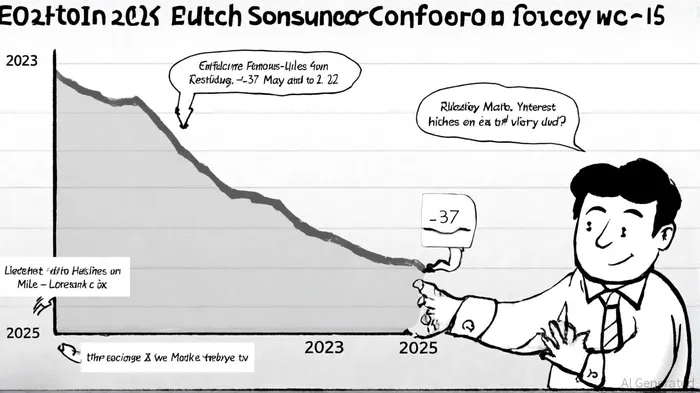
, marking one of the lowest points since early 2023 and underscoring a deepening pessimism among households[1]. This figure, , reflects a perfect storm of economic uncertainty, including volatile interest rates, global trade tensions, and inflationary pressures[2]. For investors, this signals a critical inflection point for retail and cyclical sectors, demanding a strategic reallocation of capital to mitigate risks and capitalize on emerging opportunities.
The Retail Sector: A Tale of Contradictions
While the retail sector in the Netherlands is showing early signs of recovery—driven by rising footfall in city centers like Amsterdam and Utrecht[3]—the broader picture remains fraught with challenges. E-commerce dominance continues to erode margins, and smaller retailers face existential threats from rising costs and bankruptcies[4]. For instance, Blokker's struggles have left vacancies in prime retail locations, which are now being snapped up by chains like Van Haren and TerStal[5]. However, the sector's resilience is uneven: high-quality retail properties in urban cores are attracting renewed investor interest, while secondary locations and supermarkets face margin compression from online grocery competition[6].
Investors should prioritize and sustainability-driven efficiency. Retailers integrating AI-driven personalization and energy-efficient operations are better positioned to weather the storm[7]. , driven by falling ECB rates and a focus on multifunctional, prime-location assets[8].
Cyclical Sectors: Tariffs, Turbulence, and Tactical Rotation
The Netherlands' export-dependent cyclical industries—steel, machinery, and vehicles—are under siege from U.S. tariffs and geopolitical tensions[9]. , but this is contingent on domestic demand, not global trade[10]. For investors, this means reducing exposure to export-heavy equities and pivoting toward sectors insulated from international volatility.
BCG and InvescoIVZ-- analysts advocate for a , increasing allocations to energy, industrials, and infrastructure[11]. These sectors benefit from domestic growth and infrastructure spending, while defensive plays like healthcare and utilities underperform in expansionary phases[12]. For example, energy stocks could capitalize on inflation normalization and mid-cycle commodity price rebounds[13].
Strategic Reallocation: Discipline Over Haste
The key to navigating this environment is . Investors should:
1. Maintain a financial buffer .
2. Avoid overleveraging during high-profit periods, .
3. Leverage data-driven resource reallocation, prioritizing sustainable efficiency metrics (e.g., energy use, .
Morningstar data reveals that consumer cyclical stocks, such as those in apparel and auto parts, are undervalued but face headwinds from delayed discretionary spending[17]. Bold investors might target niche opportunities in power sports or toys, but caution is warranted[18].
Conclusion: Navigating the Dutch Doldrums
The Dutch economy is in a state of liminality—a suspended state between contraction and growth[19]. For investors, this demands agility: exit overexposed cyclical sectors, double down on value-driven industrials, and hedge against regulatory risks (e.g., EU Omnibus directive[20]). As the ECB cuts rates and financing improves, prime retail and industrial assets will likely outperform. But the path forward is narrow—strategic reallocation must balance optimism with pragmatism.







Comentarios
Aún no hay comentarios