
Dutch Bros' December 29 Dip: A Symptom of Structural Tension
The sharp 3.78% drop in Dutch BrosBROS-- stock on December 29 was a contained but telling reaction to a confluence of selling pressure. The stock closed at $62.04, a move that outpaced the broader market's 0.14% loss. This was not a broad-based sell-off but a targeted event, driven by institutional and insider selling that had been building momentum.
The immediate catalysts were clear. In the third quarter, institutional investor Voya Investment Management cut its stake by 38.8%, a significant reduction that signaled a loss of conviction. More dramatically, Chairman Travis Boersma executed a $93 million sale of shares in November. When combined with other insider activity, this created a wave of selling that culminated in the December decline. The stock's recent performance had already been under pressure from this narrative of heavy dilution and aggressive growth funding, which has seen the share count nearly double since the IPO.
Yet the drop must be viewed within the stock's powerful recent trajectory. Despite the December setback, Dutch Bros had been a standout performer, gaining 8.63% over the prior month. Its longer-term story is even more striking: the stock has gained 60.6% since its September 2021 IPO, a return that slightly outpaced the S&P 500. This context is crucial. The December 29 decline was a pullback within a strong uptrend, a correction triggered by specific, known selling rather than a fundamental breakdown in the company's growth story.
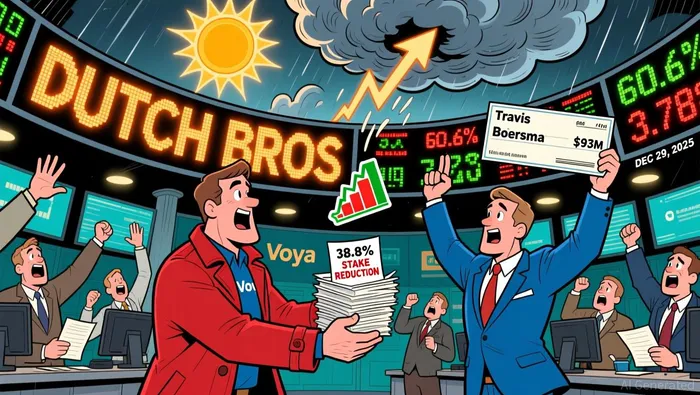
The bottom line is that this was a sharp but contained event. The selling pressure was concentrated and pre-announced, making the drop a predictable reaction rather than a new development. For investors, the key question shifts from the immediate price move to whether the stock's valuation, which remains rich at a Forward P/E of 95.43, can still justify its ambitious growth plans after such a dilutive funding cycle.
The Structural Tension: Growth Engine vs. Dilution
Dutch Bros' explosive growth is real, but it comes at a steep and structural cost. The company's financial engine is firing on all cylinders, yet the mechanism for fueling that expansion is systematically undermining shareholder returns. The tension is clear: a powerful revenue ramp is being financed by a massive issuance of new shares.
The growth story is compelling. In the third quarter of 2025, revenue surged 25.3% year-over-year to $423.58 million, beating estimates. This acceleration was driven by a 5.7% increase in systemwide same-shop sales, indicating strong underlying demand and operational execution. Management has raised its full-year revenue outlook, signaling confidence in the durability of this momentum.
The financing mechanism for this expansion is aggressive and company-owned. In 2024, Dutch Bros opened 151 new shops, with a target of 160+ total system shops in 2025. This model requires significant capital, which the company has raised through the public markets. The result is extreme share dilution. The fully diluted share count doubled from 57.4 million in Q2 2023 to 115.2 million by end-2024. This isn't a one-time event; it's a continuous feature of the growth plan, compounded by stock-based compensation.
The bottom line is a direct conflict between top-line success and per-share value. While the company's market capitalization has soared, the dilution has limited the actual gains for shareholders. The stock's 60.6% gain since its 2021 IPO slightly outpaced the S&P 500, but that return is a fraction of the company's own valuation growth. The structural tension is that every dollar of new revenue generated by a newly opened shop is diluted across twice as many shares as it was just a year ago. For investors, the challenge is to assess whether the long-term value of a much larger company justifies the immediate erosion of ownership.
Valuation and Market Sentiment: Pricing Perfection
Dutch Bros trades at a valuation that leaves no room for disappointment. The stock's forward P/E ratio of 95.43 is a steep premium to the industry average of 19.76, signaling that investors are paying a massive multiple for each dollar of expected earnings. This extreme valuation is even more pronounced when viewed through the PEG ratio, which adjusts for growth. With a PEG ratio of 2.91, the market is pricing in exceptionally high future earnings expansion. For context, the broader restaurant industry trades at a PEG of 2.3, meaning Dutch Bros is paying a significant premium for its anticipated growth trajectory.
This premium is supported by strong recent momentum. Despite a 3.78% drop yesterday, the stock remains up 8.63% over the past month, outperforming both the sector and the broader S&P 500. This persistent bullish momentum reflects a market that is fully committed to the company's growth narrative. Analysts are also confident, with a 1.07% rise in the Zacks Consensus EPS estimate over the month, projecting a 42.86% year-over-year earnings growth for the next quarter.
The bottom line is that Dutch Bros' valuation indicates its high growth expectations are already baked in. The stock is priced for perfection, with every positive earnings beat or growth acceleration already discounted. Any stumble in execution, even a modest miss against these lofty projections, could trigger a sharp repricing. The elevated PEG ratio, in particular, suggests the market has priced in a near-flawless path of expansion, leaving little margin for error.
Catalysts and Risks: Execution vs. Dilution
The near-term investment case for Dutch Bros hinges on a clear tension: execution must outpace dilution. The primary catalyst is the successful, on-time delivery of its ambitious 2029 target of 2,029 stores. Management has signaled strong confidence in this trajectory, raising its full-year revenue guidance to $1.61-$1.615 billion following a third-quarter beat. The company's operational engine is firing, with consistent transaction gains for the fifth straight quarter and record-high systemwide AUVs. This momentum, driven by a disciplined expansion plan that includes opening 38 new shops in Q3 alone, provides the top-line fuel needed to justify its lofty valuation.
Yet this growth is being funded by a significant capital structure. The major risk is continued dilution from secondary stock offerings and stock-based compensation. The company's market cap has soared 336% since its 2021 IPO, but heavy dilution has limited shareholder gains. The math is stark: backing out stock-based compensation alone would have lifted full-year earnings per share from $0.03 to $0.27 on a non-GAAP basis. This program, combined with secondary offerings, has ballooned the share count, directly pressuring per-share metrics even as the business grows.
Adding uncertainty to this dynamic is recent insider selling. In November, Chairman Travis Boersma sold a $93 million stake. While such transactions are not uncommon for executives, they introduce a layer of skepticism that can weigh on sentiment, especially when viewed alongside the company's dilutive financing strategy.
The bottom line is a straightforward race. Dutch Bros must scale its operations and customer base fast enough to offset the ongoing share count expansion. The raised guidance and strong comp sales provide a solid runway. But until the market sees a clear path where earnings per share growth finally accelerates ahead of dilution, the stock's premium multiple will remain vulnerable to any stumble in the execution of its aggressive store-opening plan.







Comentarios
Aún no hay comentarios