
DUSK's Breakout Momentum: A Convergence of Institutional Adoption and Technical Strength
In Q3 2025, DUSK NetworkDUSK-- (DUSK) emerged as a compelling case study in institutional-grade blockchain innovation, blending privacy-preserving technology with regulatory compliance to attract a new wave of institutional capital. The project's post-mainnet roadmap-anchored by Hyperstaking, Zedger Asset tokenization, and MiCA-compliant infrastructure-has positioned it at the intersection of decentralized finance (DeFi) and traditional financial systems. This analysis unpacks the on-chain, technical, and institutional signals driving DUSK's breakout momentum and evaluates its potential for large-cap crossover.
Institutional Adoption: A Privacy-First Bridge to Regulated Markets
DUSK's institutional adoption metrics in 2025 reflect a strategic alignment with the evolving demands of institutional investors. By Q3 2025, the network reported 31 million institutional wallets, a 51% year-over-year increase, with 43% of these being custodial wallets, according to CoinLaw's 2025 report. This growth is underpinned by DUSK's integration with custodian banks and its tokenization of $300M+ in assets via NPEX, a platform offering EU financial licenses for asset issuance, as outlined in Dusk's post-mainnet roadmap.
The project's focus on privacy-preserving compliance tools-such as ZK KYC/AML protocols-aligns with stringent regulations like DORA, GDPR, and MiCA, making it attractive to institutions navigating complex regulatory landscapes, as described in Dusk's post-mainnet roadmap. For instance, DuskDUSK-- Pay, a MiCA-compliant electronic money transfer network, caters to businesses requiring stablecoin solutions with higher compliance standards, a point the post-mainnet roadmap emphasizes. These developments have positioned DUSK as a bridge between traditional finance (TradFi) and blockchain, enabling institutions to tokenize real-world assets (RWAs) while maintaining privacy and regulatory adherence.
Technical Breakout: Volume, Momentum, and Structural Catalysts
DUSK's technical indicators in Q3 2025 signaled a dramatic shift in market sentiment. On July 20, 2025, the token broke out of an 8-month downtrend, with on-chain transaction volume spiking 3,530% to $7.26M, according to a CoinMarketCap update. This surge coincided with a breach of the 100-day EMA and bullish divergence in the MACD histogram, suggesting strong short-term momentum, as noted in the CoinMarketCap update. Analysts projected a price target of $0.19 based on this breakout, driven by renewed institutional interest in privacy-focused blockchains per the same CoinMarketCap coverage.
Structural catalysts further reinforced this momentum. DUSK's integration of quantum-resistant cross-chain security using lattice-based cryptography and the final preparation of the DuskEVM (an EthereumETH-- Virtual Machine layer) marked critical technical progress, developments summarized in the CoinMarketCap coverage. The DuskEVM, designed for EVM compatibility while preserving privacy features, is expected to attract developers and DeFi protocols seeking a compliant yet confidential environment, according to The Standard analysis. These upgrades, combined with the launch of the Zedger Asset protocol in beta, underscore DUSK's transition from a niche privacy project to a scalable infrastructure for institutional-grade applications.
Exchange Inflows and Market Context: Capital Flow Amid Alt-Season Dynamics
While specific exchange inflow figures for DUSK in Q3 2025 remain opaque, broader market trends suggest growing institutional participation. Futures and spot inflows tracked by Coinglass indicated increased capital deployment in DUSK, albeit without precise numbers, a point referenced in Dusk's post-mainnet roadmap. This aligns with a Q3 2025 market environment where institutional investors rotated into altcoins with real-world utility, particularly those aligned with tokenized assets and regulated infrastructure, as highlighted in a Grayscale research note.
The quarter also saw a $20 billion inflow into USDT and USDC, reflecting heightened demand for stablecoins as settlement tools, a trend noted in Dusk's post-mainnet roadmap. DUSK's Dusk Pay and MiCA-compliant CEX plans position it to capture a share of this demand by offering privacy-enhanced stablecoin solutions. Meanwhile, the broader crypto market's "alt-season" dynamics-driven by real-world asset adoption and DeFi innovation-have created favorable conditions for projects like DUSK that combine compliance with technological differentiation, a theme echoed in Grayscale's analysis.
Strategic Entry Rationale: A Convergence of Signals
The convergence of institutional adoption, technical strength, and regulatory alignment makes DUSK a compelling strategic entry point ahead of potential large-cap crossover. Key arguments include:
1. Institutional Infrastructure: DUSK's custodial wallet growth and $300M+ tokenized assets under NPEX demonstrate its ability to attract institutional capital, as reported by CoinLaw and Dusk's post-mainnet roadmap.
2. Technical Catalysts: The July 2025 breakout, supported by volume spikes and bullish momentum indicators, suggests short-term upside potential, per the CoinMarketCap update.
3. Regulatory Resilience: Compliance with MiCA and DORA ensures DUSK remains relevant in an increasingly regulated crypto landscape, a central point of Dusk's post-mainnet roadmap.
4. Market Positioning: As alt-season gains traction, DUSK's focus on privacy-preserving RWAs and EVM compatibility positions it to benefit from DeFi's institutionalization, as argued in The Standard analysis.
Conclusion: A Privacy-First Play on Institutional DeFi
DUSK's breakout in Q3 2025 is notNOT-- merely a technical phenomenon but a reflection of its strategic alignment with institutional priorities. By combining zero-knowledge privacy with MiCA-compliant infrastructure, the project addresses the dual demands of security and regulatory adherence. As institutional investors continue to tokenize assets and seek compliant DeFi solutions, DUSK's unique value proposition-rooted in its SBA consensus, ZK-VM, and DuskEVM-positions it as a strong contender for large-cap recognition. For investors, the current price action and institutional tailwinds present a timely opportunity to capitalize on a project poised at the frontier of privacy and compliance.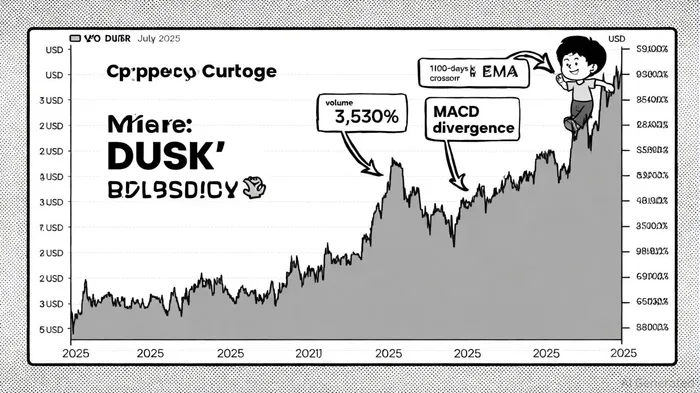






Comentarios
Aún no hay comentarios