
DuPont's Value Creation Strategy and Financial Framework
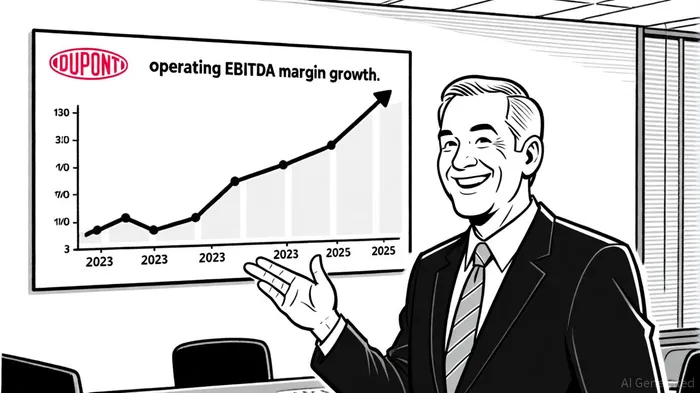
DuPont's strategic pivot toward operational efficiency and innovation-driven growth has positioned the industrial bellwether as a compelling case study in long-term shareholder value creation. By aligning its 2023–2025 financial framework with disciplined cost management, AI-enhanced R&D, and portfolio rationalization, the company has demonstrated a clear path to outperforming sector peers. Recent financial results underscore this trajectory, with operating EBITDA margins expanding by 120 basis points in Q2 2025 to 26.4% and free cash flow conversion hitting 93%—a testament to the efficacy of its operational excellence initiatives [1].
Operational Efficiency: The Engine of Margin Expansion
DuPont's focus on cost discipline has been a cornerstone of its value creation strategy. In 2024, the company achieved 100 basis points of margin expansion through automation and productivity gains, including a $150 million cost savings target and 25% automation of manufacturing processes [2]. These efforts accelerated into 2025, where Q2 results revealed a 26.4% operating EBITDA margin, driven by organic growth and “productivity gains that more than offset growth investments” [1]. Such precision in cost management is critical for sustaining profitability amid global supply chain volatility and PFAS-related litigation risks [2].
The company's operational efficiency extends beyond cost-cutting. By converting 93% of EBITDA into free cash flow, DuPont has unlocked flexibility to reinvest in high-growth markets or return capital to shareholders. This financial discipline is a direct outcome of its “operational and commercial excellence” initiatives, which prioritize lean manufacturing and digital process optimization [1].
Strategic R&D: Fueling Innovation in High-Growth Sectors
DuPont's 15% increase in R&D investment for 2025 reflects its commitment to innovation as a growth lever. The company is channeling resources into AI-accelerated discovery and sustainability solutions, with a particular focus on semiconductors, healthcare, and water technologies [2]. These sectors align with secular trends, such as the surge in chip demand and the global push for decarbonization, positioning DuPont to capture market share in markets projected to grow at double-digit rates.
For instance, its AI-driven R&D initiatives are streamlining material development cycles, reducing time-to-market for breakthrough products. This approach not only accelerates revenue generation but also strengthens DuPont'sDD-- competitive moat against rivals with less agile innovation pipelines [2].
Financial Framework: Balancing Growth and Shareholder Returns
DuPont's 2025 financial framework is designed to balance reinvestment in core operations with value accretive returns to shareholders. The company has outlined medium-term targets, including a 3–4% organic sales growth CAGR and 150–200 basis points of operating EBITDA margin improvement [1]. These metrics are underpinned by the spin-off of its electronics business, Qnity Electronics, Inc., which is expected to streamline operations and free up capital for higher-return opportunities [1].
Disciplined capital allocation further reinforces this strategy. With adjusted EPS growth of 8–10% CAGR, DuPont is prioritizing a balanced approach to dividends and share repurchases while maintaining flexibility for strategic acquisitions [1]. The Q2 2025 results, which delivered a 15% year-over-year EPS increase to $1.12, validate the effectiveness of this framework [2]. However, historical data from 2022 to 2025 indicates that DuPont's stock has underperformed following earnings beats, with an average 30-day return of –0.88% and statistically negative performance from day 5 through day 23 after such events[4].
Conclusion: A Model for Sustainable Value Creation
DuPont's integration of operational efficiency, strategic R&D, and a robust financial framework offers a blueprint for sustainable shareholder value creation. By targeting high-growth markets with AI-enhanced innovation and maintaining a disciplined approach to cost management, the company is not only navigating macroeconomic headwinds but also positioning itself for outperformance in the industrial sector. As the spin-off of Qnity and other strategic moves materialize, investors may find DuPont's stock increasingly attractive for its combination of growth potential and financial resilience.





Comentarios
Aún no hay comentarios