
Duos Edge AI: A Deep Tech Bet on the Edge Computing S-Curve
Duos Edge AI is a pure-play infrastructure bet on the edge computing S-curve. The company's model is built on the fundamental shift from centralized cloud to distributed, localized compute-a-move driven by the insatiable demand for real-time responses. The market's trajectory confirms this is a paradigm shift, not a niche trend. The edge data center market is projected to grow from $10.4 billion in 2023 to $51 billion by 2033, representing a compound annual growth rate of 19.9%. This isn't just growth; it's the exponential adoption curve of a foundational technology.
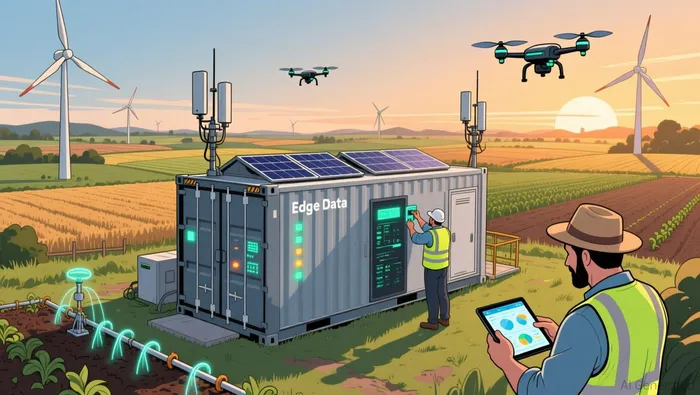
The company exemplifies this infrastructure play with its modular, rapid-deployment edge data centers. A recent deployment in partnership with the Hereford Independent School District in Texas is a textbook case. This facility provides on-premises, low-latency compute to support advanced education technology and regional business applications. Its purpose is to deliver enterprise-grade infrastructure closer to end users, enabling real-time data processing and improving network performance without the capital intensity of traditional data center development. This model is critical for scaling digital equity and community growth, particularly in underserved areas.
This infrastructure is becoming essential for the next wave of AI. As generative AI applications proliferate, they generate massive new data flows. According to GSMA data cited in a recent panel, AI is projected to add between 20% and 80% additional traffic to mobile networks. Much of this traffic will be carried over 5G, which is itself a key enabler of edge computing. The symbiotic relationship is clear: 5G's ultra-low latency requires shifting compute functions physically closer to where data is created. Without edge infrastructure, the promise of real-time AI-whether for autonomous systems, industrial automation, or immersive experiences-collapses under the weight of network delays. DuosDUOT-- Edge AI is building the fundamental rails for this new paradigm, positioning itself at the infrastructure layer where the next technological singularity will be powered.
Execution and Financial Reality: From Patents to Profitability
The company's operational momentum is now translating into tangible financial strength. After a transformative year, Duos Technologies GroupDUOT-- has significantly fortified its balance sheet and expanded its service offerings. This move from pure infrastructure play to a broader solutions provider is a critical step in building a durable business model. The company recently added two new business lines, including power consulting, which aligns with its strategic push into high-density data center parks and power solutions for AI workloads. This diversification not only opens new revenue streams but also deepens its integration into the edge computing value chain.
A key asset in this execution is its intellectual property. Duos Edge AI holds a patent covering its modular edge data center solutions, a potential competitive moat. This patent, along with others for its Railcar Inspection Portal, provides a technical barrier to entry and validates the company's engineering-first approach. It's the kind of foundational IP that can protect market share as the edge S-curve steepens.
Financially, the setup shows promise. The stock trades around $10.52, a level that reflects both the company's growth trajectory and the inherent risks of a pre-profit venture. Analysts, however, see a clear path to value creation. The consensus is a "Strong Buy" rating with an average price target of $14, implying a 33% upside. This optimism is backed by a forecast for explosive top-line growth, with revenue expected to nearly triple this year before expanding further next year. The recent guidance includes a landmark contract to manage 850MW of gas-powered turbines, which provides a major cash infusion and signals credibility with institutional capital.
The bottom line is that Duos is moving beyond the promise phase. It has secured anchor deployments, built a patent portfolio, and strengthened its financials. The current valuation suggests the market is pricing in the risk of execution, but the operational milestones and analyst targets point to a company that is successfully building the rails for the edge computing paradigm. The coming quarters will test whether this financial reality can keep pace with the exponential adoption curve it is betting on.
Catalysts, Risks, and What to Watch
The edge infrastructure thesis now hinges on a few forward-looking catalysts and a key uncertainty. The primary driver remains the acceleration of AI and 5G adoption, which will directly fuel demand for localized compute. According to GSMA data cited by industry leaders, AI is projected to add between 20% and 80% additional traffic to mobile networks beyond current forecasts. This isn't a marginal shift; it's a fundamental increase in data flows that will be carried over 5G networks, which are themselves a key enabler of edge computing. The symbiotic relationship is clear: as AI proliferates, the need to process data closer to its source-on the edge-becomes a network imperative, not a luxury.
Yet a major risk looms in the debate over AI's net impact on mobile data. There is a raging debate among senior wireless analysts over whether AI will ultimately increase or decrease overall mobile traffic. The arguments are compelling on both sides. On one hand, on-device AI processing could reduce data transmission. On the other, AI-driven applications are active engines of demand, creating new bandwidth needs for uplink, content delivery, and federated learning. The bottom line for Duos is that the edge infrastructure it builds must be ready for the scenario where traffic increases, not decreases. The company's bet is on the former, and its financial model assumes that the edge will be a primary engine of this growth.
For investors, the near-term watchlist is specific. First, monitor the operational launch of the new Abilene Edge Data Center in early 2026. This facility, announced just last week, is a critical test of the company's ability to execute its Texas expansion plan and replicate the successful school district model in another rural market. Its full operation will provide a real-world data point on demand and integration. Second, watch for the company's ability to scale this partnership model beyond education. The recent deployment with the Region 14 Education Service Center is a blueprint for bringing advanced digital infrastructure to underserved areas. Success here could open a pipeline of similar contracts in healthcare and enterprise, validating the replicability of the infrastructure layer Duos is building. The coming quarters will show whether the company can turn its strategic partnerships into a scalable, revenue-generating engine.





Comentarios
Aún no hay comentarios