
Duolingo's Struggle to Keep Up: How Shifting Investor Sentiment is Testing the EdTech Giant's Ad-Dependent Model
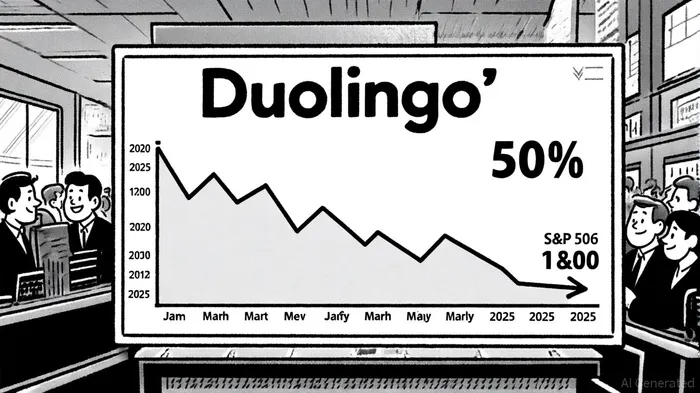
Investors have long treated DuolingoDUOL-- (NASDAQ: DUOL) as a poster child for the edtech boom, but recent volatility has exposed cracks in its ad-dependent model. While the broader EdTech sector has thrived on AI-driven innovation and disciplined growth, Duolingo's stock has stumbled, . This divergence underscores a critical shift in investor sentiment: the market is demanding more from edtech companies, particularly those reliant on advertising and freemium strategies.
The EdTech Sector's AI-Driven Renaissance
The EdTech sector has entered a new era, with investors prioritizing platforms that deliver measurable ROI and scalable profitability. According to a report by Chargebee, the 2025 EdTech market is characterized by a focus on "outcome-based pricing," AI integration, and efficient capital allocation [1]. Companies leveraging AI for personalized learning and adaptive content delivery are commanding higher valuations, . This shift reflects a broader market preference for businesses that balance growth with profitability-a metric often referred to as the "rule of 40," which evaluates whether a company's growth rate plus profit margin exceeds 40% [3].
Duolingo, however, remains a mixed bag. , its monetization struggles persist. , , largely due to AI-related costs for its Max tier [4]. These pressures highlight a key vulnerability: Duolingo's reliance on a freemium model that prioritizes user growth over immediate profitability.
Valuation Premiums and the Risks of AI-Driven Growth
Duolingo's valuation multiples-13.6x EV/Revenue and 48.5x EV/EBITDA-far exceed the sector's median of 1.6x and 13.4x, respectively [4]. . Yet, . Analysts at note that while AI integration is a "transformative potential," it also introduces execution risks, such as quality compromises if product launches outpace user demand [5].
The market's skepticism is further fueled by Duolingo's exposure to ad-dependent revenue streams. , the company's advertising and testing services remain a wildcard. With investors increasingly favoring outcome-based pricing models that guarantee tangible economic benefits [1], Duolingo's ad-supported approach may struggle to justify its premium valuation if monetization rates fail to improve.
A Tenuous Path Forward
Duolingo's management has signaled confidence in its ability to optimize AI costs and expand into new verticals like Math and Music [1]. However, . , but this assumes continued user growth and margin stabilization. The company's ability to navigate AI-driven competition-such as Alphabet's advanced translation tools-will also be critical [5].
For now, Duolingo remains a "Moderate Buy," but investors must weigh its AI-driven innovation against structural risks. The edtech sector's shift toward profitability and hybrid pricing models suggests that Duolingo's ad-dependent strategy may need to evolve to sustain its valuation premium.





Comentarios
Aún no hay comentarios