
Duolingo's Emerging Growth Catalysts: A Deep Dive into Consumer Engagement and Monetization Strategies
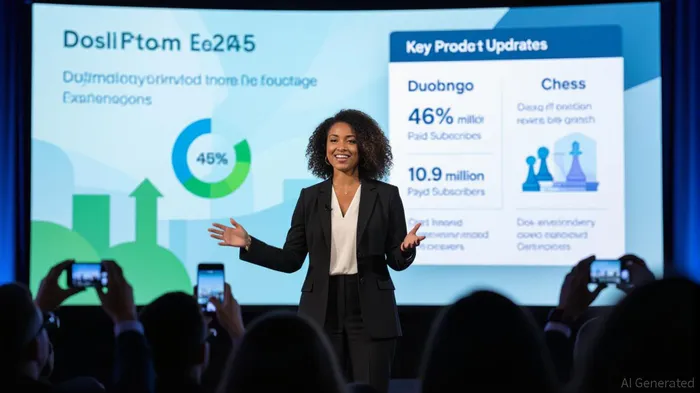
Duolingo, the edtech giant that revolutionized language learning, is recalibrating its growth strategy with a dual focus on hyper-engagement and AI-driven monetization. At its annual Duocon 2025 event, the company unveiled a suite of product updates and pricing adjustments that signal a bold pivot toward transforming casual learners into lifelong subscribers. For investors, the question is no longer whether DuolingoDUOL-- can scale—it's how it will sustain its momentum in an increasingly competitive AI-powered education landscape.
Consumer Engagement: Bridging Learning and Real-World Impact
Duolingo's latest updates aim to deepen user attachment by aligning learning outcomes with tangible professional and social value. The integration of Duolingo Scores into LinkedIn profiles is a masterstroke, allowing users to showcase language proficiency on the world's largest professional network. This feature not only validates Duolingo's educational credibility but also creates a feedback loop: users are incentivized to improve their scores to enhance career prospects. According to a report by GlobeNewswire, this integration reflects the company's broader mission to “turn learning into real-world power” [1].
Simultaneously, the expansion of the Duolingo Chess course—now available on Android and featuring player-versus-player (PvP) mode on iOS—demonstrates Duolingo's ambition to diversify its offerings beyond language learning. By gamifying cognitive skills and fostering social interaction, the platform is tapping into the $1.5 billion global chess market while retaining its core user base. The addition of non-language courses like Math and Music further cements Duolingo's identity as an “educational ecosystem” [4].
AI is also playing a pivotal role in enhancing engagement. The AI-powered Video Call feature, now expanded to nine languages, provides real-time feedback and personalized practice, making language learning feel more interactive and effective. As stated by Reuters, these tools are critical for sustaining user retention in a market where 70% of free app users typically disengage within 30 days [2].
Monetization: Pricing Power and AI-Driven Conversion
Duolingo's monetization strategy has evolved from a pure freemium model to a tiered approach that leverages AI to upsell premium features. In Q2 2025, the company raised the annual price of its Super Subscription from $83.99 to $95.99, a move that initially raised eyebrows but coincided with a 46% surge in subscription revenue [3]. This growth was driven by a 37% increase in paid subscribers, now exceeding 10.9 million, as AI-powered features like Duolingo Max—offering generative AI for role-playing and error analysis—proved effective at converting free users [2].
The Energy System, a gamified engagement tool replacing the previous “Hearts” model, has also been a silent revenue driver. By increasing daily session frequency and reducing churn, it has contributed to Duolingo's ability to maintain a 41% overall revenue growth in Q2 2025 [5]. However, the company faces margin pressures: AI infrastructure costs have eroded gross margins, a trade-off for maintaining cutting-edge personalization [3].
Financial Performance and Market Position
Post-Duocon, Duolingo's financials tell a story of cautious optimism. While global daily active users (DAUs) grew 28% year-over-year in Q3 2025 (down from 39% in Q2), the platform's subscription revenue hit $210.7 million, fueled by AI-driven engagement [4]. The company has raised its 2025 revenue forecast to $1.01–$1.02 billion, up from $995–$1 billion, betting on the long-term value of AI-powered tools [3].
Yet challenges persist. The slowing DAU growth and rising competition from AI-native platforms like ChatGPT and Coursera's AI courses highlight the need for continuous innovation. Duolingo's response? A $50 million investment in AI research and partnerships with universities to validate its non-language courses [1].
Investment Outlook
For investors, Duolingo's current trajectory suggests a company in transition. Its ability to monetize engagement through AI-driven personalization and strategic partnerships (e.g., LinkedIn) positions it to outperform in the $12 billion global language learning market. However, margin pressures and the risk of user fatigue in a saturated edtech space warrant caution.
Conclusion
Duolingo's Duocon 2025 updates underscore its ambition to become the go-to platform for skills that matter in both personal and professional contexts. By marrying AI-driven engagement with real-world utility, the company is not just selling subscriptions—it's selling a vision of lifelong learning. For investors willing to navigate near-term margin risks, the rewards could be substantial.





Comentarios
Aún no hay comentarios