
DT Midstream's Strategic Position in the Natural Gas Infrastructure Boom
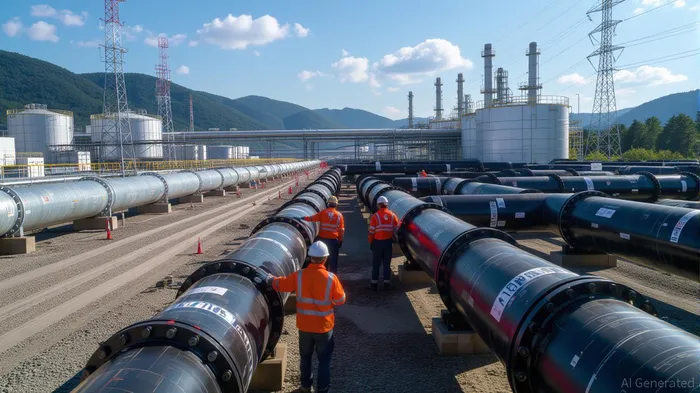
In the evolving landscape of energy infrastructure, DT MidstreamDTM-- Inc. (NYSE: DTM) stands out as a masterclass in strategic alignment with macroeconomic and regulatory tailwinds. With the U.S. and Canada pivoting toward a natural gas-centric energy transition, DT Midstream is uniquely positioned to capitalize on surging demand for liquefied natural gas (LNG), power generation infrastructure, and cross-border pipeline modernization. The company's recent investment-grade credit rating upgrades, robust organic project pipeline, and favorable regulatory environment have created a compelling case for long-term investors seeking exposure to a sector poised for structural growth.
The Credit Upgrade: A Catalyst for Financial Flexibility
DT Midstream's achievement of investment-grade ratings from Fitch (BBB-), Moody'sMCO-- (Baa3), and S&P Global (BBB-) in 2024 and 2025 marks a pivotal milestone. These upgrades, driven by the company's strong balance sheet and operational scale, are not merely symbolic. They reduce borrowing costs, enhance liquidity, and open access to a broader pool of institutional capital. For a midstream operator, this means the ability to fund growth projects at lower interest rates while maintaining a disciplined capital structure. As David Slater, DT Midstream's CEO, noted, the ratings reflect “the strength of our operations and the confidence in our ability to deliver sustainable cash flows.”
Organic Growth: Fueling EBITDA and Dividend Expansion
The company's 2025 capital deployment strategy is a masterstroke of strategic infrastructure development. With a $2.3 billion backlog of projects and $1.1 billion already reaching final investment decision (FID), DT Midstream is executing on a pipeline of initiatives that directly align with long-term demand drivers.
- Guardian Pipeline Expansion: The 15% capacity boost to the Guardian Pipeline, anchored by a 20-year negotiated rate contract with an investment-grade utility, is a textbook example of risk-mitigated growth. Expected to be operational by 2028, this project is projected to add hundreds of millions in annual EBITDA.
- Haynesville LEAP Phase Four: Originally slated for 2027, this expansion is now on track for 2026, underscoring DT Midstream's operational agility. The project is expected to enhance connectivity to LNG facilities, capturing a share of the 16 Bcf/day surge in LNG demand projected through 2035.
- Interstate Pipeline Modernization: Projects like the $130–150 million Guardian modernization phase will improve reliability for customers in Wisconsin, aligning with the Trump administration's push for grid resilience.
These projects are not speculative bets but capital-efficient, demand-backed expansions. DT Midstream's reaffirmed 2025 adjusted EBITDA guidance of $1.095–$1.155 billion and 2026 outlook of $1.155–$1.225 billion underscore the company's confidence in its ability to translate infrastructure spending into sustainable cash flow.
Regulatory Tailwinds: A Boon for U.S. LNG and Power Infrastructure
The Trump administration's aggressive deregulation of natural gas and LNG infrastructure has created a near-perfect environment for DT Midstream. The Federal Energy Regulatory Commission's (FERC) recent waivers of Order No. 871 and blanket certificate cost limitations have accelerated project timelines, reducing regulatory friction for companies like DTM.
Meanwhile, the administration's emphasis on LNG as a strategic export commodity—backed by policies like Executive Order 14154—ensures that demand for DT Midstream's infrastructure will remain robust. The U.S. Energy Information Administration's (EIA) projection of LNG exports reaching 9.8 trillion cubic feet by 2037 further reinforces this thesis.
Canada's regulatory reforms, though less immediate, are also favorable. The Canada Energy Regulator's (CER) modernization of pipeline regulations and cost recovery frameworks will streamline cross-border projects, which could become critical as U.S. LNG demand outpaces domestic pipeline capacity.
Power Generation: The Next Frontier
DT Midstream's foray into power generation infrastructure is a forward-looking move. With power demand in the PJM and MISO regions expected to grow by over 40% over two decades, the company's utility-scale projects—such as the AESAES-- lateral in West Virginia—position it as a key enabler of grid stability. Natural gas, despite its green credentials, remains indispensable as a backup for intermittent renewables. DT Midstream's interconnected asset base gives it a competitive edge in this transition.
Dividend Growth: A 5–7% Annual Target with Strong Underpinnings
DT Midstream's commitment to a 5–7% annual dividend growth rate is not just a promise but a financial imperative. With 80% of its capital allocated to its pipeline segment, which generates long-term, contracted cash flows, the company has the durability to sustain this trajectory. The investment-grade ratings and $385 million 2025 capital expenditure plan further reinforce this resolve.
Conclusion: A High-Conviction Play in a Structural Growth Sector
DT Midstream's strategic positioning—anchored by credit upgrades, a disciplined organic project pipeline, and regulatory tailwinds—makes it a standout in the midstream sector. While the company's stock has outperformed the S&P 500 over the past year, its intrinsic value remains undervalued relative to its growth potential. For investors seeking exposure to the natural gas infrastructure boom, DTM offers a rare combination of capital efficiency, demand certainty, and dividend sustainability.
The time to act is now. With LNG demand accelerating and regulatory hurdles easing, DT Midstream is not just riding the wave—it's building the boat.





Comentarios
Aún no hay comentarios