
The U.S. Drone Defense Sector: A Strategic Inflection Point as China's Dominance Faces Domestic Pushback
The U.S. drone defense sector is undergoing a seismic shift, driven by a confluence of policy reforms, technological innovation, and geopolitical urgency. As China's dominance in commercial drone manufacturing faces mounting domestic resistance, the United States is accelerating its pivot toward self-reliance in unmanned systems. This transformation is not merely a response to foreign competition but a strategic recalibration of national security priorities, with defense tech equity investors poised to capitalize on a sector at the intersection of policy, innovation, and capital.
Policy as Catalyst: From Procurement Reforms to Strategic Funding
The Biden administration's American Security Drone Act (ASDA) of 2023 has become a cornerstone of this shift, mandating a government-wide policy to prioritize secure UAS procurement and collaboration across agencies like the Department of Homeland Security and NIST according to legal analysis. Complementing this, the Federal Acquisition Regulation (FAR) clause 52.240-1, effective December 2025, explicitly bans the use of drones from foreign entities such as DJI and Autel in federally funded contracts. These measures are part of a broader $33 billion defense spending package for drones and AI, with $13.5 billion allocated to unmanned systems-a-clear signal of the sector's strategic importance as reported.
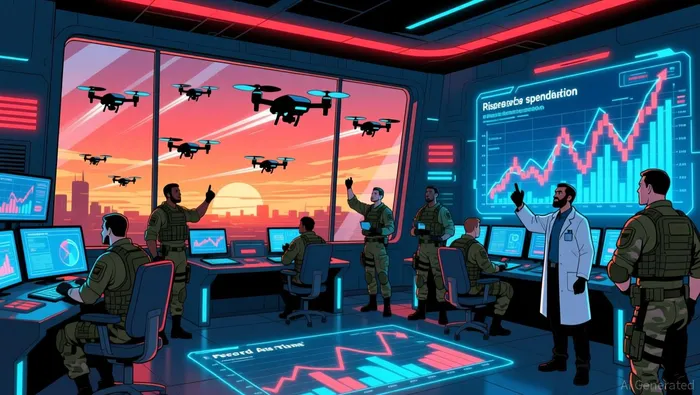
The National Defense Authorization Act (NDAA) for 2026 further amplifies this momentum by granting state and local law enforcement limited counter-UAS authority, addressing vulnerabilities in critical infrastructure and public safety. Such policies are not just regulatory hurdles for foreign firms but enablers for domestic innovators, creating a fertile ground for U.S.-based drone defense startups to scale.
Market Dynamics: From Swarm Drones to AI-Driven Autonomy
The global swarm drone market, valued at $828.5 million in 2024, is projected to grow to $3,060.8 million by 2032 at a CAGR of 17.8%, driven by advancements in AI, machine learning, and autonomous coordination according to market research. The U.S. military's Replicator initiative, launched in 2023, aims to deploy thousands of attritable autonomous systems by 2025, with a second phase focused on counter-drone capabilities as detailed. This initiative aligns with the Pentagon's Rapid Defense Experimentation Reserve (RDER), which prioritizes technologies for base defense, contested logistics, and autonomous drone collaboration as reported.
Real-world applications, such as Ukraine's Operation Spiderweb in June 2025-where 117 drones struck Russian air bases-have underscored the tactical potential of swarm technologies according to analysis. The U.S. military is now racing to integrate similar capabilities, with Firestorm Labs securing a $100 million IDIQ contract from the Air Force in January 2025 to develop small UAS with advanced autonomy as noted. Meanwhile, the counter-swarm drone defense market, valued at $1.62 billion in 2025, is expected to grow to $4.95 billion by 2030, driven by AI-enabled tracking and directed energy systems according to market data.
Investment Landscape: From Startups to Strategic Acquisitions
The surge in defense tech funding underscores the sector's allure. In 2025 alone, $19 billion was raised for defense startups, with Anduril Industries securing $2.5 billion in a single round to expand its autonomous drone and AI-based systems as reported. The U.S. Department of Defense's $1.8 billion allocation for AI and machine learning initiatives in 2024–2025 further highlights the government's commitment to AI-driven warfare according to industry analysis.
Startups like Swarmer, a Ukrainian firm specializing in autonomous drone swarm software, exemplify the sector's innovation. With $15 million in Series A funding and plans to scale to swarms of over 100 drones, Swarmer's technology translates human-defined objectives into tactical actions, leveraging data from 82,000 combat missions according to company data. While Swarmer operates in a different geopolitical context, its success illustrates the viability of swarm-based solutions-a model the U.S. military is actively adopting.
Strategic Inflection Point: Risks and Opportunities
Despite the optimism, challenges persist. Secure communication, low-latency authentication, and coordination in contested environments remain technical hurdles as noted. The May 2024 Shanghai drone light show malfunction, where hundreds of drones crashed due to synchronization errors, highlights the fragility of current systems according to reports. However, these risks also present opportunities for firms specializing in robust communication links and fail-safe mechanisms.
For investors, the key lies in identifying companies that align with the U.S. military's strategic priorities: low-cost attritable systems, AI-driven autonomy, and counter-drone technologies. Firms like Helsing and Apium Swarm Robotics, which partner with defense giants like Red Cat HoldingsRCAT-- and Systematic, demonstrate how collaboration between startups and established players can accelerate innovation.
Conclusion: A Sector Poised for Disruption
The U.S. drone defense sector is at a strategic inflection point, driven by policy reforms, technological breakthroughs, and geopolitical imperatives. As China's dominance in commercial drone manufacturing faces domestic pushback, the United States is leveraging its industrial and technological edge to build a resilient, self-reliant ecosystem. For equity investors, this is a sector where policy, innovation, and capital converge-a rare opportunity to back the next generation of defense technologies while aligning with national security imperatives.







Comentarios
Aún no hay comentarios