
Dream Industrial REIT (DREUF) Navigates Q1 2025 with Resilience Amid Market Headwinds
In a quarter marked by both promise and turbulence, Dream Industrial Real Estate Investment Trust (DREUF) reported mixed results for Q1 2025. While the REIT maintained strong financial fundamentals—driven by robust leasing activity and disciplined capital management—headwinds like delayed tenant decisions and occupancy declines in key markets tempered growth expectations. Here’s a deep dive into the numbers and strategic moves that define DREUF’s trajectory.
Financial Resilience Amid Volatility
DREUF’s Q1 performance underscored its ability to navigate macroeconomic uncertainty. Diluted Funds from Operations (FFO) per unit rose 5.8% year-over-year to $0.26, driven by a 3.1% increase in comparable property NOI on a constant currency basis. Regional performance diverged:
- Canada saw a 4.2% NOI growth, led by 11.1% growth in Ontario, though Quebec lagged with a 4.4% decline due to tenant consolidations.
- Europe posted 1.6% NOI growth, aided by CPI-indexed leases and rental increases.
Occupancy rates remained stable at 95.4% in-place and committed, though dips in Ontario and Quebec were noted. Management emphasized that these fluctuations were within expectations, with annual occupancy projected to align with mid-95% levels by year-end—a testament to the portfolio’s quality.
Leasing Momentum and Strategic Investments
Leasing activity remained a bright spot, with 1.5 million square feet of leases signed or advanced by April 2025, yielding a 23.1% weighted-average rental spread. Regional highlights included:
- Ontario/Quebec: 57% and 51% spreads, respectively, reflecting strong demand for industrial space.
- Europe: 16.4% spreads, including a 141,000 sq ft lease in France tied to CPI adjustments.
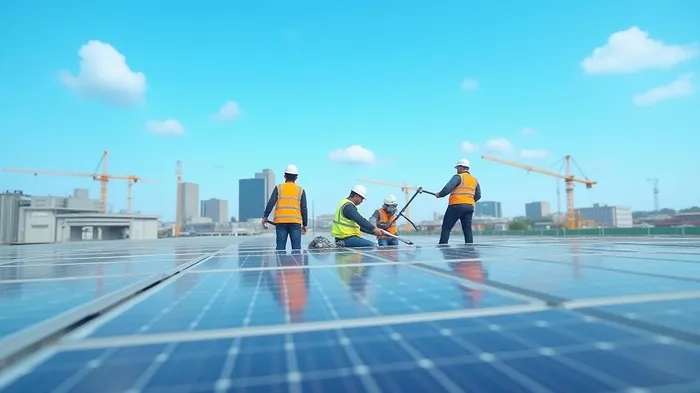
The solar program advanced significantly, with a completed Netherlands project delivering a 10% yield on cost. A pipeline of 28 new projects—valued at over $110 million—targets 8-10% returns, positioning DREUF to capitalize on the renewable energy boom. Meanwhile, power capacity upgrades (e.g., 180 MW in Ontario) aim to attract data center tenants, a high-growth sector.
Debt Management and Capital Discipline
DREUF maintained a robust balance sheet, critical for weathering volatility:
- Liquidity: $751 million, including a $250 million unsecured term loan extended to 2029 at 3.17%.
- Debt Metrics: Net debt-to-EBITDAFV of 8.2x and 36.9% net debt-to-assets, both within conservative thresholds.
The company also executed a $20 million share buyback under its NCIB program, signaling confidence in its valuation. However, $450 million in debt maturities due in December 2025 remain under evaluation—a manageable risk given its liquidity and access to capital.
Challenges and Risks
Despite its strengths, DREUF faces near-term hurdles:
1. Leasing Slowdowns: New leasing activity in Ontario and Quebec stalled in March/April due to tariff uncertainty and prolonged decision timelines for large tenants. Management expects this to drag 2025 FFO/NOI growth to the lower end of its 6-8% guidance.
2. Occupancy Pressures: A 200,000 sq ft non-renewal in Germany (Q2) and another in Ontario (Q4) could strain occupancy temporarily. However, retention rates are expected to remain near 70% historical averages.
3. Bad Debt: A one-off provision in Q1—linked to an isolated tenant dispute—adds short-term noise but lacks systemic implications.
Strategic Priorities for Sustained Growth
- Focus on High-Yield Initiatives: Solar projects and power upgrades will anchor organic growth, with $110 million in solar investments and 180 MW of capacity enhancements in the pipeline.
- Acquisitions with Discipline: Recent purchases, such as the $59 million Oakville, Ontario property and 3.8-acre Dutch land parcel, align with DREUF’s urban, high-demand asset strategy.
- Risk Mitigation: The balance sheet’s flexibility allows the REIT to refinance debt, pursue accretive deals, and return capital to shareholders without compromising liquidity.
Conclusion: A Steady Hand in Uncertain Times
Dream Industrial REIT’s Q1 results paint a picture of a company that’s both pragmatic and opportunistic. While near-term growth may lag initial expectations, its 8.2x net debt-to-EBITDAFV ratio, $750 million liquidity, and 23.1% rental spreads provide a sturdy foundation. The solar pipeline and power upgrades further position DREUF to capture long-term trends in sustainability and data center demand.
Investors should weigh the risks—such as delayed leasing decisions and occupancy variability—against the REIT’s proven ability to deliver. With FFO growth of 5.8% and 95.4% occupancy, DREUF remains a resilient play in industrial real estate. As management noted, “2025 sets the anchor for stronger 2026 results”—a sentiment supported by its disciplined strategy and robust balance sheet.
In a sector where adaptability is key, Dream Industrial REIT is navigating headwinds with the tools to emerge stronger. For investors seeking stability in industrial real estate, DREUF’s mix of defensive fundamentals and growth catalysts warrants attention.
Final Note: While DREUF faces near-term challenges, its strategic focus on high-yield assets and a fortress balance sheet suggest it’s well-positioned to capitalize on post-2025 recovery. The jury is out on short-term returns, but the long-term outlook remains promising.







Comentarios
Aún no hay comentarios