
Dragonfly Energy's Strategic Leap: Fueling the Hydrogen Transition and Post-IPO Growth
The energy transition is no longer a distant dream-it's a $2.5 trillion market reality, and Dragonfly EnergyDFLI-- is positioning itself at the crossroads of two transformative technologies: lithium battery innovation and hydrogen energy. With its recent $28.8 million IPO and a historic mid-air hydrogen refueling demonstration, the company is not just surviving in the clean energy race-it's accelerating ahead of the pack.
A Dual-Pronged Strategy: Batteries and Hydrogen
Dragonfly Energy's core business remains its lithium battery technology, where it has established itself as a leader in deep-cycle energy storage. By 2025, the company had delivered over 400,000 batteries to market, with a 23% year-over-year revenue surge in Q2 and a projected 26% growth in Q3, as reported in the Q2 2025 results. Its patented dry electrode manufacturing process reduces energy consumption and CO2 emissions, while its nonflammable all-solid-state battery cells have demonstrated over 1,000 cycles in testing, as shown in the Q2 2025 slides. These advancements are critical for high-growth sectors like heavy-duty trucking and industrial power, where Dragonfly targets a $56.8 billion total addressable market by 2025 according to the company's corporate presentation.
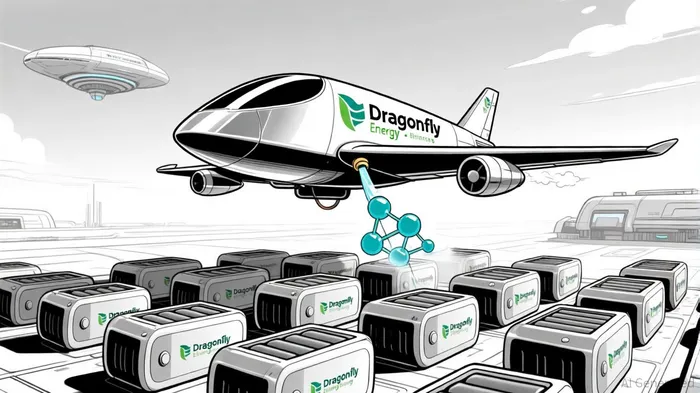
Yet the company's hydrogen ambitions are equally compelling. In a world-first achievement, Dragonfly's Dragonfly Hydrogen Plane completed a mid-air refueling, proving hydrogen's viability as a zero-emission aviation fuel. This breakthrough isn't just a PR stunt-it's a technical milestone that addresses hydrogen's storage and propulsion challenges, aligning with the U.S. National Hydrogen Strategy. While Dragonfly hasn't outlined a detailed hydrogen roadmap post-IPO, its partnerships with Airstream and Ember RV, coupled with Nevada Tech Hub funding, suggest a strategic pivot toward hydrogen infrastructure and OEM integration, per the company's Airstream partnership.
Post-IPO Fuel: Capital Allocation and Strategic Flexibility
The October 2025 IPO, which raised $28.8 million, is a lifeline for Dragonfly's growth. The proceeds will repay $4 million in term loans, fund working capital, and accelerate next-generation battery tech-specifically scaling its dry electrode process and solid-state development-according to the closing of the offering. This capital infusion also simplifies the company's debt structure, with extended maturities and a PIK interest option providing financial flexibility, as described in the company's debt restructuring announcement.
Critically, the IPO aligns with broader hydrogen trends. The U.S. Department of Energy's Hydrogen Program Plan emphasizes cross-sector collaboration, and Dragonfly's OEM partnerships (e.g., Airstream's 2026 motorhome lines) position it to benefit from federal incentives for clean energy adoption. While the company's immediate focus remains battery tech, its hydrogen plane project and alignment with national strategies hint at a long-term play in hydrogen storage and distribution-a sector projected to grow 8% annually through 2030 according to the Hydrogen Roadmap 2025.
Risks and Rewards: A Balancing Act
Investors should acknowledge Dragonfly's ongoing net losses and reliance on capital raises. However, its improving gross margin (28.3% in Q2 2025) and OEM traction-such as Battle Born Batteries becoming standard in Airstream and Ember RV models-signal operational maturation, as noted in the expanded OEM partnership. The company's recent patent for IntelLigence® battery communication tech further cements its competitive edge, enhancing system reliability and interoperability, with details provided in the U.S. patent.
The hydrogen angle adds speculative upside. While Dragonfly hasn't explicitly detailed a hydrogen roadmap, its aviation project and U.S. National Hydrogen Strategy alignment suggest it's positioning to capitalize on infrastructure gaps. For example, the EU's 40 GW green hydrogen target and U.S. tax incentives for hydrogen hubs could create demand for Dragonfly's refueling technologies, as discussed in hydrogen technology predictions.
Conclusion: A High-Volatility, High-Reward Play
Dragonfly Energy's IPO isn't just about survival-it's about seizing a $56.8 billion battery market and a nascent but explosive hydrogen sector. With its technical prowess, strategic partnerships, and alignment with federal clean energy goals, the company is well-positioned to deliver outsized returns for investors willing to ride the volatility. However, success hinges on executing its hydrogen vision and scaling battery production without burning through cash. For those who believe in the energy transition, Dragonfly's stock is a compelling, if risky, bet.





Comentarios
Aún no hay comentarios