
Dragonfly Energy's $55.4M Public Offering: Strategic Capital Deployment and Market Positioning in a Booming Renewable Fuels Sector
Dragonfly Energy's recent $55.4 million public offering represents a pivotal moment for the company as it seeks to strengthen its financial foundation and accelerate its ambitions in the renewable fuels sector. The offering, priced at $1.35 per share for 36 million common shares and $1.3499 per pre-funded warrant for 5 million units, generates gross proceeds of $55.4 million before underwriting costs. Underwriters also retain a 30-day option to purchase an additional 6.15 million shares, potentially boosting total proceeds, according to a GlobeNewswire release. This capital infusion is strategically allocated to address immediate liabilities, fund operational expansion, and invest in cutting-edge battery technologies that align with the sector's transformative trends.
Strategic Capital Deployment: Debt Reduction and R&D Prioritization
A significant portion of the proceeds-$45 million-will be used to prepay outstanding term loan debt, a move that reduces financial risk and improves liquidity. This restructuring is critical for a company that reported a $7.0 million net loss in Q2 2025, despite a 23% year-over-year increase in net sales to $16.2 million, according to the company's Q2 2025 results. By deleveraging its balance sheet, Dragonfly EnergyDFLI-- can redirect resources toward growth initiatives.
The remaining funds will support investments in next-generation battery technologies, particularly the scaling of its proprietary dry electrode process and solid-state battery applications. These innovations are central to the company's mission of developing nonflammable, high-performance energy storage solutions. The dry electrode technology, for instance, promises faster production cycles and reduced costs compared to traditional wet electrode methods, positioning Dragonfly to compete in markets demanding safer, more efficient batteries, as noted in the GlobeNewswire release.
Market Positioning: Navigating a Competitive Landscape
Dragonfly Energy operates in a sector characterized by rapid innovation and intense competition. While its market share in the industrial machinery and components industry remains modest at 0.06%, according to the Q2 2025 results, the company has demonstrated resilience through niche market penetration. The Q2 2025 results highlighted a 50.6% surge in OEM segment sales, driven by demand from RV and heavy-duty trucking customers. This growth underscores Dragonfly's ability to capitalize on sector-specific needs, even as it faces larger rivals like Enovix, Stem Inc., and Solid Power, according to a Mordor Intelligence report.
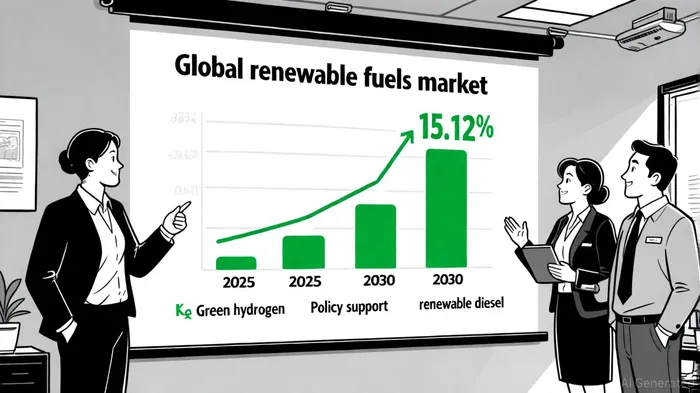
The renewable fuels sector itself is expanding at an unprecedented pace. By 2030, the global market is projected to reach $276.31 billion, fueled by blending mandates, corporate decarbonization goals, and policy incentives, according to the Mordor Intelligence report. Dragonfly's focus on solid-state batteries aligns with this trajectory, as these technologies are increasingly seen as critical for electric vehicles and grid-scale storage. The company's entry into the heavy-duty trucking industry further diversifies its revenue streams, a strategic move in a sector where electrification is gaining momentum, as the Q2 2025 results indicate.
Sector Trends and Dragonfly's Long-Term Prospects
The renewable fuels industry is being reshaped by technological and policy-driven forces. Green hydrogen, for example, is emerging as a key disruptor, with a projected CAGR of 41.5% through 2035, per the Mordor Intelligence report. While Dragonfly Energy has not yet entered the hydrogen space, its expertise in battery technology positions it to benefit from cross-sector synergies, particularly in energy storage applications.
Artificial intelligence is another transformative force, optimizing supply chains and reducing operational costs in renewable energy projects, as noted in the Mordor Intelligence report. Dragonfly's ability to integrate AI-driven efficiencies into its manufacturing processes could enhance its competitive edge, particularly as it scales production of dry electrode and solid-state batteries.
However, challenges persist. Volatile feedstock prices and regulatory uncertainties around indirect land-use change (ILUC) remain risks for the sector, according to the Mordor Intelligence report. Dragonfly's debt reduction and R&D investments aim to mitigate these vulnerabilities, but execution will be key. The company's projected Q3 2025 sales of $15.9 million-up 25% year-over-year-suggest optimism, though profitability remains elusive, as reported in the Q2 2025 results.
Conclusion: A Calculated Bet on the Future of Energy
Dragonfly Energy's $55.4 million public offering reflects a calculated strategy to stabilize its financial position while investing in technologies poised to shape the renewable fuels sector. By addressing debt obligations and accelerating R&D, the company is positioning itself to capitalize on long-term growth drivers such as electrification, green hydrogen, and AI-driven efficiency. While its current market share is small, the renewable fuels industry's projected expansion offers ample opportunities for niche players with innovative solutions. Investors should monitor Dragonfly's progress in scaling its dry electrode and solid-state battery technologies, as well as its ability to navigate sector-specific challenges.





Comentarios
Aún no hay comentarios