
Doximity's Strategic AI Expansion and Advertising Shifts: A Path to Sustained Growth?
In the rapidly evolving healthcare technology landscape, DoximityDOCS-- (DOCS) has emerged as a pivotal player, leveraging artificial intelligence (AI) and physician-focused advertising to redefine digital engagement for healthcare providers. With a recent acquisition of Pathway Medical, a surge in AI tool adoption, and a strategic pivot toward healthcare provider (HCP)-centric advertising, the company is positioning itself at the intersection of innovation and monetization. This analysis evaluates whether these moves can translate into sustained long-term value creation for investors.
AI-Driven Workflow Integration: A Cornerstone of Growth
Doximity's 2025 healthcare digital engagement strategy has been anchored by its aggressive expansion of AI tools. The acquisition of Pathway Medical for $63 million has significantly bolstered its clinical AI capabilities. Pathway's AI model, which scored 96% on the U.S. Medical Licensing Examination benchmark, now powers Doximity's free tools, including Scribe and Doximity GPT. These tools are designed to streamline clinical workflows, from documentation to decision-making, and have seen adoption grow over 5x year-over-year in Q1 2026 according to analysts.
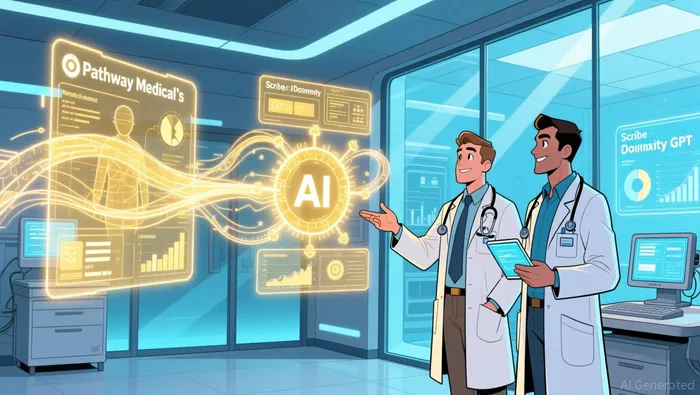
The integration of Pathway's structured dataset-spanning guidelines, drugs, and landmark trials-into Doximity's platform has created a unique value proposition. By offering these advanced tools at no cost to over 80% of U.S. physicians, Doximity is embedding itself into daily clinical routines. This strategy not only enhances user retention but also lays the groundwork for future monetization through enterprise solutions, as hinted by the CEO. Analysts argue that this dual approach-free tools for individual physicians and paid solutions for institutions-could mirror the success of SaaS models in other industries.
Advertising Shifts: From DTC to HCP-Centric Campaigns
Doximity's advertising strategy is undergoing a critical transformation as regulatory scrutiny intensifies on direct-to-consumer (DTC) drug advertising. Analysts from BofA Securities and Morgan Stanley highlight that pharmaceutical companies may increasingly shift budgets to HCP-focused platforms like Doximity. This trend aligns with Doximity's existing strengths: its proprietary data on 2 million U.S. clinicians and its ability to deliver measurable ROI through targeted campaigns.
Case studies underscore the platform's effectiveness. For instance, a Northeastern health system reduced patient leakage by 32% using Doximity's Colleague Connect® and DocNews® outreach. Another academic health system achieved a 47% open rate and 14% connection rate by introducing a new Chief of Congenital Heart Surgery to potential referrers. These metrics demonstrate Doximity's ability to drive meaningful engagement, with one campaign yielding a 57:1 ROI for Main Line Health. Such results validate the platform's value proposition and suggest a scalable model for healthcare marketers.
Financial Performance and Analyst Optimism
Doximity's Q3 2025 financial results reinforce the bullish narrative. Revenue reached $168.6 million, up 25% year-over-year, while net income and adjusted EBITDA grew by 57% and 39%, respectively. These figures exceeded expectations, contributing to a 25% stock price surge in after-hours trading according to analysts. Analysts have upgraded the stock, with BofA Securities setting an $82 price target (84% upside from current levels) and Raymond James citing undervaluation according to reports.
The optimism is rooted in Doximity's balance sheet strength and its long-term financial targets. The company aims for $1 billion in revenue by fiscal 2028, driven by workflow tools and AI innovations. Projections suggest revenue of $805.8 million and earnings of $280.5 million by 2028, translating to a fair value of $71.11 according to financial analysis. While these forecasts are ambitious, they reflect confidence in Doximity's ability to monetize its AI-driven platform and advertising shifts.
Risks and Considerations
Despite the positives, risks remain. Doximity's reliance on pharmaceutical marketing budgets exposes it to industry fluctuations and regulatory changes. Additionally, the monetization of AI tools-currently free for individual users-remains unproven. While enterprise solutions are a logical next step, competition from players like OpenEvidence could challenge Doximity's market position.
Conclusion: A Compelling Long-Term Play?
Doximity's strategic AI expansion and advertising shifts position it as a compelling healthcare tech play. The integration of Pathway's AI into clinical workflows, combined with a proven HCP advertising model, creates a flywheel effect: enhanced user engagement drives data quality, which in turn powers better AI tools and advertising outcomes. Analyst upgrades and strong financial performance further validate this trajectory.
However, investors must weigh the risks of delayed monetization and industry-specific vulnerabilities. For those with a long-term horizon, Doximity's ability to adapt to regulatory trends and leverage AI for both efficiency and revenue could unlock substantial value. As the healthcare sector continues its digital transformation, Doximity's role as a bridge between clinicians and innovators may prove indispensable.







Comentarios
Aún no hay comentarios