
Dow Jumps to Record High Amid Tech Earnings Woes — What This Means for Investors
Market Divergence: The Great Split in U.S. Stocks
On December 12, 2025, the U.S. stock market displayed a striking split: the Dow Jones Industrial Average and S&P 500 hit record highs, while the Nasdaq Composite fell. This divergence signals a shift in investor sentiment, with many moving away from high-growth tech and AI stocks toward more stable, established sectors. The Fed's recent rate cut and mixed earnings reports from tech giants like OracleORCL-- and BroadcomAVGO-- are reshaping how investors approach the market.
Record Highs for the Dow, Mixed News for Tech
The Dow Jones Industrial Average surged 1.3% to close at 48,704.01, 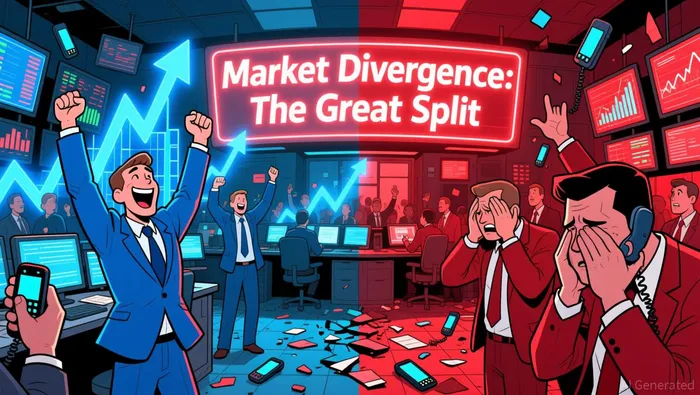 reaching a new peak. The S&P 500 also climbed to a record, gaining 0.2%. Meanwhile, the Nasdaq Composite dropped 0.3% as investors rotated out of tech. This performance highlights what's been dubbed the "Great Divergence" in the market — a trend where growth stocks lag while value and cyclical sectors gain traction as investors reassess tech valuations. Oracle's 10.8% drop, due to weak cloud sales and increased capital spending, was a major contributor to the Nasdaq's slide according to market analysis.
The Fed's Influence and Market Reaction
The Federal Reserve's decision to cut rates for the third time this year on December 10 initially lifted investor optimism across all major indices according to market reports. However, this momentum faded quickly as Oracle and Broadcom released disappointing earnings reports. The tech sector's struggles overshadowed the Fed's rate-cut optimism, causing a sharp rotation to value stocks. Treasury yields also fell in the wake of the rate cut, reinforcing the idea that investors are seeking safer assets as markets adjusted to the rate cut.
Rotation to Value and Cyclical Sectors
The market's shift in focus isn't just a short-term reaction — it reflects a broader reevaluation of the high-growth tech narrative that dominated 2024 and early 2025. Oracle's earnings miss raised concerns about AI spending and data center demand, leading to a reassessment of tech valuations. In contrast, financials and industrials have seen strong inflows, with investors seeking stability. The CBOE Volatility Index (VIX) fell 5.8% to 14.85, suggesting that while the market is cautious, it is not in panic mode according to market analysis.
What This Means for Investors
For individual investors, this market divergence offers both caution and opportunity. The key takeaway is that the days of all-market broad growth — particularly in tech — are temporarily over. That doesn't mean tech is in trouble, but rather that it's being reassessed in the context of broader economic conditions and corporate earnings. On the other hand, sectors like industrials, financials, and healthcare are showing resilience and earnings strength, making them more attractive in a shifting rate environment as the market reevaluates tech.
Investors who have been heavily positioned in high-growth tech stocks may need to adjust their strategy, at least in the near term. Diversifying into sectors that are performing well in a rate-cutting environment could be a prudent move. For those who missed the tech rally earlier in the year, this may be a moment to reassess whether it's still a viable entry point — or whether it's best to wait for clearer signs of stabilization as market conditions evolve.
Looking Ahead
While the Fed's rate-cutting cycle is likely to support markets in the near term, the path forward for stocks — especially tech — remains uncertain. Oracle and Broadcom's earnings are just the latest sign that the AI hype may be hitting a wall, at least for now. If other major tech firms, like Microsoft or Alphabet, report similar concerns in upcoming earnings reports, the rotation to value and cyclical sectors could accelerate according to market analysts.
Investors should also keep an eye on broader economic indicators like inflation data and employment reports. If the Fed's rate-cutting path is more aggressive than expected, that could further boost value stocks and pressure high-growth assets. In the meantime, the market's mixed performance serves as a reminder that while the Fed is a powerful force, it's the fundamentals of individual companies that ultimately drive long-term returns as market fundamentals shift.







Comentarios
Aún no hay comentarios