
Dover's MP Series: A Strategic Leap in Digital Textile Printing
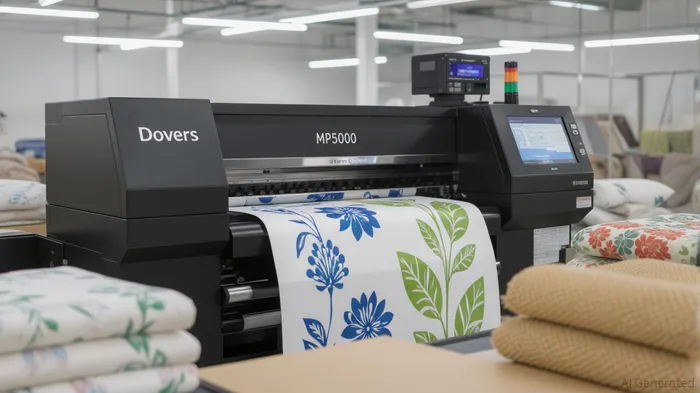
The global digital textile printing market is undergoing a seismic shift, driven by sustainability mandates, operational efficiency demands, and the rise of on-demand production. At the forefront of this transformation is Dover's MP Series, a suite of digital textile printers launched by its subsidiaries MS Printing Solutions and JK Group. With production speeds up to 630 square meters per hour, advanced sustainability features, and a focus on total cost of ownership, the MP Series positions DoverDOV-- to capitalize on a market projected to grow from USD 42.30 billion in 2025 to USD 69.27 billion by 2034, at a compound annual growth rate (CAGR) of 5.6%[1]. This analysis evaluates Dover's competitive advantages and long-term ROI potential in a sustainability-driven industry.
Technical Innovation and Market Positioning
Dover's MP Series is engineered to address the fragmented needs of the textile printing sector. The five models—MP3000, MP3100, MP4000, MP4100, and MP5000—cater to sublimation, sportswear, fashion, and direct-to-fabric applications[2]. The MP5000, for instance, supports 16 Kyocera Katana print heads and is compatible with reactive, disperse, acid, and pigment inks, enabling versatility across fabric types[3]. This technical breadth allows Dover to target both niche and mass-market segments, a critical edge in an industry where customization and scalability are paramount.
The printers also integrate EtherCAT-based electronics for real-time data processing and Qwizard touchscreen controls for streamlined workflow management[2]. These features reduce downtime and operator error, aligning with industry trends toward automation and AI-driven production[4]. By prioritizing durability—20% fewer parts compared to prior models—Dover minimizes maintenance costs, a key consideration for manufacturers seeking to optimize long-term ROI[3].
Sustainability as a Competitive Edge
Sustainability is no longer a peripheral concern in textile printing; it is a core differentiator. The MP Series leverages eco-certified Digistar Pigment and reactive dyes, which eliminate pre- and post-treatment processes, reducing water and energy consumption[5]. This aligns with regulatory pressures in Europe and North America, where stringent environmental standards are reshaping supply chains[6].
Moreover, the printers' silicone-sealed Kyocera Katana heads enhance cleaning efficiency, reducing ink waste and downtime[5]. For investors, this translates to lower operational costs and a stronger value proposition in markets where consumers are increasingly willing to pay premiums for sustainable products. A 2025 study found that 49% of consumers prioritize eco-friendly print-on-demand options, a trend that dovetails with Dover's strategy[7].
Market Share and ROI Potential
While Dover's exact market share for the MP Series remains undisclosed, its positioning as a Tier 2 player in a moderately consolidated market offers strategic advantages. Tier 1 competitors like Kornit DigitalKRNT-- and Mimaki dominate with advanced R&D but often command premium pricing[8]. Dover's focus on total cost of ownership—combining durability, reduced maintenance, and eco-friendly inks—positions it to attract mid-sized operations and niche players seeking cost-effective innovation[2].
The ROI case for the MP Series is further strengthened by the market's structural tailwinds. Digital textile printing's ability to shorten lead times, reduce waste, and enable small-batch production aligns with the rise of e-commerce and fast fashion[9]. For example, the direct-to-fabric segment, which the MP5000 targets, accounted for 52.4% of the 2024 market share, driven by pigment-based inks and on-demand manufacturing[10]. Dover's integration of bile optimization software and hybrid printing techniques also enhances profitability by minimizing material waste[11].
Challenges and Mitigation Strategies
Despite its strengths, Dover faces headwinds. High initial equipment costs and the need for technical expertise remain barriers to adoption, particularly for small enterprises[12]. However, the MP Series' emphasis on sustainability and operational efficiency—such as 630 sqm/h speeds for the MP4000—addresses these pain points by accelerating payback periods through productivity gains[3]. Additionally, Dover's partnerships with regional ink suppliers and localized customization capabilities position it to compete in Tier 3 markets[13].
Conclusion
Dover's MP Series represents a calculated leap into a market defined by sustainability, speed, and customization. By combining cutting-edge technology with eco-conscious design, the printers address both operational and environmental pain points. As the market grows at a CAGR of 5.6%, Dover's focus on total cost of ownership and Tier 2 innovation positions it to capture a significant share of the USD 69.27 billion opportunity by 2034. For investors, the MP Series underscores Dover's ability to align with industry tailwinds while delivering long-term ROI through durability, efficiency, and sustainability.





Comentarios
Aún no hay comentarios