
DoubleZero Token's 65% Price Collapse: A Supply-Side Risk Analysis
The recent 65% price collapse of DoubleZero's 2Z token, according to a Cryptorank report, has sparked intense debate about the risks inherent in its tokenomics model. While the project's launch on major exchanges like Binance AlphaALPHA-- and Coinbase initially generated optimism, as noted in a Capwolf report, the underlying supply-side dynamics reveal critical misalignments that contributed to the market's sharp correction. This analysis dissects the tokenomics of 2Z, focusing on inflationary pressures, vesting schedules, and distribution anomalies that exposed the ecosystem to volatility.
1. Disproportionate Initial Circulating Supply
The 2Z token's total supply is capped at 10 billion units, but its initial circulating supply of 3.47 billion tokens (34.71%), per a Cryptoninjas report, starkly contrasts with the 700 million (7%) outlined in the project's MICA whitepaper. This 4.96x overhang in liquidity created immediate downward pressure on the token's price. By flooding the market with nearly a third of the total supply at launch, the project failed to align with conventional tokenomics best practices, where early circulating supplies typically range between 5–15%, as described in a BitUnix guide.
Such a large initial supply likely triggered panic selling among early investors, who may have viewed the token as overvalued. According to Cryptorank, the discrepancy between the whitepaper and actual supply was a primary catalyst for the 65% price drop. This underscores the importance of transparency in tokenomics documentation-a failure that eroded trust and destabilized market sentiment.
2. Vesting Schedules: A Double-Edged Sword
DoubleZero's vesting structure for team and institutional allocations (1.00 billion and 1.20 billion tokens, respectively) spans 36 months under a "Cliff Linear Vest" model, as covered by Capwolf. While vesting schedules are designed to prevent early dumping, the sheer volume of tokens locked in these allocations raises concerns about future liquidity shocks. For instance, if 1.5% of the total supply (150 million tokens) vests simultaneously in a single quarter, it could overwhelm market demand and trigger further price declines, according to a SolanaFloor report.
Moreover, the staggered vesting for U.S. and non-U.S. investors introduces asymmetry. U.S. participants face a 1-year cliff, while non-U.S. investors begin vesting 40 days post-purchase or after the mainnet launch (Q3 2025), per the SolanaFloor coverage. This uneven timeline risks creating liquidity imbalances, as non-U.S. investors gain earlier access to tradable tokens, potentially exacerbating short-term volatility.
3. Hybrid Inflationary-Deflationary Model: Gaps in Execution
DoubleZero employs a hybrid model of inflationary minting (to reward validators) and deflationary burning (to manage oversupply), as first detailed by Cryptoninjas. However, the absence of a clear, scheduled burning mechanism-unlike Binance Coin (BNB) or Ethereum's EIP-1559-leaves the ecosystem vulnerable to unchecked inflation, a risk outlined in a tokenomics analysis. While the project's whitepaper mentions transaction fee burns, the lack of concrete metrics or timelines for these burns creates uncertainty.
For example, if the inflation rate exceeds the rate of token burns, the net supply could expand, diluting existing holders. This risk is compounded by the fact that 6.53 billion tokens (65.3% of the total supply) remain locked under multi-year vesting schedules, as previously reported by Cryptoninjas. Without a robust deflationary counterbalance, the project's long-term value preservation goals may remain unmet.
4. Airdrops and Marketing Allocations: Immediate Supply Shock
The Binance HODLer Airdrop distributed 35 million 2Z tokens, and an additional 5 million were reserved for post-launch marketing, details that were covered by Cryptoninjas. These allocations, while intended to boost adoption, likely exacerbated the initial supply glut. Airdropped tokens often face rapid selling pressure as recipients cash out, particularly in a bearish market environment. This dynamic aligns with historical patterns observed in tokens like Shiba InuSHIB-- (SHIB), as noted in a Coindesk analysis.
Conclusion: A Cautionary Tale for Tokenomics Design
DoubleZero's 2Z token collapse serves as a cautionary case study in the perils of misaligned tokenomics. The project's overreliance on an inflationary model, coupled with a poorly calibrated initial circulating supply and opaque deflationary mechanisms, created a perfect storm for volatility. While the vesting schedules aim to ensure long-term commitment, they also introduce future liquidity risks that could destabilize the market.
For investors, the lesson is clear: tokenomics must prioritize supply-side discipline. A balanced approach-combining transparent vesting, scheduled burns, and conservative initial allocations-is essential to avoid the kind of price collapse that has eroded DoubleZero's value. As the crypto market matures, projects that fail to address these fundamentals will increasingly struggle to retain investor confidence. 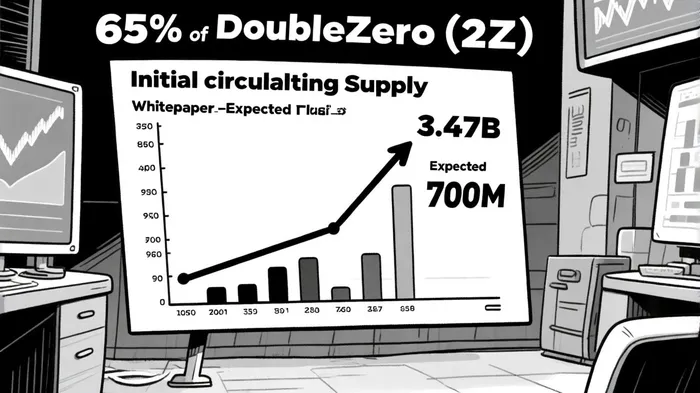






Comentarios
Aún no hay comentarios