
The Double-Edged Sword of Megastar Partnerships: How Celebrity Endorsements Drive Retail Stock Volatility and Brand Value
In the ever-shifting landscape of retail, the allure of megastar partnerships has become both a siren song and a cautionary tale. From 2023 to 2025, the interplay between celebrity influence and stock performance has revealed a paradox: while these collaborations can ignite explosive short-term gains, they often lack the durability to sustain long-term value. This article dissects the mechanics of celebrity-driven retail strategies, their financial implications, and the critical lessons for investors navigating this volatile terrain.
The Hype Cycle: Short-Term Gains and Fragile Fundamentals
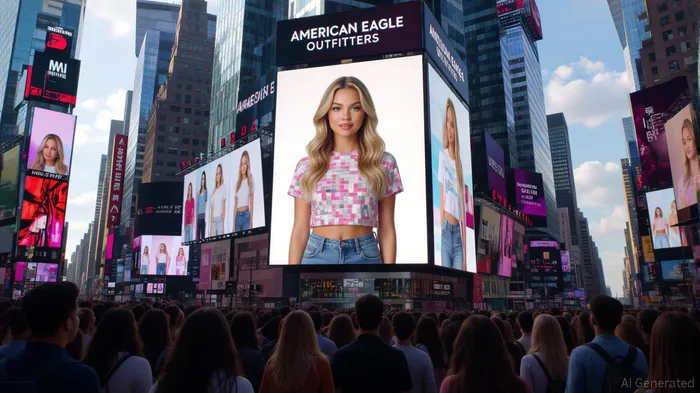
The most striking example of celebrity-driven retail volatility emerged in July 2025, when American Eagle OutfittersAEO-- (AEO) launched a campaign starring actress Sydney Sweeney. The campaign, which included 3D billboards and AI-powered virtual try-ons, triggered a 17% after-hours stock surge. However, this momentum collapsed within days as analysts from JefferiesJEF-- and Morgan StanleyMS-- downgraded the stock, citing a 5% revenue decline and weak fundamentals. AEO's stock correction underscored a critical truth: celebrity endorsements can generate fleeting attention but rarely address underlying operational challenges.
Similarly, GoProGPRO-- (GPRO) and Kohl'sKSS-- (KHC) experienced 25% and 12% price spikes, respectively, following influencer-backed campaigns. These surges were fueled by meme stock dynamics and low short interest, yet both stocks plummeted when earnings failed to meet expectations. The pattern is clear: celebrity-driven retail stocks often trade on speculative fervor rather than sustainable business models.
The Academic Lens: Authenticity and Alignment
Academic research from the Journal of Business Research (2023) provides a framework for understanding these dynamics. The study emphasizes that celebrity endorsements succeed when there is a congruence between the celebrity's image and the brand's values. For instance, Sweeney's alignment with AEO's Gen Z-focused strategy initially amplified consumer engagement. However, the same study warns that authenticity is paramount. When consumers perceive endorsements as purely transactional, the emotional resonance—and thus the financial impact—diminishes.
This aligns with the "transfer-of-meanings" model, where celebrities imbue products with cultural significance. Yet, as the AEOAEO-- case illustrates, this transfer is fragile. If the brand fails to deliver on the promised experience, the stock price reverts to its intrinsic value, often with sharp corrections.
The Counterexample: Value-Driven Retail Success
While celebrity-driven stocks falter, value-oriented retailers like WalmartWMT-- (WMT) have thrived. In Q2 2025, Walmart reported a 4.2% rise in same-store sales and an 8.5% increase in operating income, driven by strategic rollbacks on 7,200 items and a 25% price advantage over traditional supermarkets. Its stock surged 7% in pre-market trading after raising full-year guidance, demonstrating that financial discipline and pricing power outperform celebrity hype in a high-inflation environment.
Investment Implications: Navigating the Risks
For investors, the lessons are twofold. First, celebrity-driven stocks should be approached with caution. While these stocks can experience rapid price increases, they are inherently speculative. Key metrics to monitor include short interest (e.g., AEO's 13% short interest in July 2025), social media sentiment, and earnings trends. Second, diversification is critical. Balancing exposure to celebrity-driven retailers with value-oriented peers like Walmart and CostcoCOST-- (COST) can mitigate risk while capitalizing on broader consumer trends.
Conclusion: The Future of Retail and Celebrity Influence
The 2023–2025 period has shown that celebrity endorsements can create temporary retail stock surges, but these gains are often unsustainable. As consumer preferences shift toward value-conscious spending and macroeconomic uncertainties persist, the long-term success of retail companies will depend on operational efficiency, pricing power, and alignment with core consumer needs. Investors who recognize this dynamic—and prioritize fundamentals over fleeting hype—will be better positioned to navigate the evolving retail landscape.
In the end, the megastar partnership remains a double-edged sword: a tool for short-term visibility but a liability without the substance to sustain it. The future belongs to retailers that blend cultural relevance with financial resilience.





Comentarios
Aún no hay comentarios