
The Double-Edged Sword of Growth: Cybersecurity Risks in Crypto Hardware Wallets and Institutional Adoption
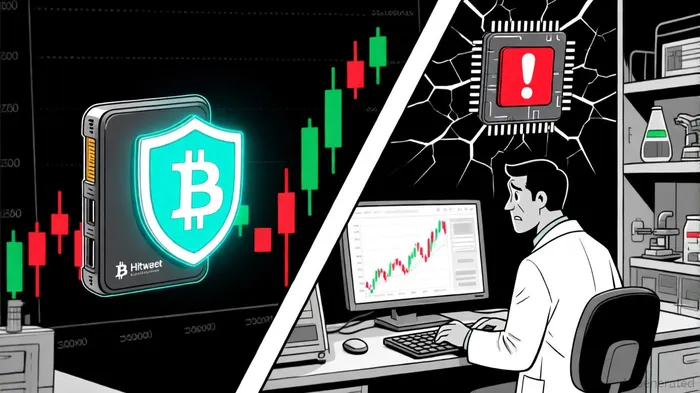
The cryptocurrency industry's rapid ascent has brought both innovation and existential risks. Nowhere is this duality more evident than in the hardware wallet market, a critical linchpin for institutional adoption. While the sector is projected to grow at a blistering 28.79% CAGR through 2033[1], recent cybersecurity vulnerabilities in leading hardware wallets have exposed a fragile underbelly. For investors, the question is no longer if these risks matter, but how they will reshape the landscape of institutional trust and capital allocation.
The Vulnerability Tsunami: From Microcontrollers to Market Confidence
In March 2025, Ledger's research arm, Ledger Donjon, uncovered a critical flaw in Trezor's Safe 3 and Safe 5 models. The vulnerability, tied to the devices' microcontroller, allowed attackers to bypass firmware integrity checks—a potential gateway for advanced attacks like supply chain compromises[1]. Trezor's patch was incomplete, requiring users to source devices directly from official channels to mitigate risks[3]. This incident underscores a sobering reality: even the most battle-tested hardware wallets are not immune to zero-day exploits.
Meanwhile, a separate but equally alarming vulnerability—CVE-2025-27840—has shaken the industry. Researchers demonstrated how the ESP32 chip, used in budget-friendly wallets like Blockstream Jade, could be exploited to extract private keys and forge ECDSA signatures. In a real-world test, attackers stole 10 BTC from a live wallet without user detection[1]. The flaw stems from a weak random number generator and the chip's inability to reject invalid private keys, making cryptographic operations dangerously predictable[2]. With billions of ESP32-powered IoT devices in circulation, the implications extend far beyond crypto, raising fears of state-level espionage[2].
Market Growth vs. Institutional Hesitation
Despite these risks, the hardware wallet market is booming. Valued at $0.35 billion in 2025, the sector is being driven by institutional demand for multi-signature support, biometric authentication, and USB-based reliability[1]. However, vulnerabilities like those in Trezor and ESP32 could erode confidence. Institutions, which prioritize security over cost, may hesitate to adopt wallets with known flaws—especially when higher-end models from Ledger and Trezor (which avoid ESP32) offer superior hardware security modules[3].
The irony is palpable: the same innovation that fuels growth also creates new attack vectors. For example, while Bluetooth and Wi-Fi connectivity enhance user experience, they also open doors for remote exploits[2]. This tension between convenience and security will define the next phase of the market.
Investment Implications: Navigating the Security-First Paradigm
For investors, the key lies in discerning which players are future-proofing their offerings. Ledger and Trezor's collaborative approach—where competitors share threat intelligence—signals a maturing industry[3]. However, companies relying on cost-cutting measures (e.g., ESP32) may face reputational and regulatory headwinds.
Institutional adoption hinges on trust, and trust is earned through transparency. Firms that prioritize open-source audits, multi-layered security, and proactive patching (like Trezor's post-vulnerability response[1]) will likely dominate. Conversely, wallets with opaque supply chains or unpatched flaws could see declining market share.
Conclusion: The Road Ahead
The hardware wallet market is at a crossroads. While its growth trajectory is undeniable, cybersecurity risks could act as a brake on institutional adoption. Investors must weigh the sector's potential against its vulnerabilities, favoring companies that treat security as a non-negotiable feature rather than an afterthought. For now, the industry's collaborative spirit—where rivals work together to patch each other's flaws—offers a glimmer of hope. But in crypto, hope is not a strategy. It's a starting point.







Comentarios
Aún no hay comentarios