
The Double-Edged Sword: Cryptocurrencies in Sanction-Evading Trade and the Regulatory Gauntlet Ahead
Cryptocurrencies have emerged as a double-edged sword in the realm of geopolitical trade. On one hand, they represent a technological marvel enabling decentralized, borderless transactions. On the other, they've become a tool for sanction evasion, enabling bad actors to circumvent economic restrictions and fund destabilizing activities. As of 2025, the interplay between crypto's utility and its misuse has reached a critical inflection point, with regulators, law enforcement, and market participants scrambling to balance innovation with compliance.
The Rise of Crypto in Sanction-Evading Trade
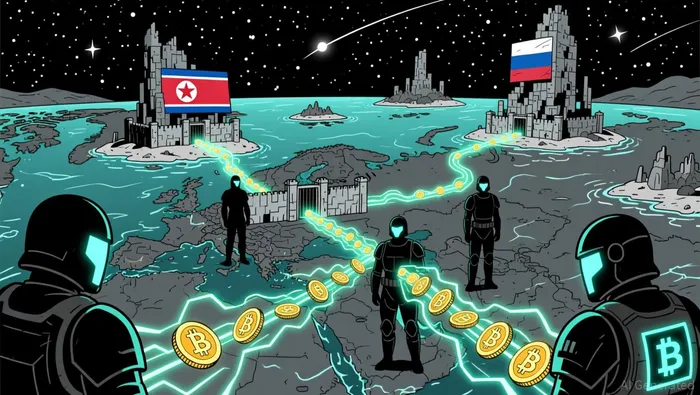
The past two years have seen a surge in high-profile cases of cryptocurrencies being weaponized for geopolitical ends. North Korea's $1.5 billion hack of ByBit in early 2025 is a stark example. This wasn't just a theft-it was a calculated move to bypass U.S. and U.N. sanctions, funneling stolen funds into the regime's illicit networks. Similarly, the Russia-Ukraine conflict has highlighted crypto's role in evading financial restrictions. A TVP-VAR model analysis revealed that cryptocurrencies exhibited heightened liquidity and interconnectedness during the war, suggesting their use in sustaining military operations and circumventing Western sanctions.
These cases underscore a broader trend: bad actors are leveraging crypto's pseudonymity and decentralized infrastructure to exploit regulatory gaps. Privacy coins like Monero and unregulated DEXs have further complicated detection efforts.
Regulatory Responses: A Global Arms Race
Governments and international bodies have responded with a mix of enforcement actions and legislative overhauls. The U.S. DOJ has cracked down on platforms like Garantex (and its rebranded variant Grinex), which used the A7A5 stablecoin to launder funds for Russian sanctions evasion and ransomware operations. Meanwhile, the European Union's MiCA regulation, which took effect in early 2025, has imposed strict rules on stablecoins, requiring 1:1 reserve backing and mandatory audits.
The U.S. followed suit with the GENIUS Act in July 2025, mandating full reserve backing for dollar-stablecoins and monthly public disclosures. These frameworks aim to reduce the risk of stablecoins being used as conduits for illicit finance. However, their effectiveness hinges on cross-jurisdictional coordination. For instance, while the FATF's updated Travel Rule has been adopted by 99 jurisdictions, stablecoins remain a significant vector for sanctions evasion due to their cross-border nature.
Effectiveness and Challenges of 2025 Regulations
The MiCA and GENIUS Act frameworks have made strides in curbing misuse, but implementation challenges persist. In the EU, divergent national interpretations of MiCA have led to fragmented enforcement, while in the U.S., the rapid rollout of the GENIUS Act has left businesses scrambling to adapt. Additionally, the rise of decentralized finance and cross-chain bridges has created new blind spots. For example, North Korea's use of OTC brokers and unregulated DEXs to exploit sanction loopholes highlights the limitations of centralized oversight.
Despite these hurdles, the regulatory landscape is maturing. The EU's alignment of MiCA with MiFID and the U.S. focus on harmonizing AML/CFT programs with sanctions compliance are steps toward a more cohesive framework. However, the global nature of crypto means that regulatory arbitrage remains a risk. Jurisdictions with lax oversight, such as certain offshore hubs, could become new hotspots for illicit activity.
Future Trends: AI, Enforcement, and the Stablecoin Conundrum
Looking ahead, the next decade will be defined by technological advancements and regulatory innovation. Governments are increasingly deploying AI and blockchain analytics to track illicit transactions. For instance, the U.S. Treasury has used AI-driven tools to identify North Korean shadow fleets and crypto wallets linked to ransomware payments. By 2030, these technologies are expected to become standard infrastructure in compliance programs, moving from niche tools to essential components.
Stablecoins will remain a focal point. While the GENIUS Act and MiCA have imposed stringent requirements, their global adoption has also sparked a regulatory arms race. Japan, Hong Kong, and the UAE are developing their own stablecoin frameworks, reflecting a growing consensus on the need for oversight. However, the rise of algorithmic stablecoins and cross-border payment systems could reintroduce systemic risks, particularly if reserve backing is not transparent.
Market Risks and Investment Implications
The market risks of crypto-enabled sanction evasion are substantial. As of 2025, illicit entities hold nearly $15 billion in crypto assets, with stolen funds representing the largest category. Downstream wallets hold over $60 billion in balances, much of which is tied to ransomware, fraud, and sanctions evasion. For investors, this creates a paradox: while crypto's institutional adoption is growing, its association with illicit activity could trigger regulatory crackdowns that stifle innovation.
Enforcement trends also suggest a shift toward victim-focused accountability. Authorities are prioritizing actions against fraud, Ponzi schemes, and AML violations, which could lead to increased litigation risks for crypto firms. The DOJ's 2025 mid-year update highlighted a 40% rise in crypto-related prosecutions compared to 2024, signaling a sustained focus on this space.
Conclusion: Navigating the Regulatory Gauntlet
The long-term viability of cryptocurrencies in geopolitical trade hinges on the balance between innovation and compliance. While regulatory frameworks like MiCA and the GENIUS Act have made progress, they must evolve to address decentralized infrastructure and cross-border arbitrage. For investors, the key is to monitor enforcement trends, technological advancements, and the geopolitical landscape.
Cryptocurrencies will likely remain a tool for both legitimate commerce and sanction evasion. The difference will be determined by how effectively regulators and market participants can close loopholes without stifling the technology's potential. As the 2030s approach, the winners in this space will be those who navigate the regulatory gauntlet with agility and foresight.







Comentarios
Aún no hay comentarios