
The Double-Edged Sword of AI in Finance: Behavioral Biases and the Risk of Regret
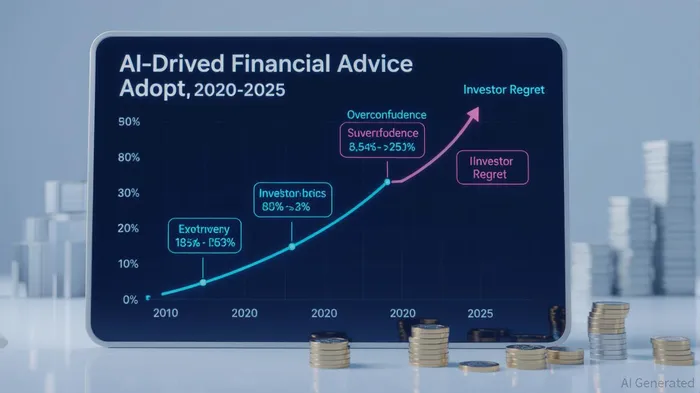
The rise of AI-driven financial advice has been hailed as a revolution in democratizing access to personalized wealth management. Institutions and startups alike are deploying generative AI tools to streamline portfolio optimization, risk assessment, and even retirement planning. Yet, beneath the surface of this technological optimism lies a growing tension between user expectations and the realities of behavioral finance. As AI chatbots and algorithmic advisors gain traction, they risk amplifying cognitive biases—such as overconfidence and anchoring—that could lead to regret-driven market corrections. For investors in AI fintech, this dynamic raises urgent questions about valuation sustainability and systemic risk.
AI and the Amplification of Behavioral Biases
Behavioral finance has long documented how investors deviate from rational decision-making. Overconfidence, for instance, leads individuals to overestimate their knowledge or the accuracy of AI-generated forecasts, while anchoring biases cause them to fixate on historical data points or initial recommendations[1]. The integration of AI into financial advice exacerbates these tendencies. Users may trust algorithmic outputs without scrutiny, assuming that "black-box" models eliminate human error. However, AI systems often inherit biases from their training data or lack transparency in their reasoning, creating a false sense of security[2].
A case in point is the MIT Generative AI Impact Consortium's work, which highlights how AI-human collaboration can yield outcomes neither could achieve alone[3]. While this synergy is promising, it also introduces new risks. For example, if an AI chatbot recommends a high-risk investment based on incomplete market data, overconfident users may double down, only to face losses when market conditions shift. Similarly, anchoring biases could delay portfolio rebalancing during downturns, as investors cling to AI-generated benchmarks that no longer reflect reality.
The Gap Between Expectations and Outcomes
User behavior trends suggest a widening gap between the perceived benefits of AI and its practical limitations. Financial institutionsFISI-- market AI tools as "personalized" and "unbiased," yet these systems often rely on aggregated datasets that may not account for individual risk tolerances or life circumstances[4]. A 2024 MIT study on GenSQL, a tool designed to simplify data analysis, underscores this issue: while AI can process vast datasets efficiently, it struggles to contextualize user-specific variables like liquidity needs or emotional thresholds for loss[5].
This disconnect becomes particularly problematic during market corrections. When volatility spikes, investors may rush to adjust portfolios based on AI-generated advice, only to discover that the recommendations lack nuance. For example, an AI chatbot trained on historical bull markets might fail to account for liquidity constraints during a crisis, leading users to sell assets at fire-sale prices. The resulting regret—measured in both financial losses and eroded trust—could trigger broader market instability as panic spreads[6].
Long-Term Implications for Fintech Investors
The fintech sector's current valuation multiples reflect an assumption that AI will consistently outperform traditional advisory models. However, the lack of robust data on adoption rates and regret metrics for 2024–2025 suggests that this optimism may be premature[7]. Startups relying on AI-driven advice face a dual challenge: proving their tools' efficacy in real-world scenarios while navigating regulatory scrutiny over algorithmic transparency.
For institutional investors, the risks are twofold. First, overvalued AI fintech stocks could face corrections if user adoption stalls or if regulatory frameworks impose stricter disclosure requirements. Second, systemic risks emerge if widespread reliance on flawed AI models leads to synchronized investment errors. The MIT Generative AI Impact Consortium's emphasis on interdisciplinary collaboration—uniting technologists, behavioral scientists, and policymakers—highlights the need for safeguards[8]. Yet, such measures remain aspirational rather than operational.
Conclusion: A Call for Caution
The integration of AI into financial advice is inevitable, but its success hinges on addressing behavioral finance pitfalls. For now, the evidence points to a market where user expectations outpace the capabilities of AI tools. Investors must weigh the transformative potential of these technologies against the risks of overconfidence, anchoring, and regret-driven corrections. As the MIT research underscores, the future of AI in finance will depend not just on algorithmic innovation but on fostering a culture of transparency and user education[9]. Until then, caution—rather than exuberance—should guide investment decisions in this high-stakes sector.







Comentarios
Aún no hay comentarios