
DoorDash's Strategic Retail Expansion: Unlocking Growth and Retention in the On-Demand Economy
Unlocking New Revenue Streams
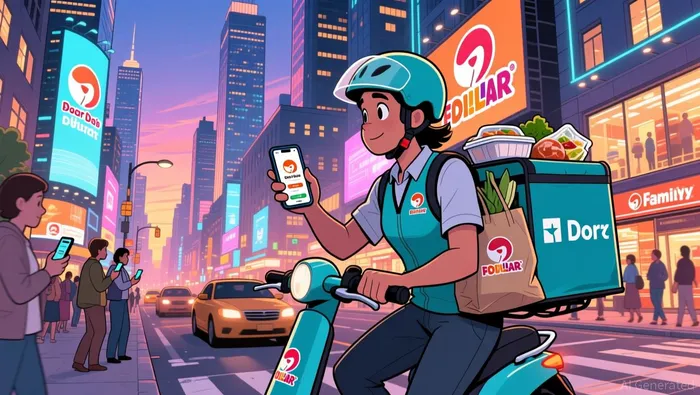 The partnership with Family Dollar, a discount retail chain with a strong presence in underserved markets, allows DoorDash to monetize a previously untapped segment of consumer demand. By enabling on-demand delivery of groceries, household goods, and personal care items, DoorDash is expanding its service beyond food delivery, a sector that has faced margin pressures due to rising labor and logistics costs according to its Q2 2025 financial results. According to Bloomberg, the collaboration includes promotional incentives such as a 25% discount for new users via the promo code FDONDD, which could drive immediate order growth and customer acquisition.
Moreover, the integration of Family Dollar products into DashPass-a subscription service offering zero delivery fees-further incentivizes users to consolidate their shopping and dining needs on a single platform as reported in investor updates. This bundling strategy not only increases the average order value but also creates a flywheel effect, where convenience and affordability drive repeat usage. For investors, this signals a shift toward higher-margin, recurring revenue streams, which are critical for long-term profitability in the on-demand sector.
Strengthening User Retention
User retention has been a key focus for DoorDash, particularly as competition intensifies. While the company has not disclosed specific retention metrics tied to the Family Dollar partnership, its Q2 2025 financial results highlighted strong performance from mature user cohorts. The partnership's emphasis on affordability-Family Dollar's low-cost offerings combined with DoorDash's delivery efficiency-could further solidify customer loyalty, especially among price-sensitive demographics.
The holiday season, a critical period for delivery platforms, has already demonstrated the partnership's potential. In November and December 2024, DoorDash reported record delivery volumes during Thanksgiving and Christmas, with Sundays emerging as particularly busy days for food and grocery orders as noted in merchant analytics. By leveraging its existing delivery infrastructure to handle peak demand, DoorDash is not only meeting seasonal surges but also reinforcing its reliability as a one-stop delivery solution. This capability is a significant differentiator in a market where competitors like Uber Eats and Amazon are investing heavily in robotic deliveries and subscription-based grocery services as outlined in a 2025 market report.
Competitive Positioning and Market Dynamics
DoorDash's expansion into retail delivery places it in direct competition with Amazon's newly launched monthly grocery delivery service for Prime members as detailed in financial disclosures. However, DoorDash's agility and first-mover advantage in the on-demand space provide a distinct edge. Unlike Amazon's subscription model, which targets Prime members, DoorDash's partnership with Family Dollar broadens its appeal to a more diverse demographic, including non-Prime users who prioritize convenience and affordability.
Meanwhile, Uber Eats' focus on technological innovation-such as robotic deliveries-highlights the sector's competitive intensity as reported in market analysis. Yet, DoorDash's strategic alliances with local businesses and its ability to scale rapidly through partnerships like Family Dollar suggest a more sustainable path to market dominance. The U.S. online delivery market is projected to grow at a compound annual rate of 9.3–9.9% through 2033 as projected in a 2025 market report, and DoorDash's dual focus on food and retail delivery positions it to capture a larger share of this growth.
Investment Case: A Compelling Long-Term Play
DoorDash's stock has already responded positively to the Family Dollar partnership, with shares rising 2.56% in pre-market trading according to investor updates. This momentum, combined with the company's 21% year-over-year order growth in Q3 2025, reflects investor confidence in its strategic direction. For near-term investors, the partnership's alignment with peak shopping seasons and its potential to drive user retention make it a compelling case for capital allocation.
However, risks remain. The on-demand economy is highly competitive, and rivals like Amazon and Uber Eats are unlikely to cede ground easily. DoorDash must continue innovating-whether through AI-driven logistics or expanded partnerships-to maintain its edge. That said, the company's ability to adapt and scale, as evidenced by its 26.43% year-to-date stock gain, suggests it is well-positioned to navigate these challenges.
Conclusion
DoorDash's partnership with Family Dollar is more than a tactical move; it is a strategic repositioning that aligns with the evolving needs of consumers and the competitive dynamics of the on-demand economy. By unlocking new revenue streams through retail delivery and enhancing user retention via affordability and convenience, DoorDash is building a durable moat in a market poised for sustained growth. For investors, this represents a timely opportunity to capitalize on a company that is not only adapting to change but leading it.





Comentarios
Aún no hay comentarios