
DoorDash's Hardware Gambit: A Strategic Masterstroke for Long-Term Growth?
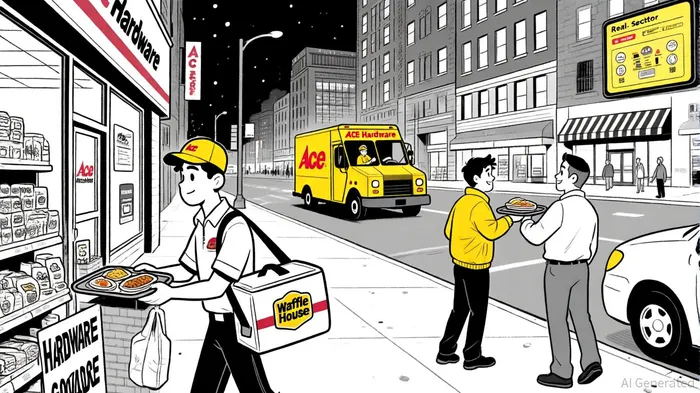
In the ever-evolving landscape of on-demand services, DoorDashDASH-- (DASH) has consistently proven its ability to pivot and innovate. But its 2025 foray into hardware and home improvement delivery-cemented by its landmark partnership with Ace Hardware-marks a pivotal shift in its strategic trajectory. This move isn't just about diversifying revenue streams; it's about redefining DoorDash's role as a cornerstone of local commerce. Let's break down what this means for investors.
Strategic Diversification: Beyond the Plate
DoorDash's core food delivery segment has long operated on razor-thin margins, a vulnerability the company has sought to mitigate through expansion. By partnering with Ace Hardware, DoorDash now offers on-demand delivery of hardware, tools, and garden supplies from over 4,000 U.S. locations[1]. This partnership isn't just a lateral move-it's a vertical leap into a high-margin category. According to a report by Retail Tech Innovation Hub, the collaboration positions Ace Hardware as the first and largest nationwide hardware co-op on DoorDash, enabling customers to access over 100,000 products[2].
The implications are profound. By tapping into the $380 billion U.S. home improvement market[3], DoorDash is no longer just competing with Uber Eats or Grubhub; it's challenging Amazon's local retail dominance. The ability to deliver hardware goods-often bulky and time-sensitive-also tests and strengthens DoorDash's logistics infrastructure, a critical asset for long-term scalability.
Technological Innovation: The Engine Behind the Expansion
DoorDash's hardware ambitions are underpinned by a relentless focus on AI and automation. Data from NextSprints reveals that advanced logistics algorithms have already reduced delivery times by 30% and boosted customer retention by 20%[4]. The company is now testing multi-modal delivery options, including e-bikes and autonomous vehicles, in select markets. These innovations aren't just about speed-they're about cost efficiency. For every 10% reduction in delivery costs, DoorDash's EBITDA margins could expand by 2-3 percentage points[5].
Moreover, the acquisition of Symbiosys in June 2025 has turbocharged DoorDash's adtech capabilities. With its advertising division, Wolt Ads, already surpassing $1 billion in annual revenue[6], the company is now capturing a cut of every transaction, not just delivery fees. This shift to a "platform-as-a-service" model mirrors Amazon's transition from marketplace to cloud giant-a trajectory that could unlock massive valuation upside.
Ecosystem Expansion: The Network Effect
DoorDash's ecosystem is rapidly evolving into a one-stop shop for local commerce. The recent $3.9 billion acquisition of Deliveroo[7] has expanded its international footprint to 40+ countries, while partnerships like the one with Waffle House for overnight delivery[8] are carving out new customer segments. By integrating hardware, groceries, and retail into its app, DoorDash is creating a flywheel effect: more delivery options increase user frequency, which in turn attracts more merchants and advertisers.
The financial math is compelling. DoorDash aims to facilitate $100 billion in gross merchandise value (GMV) by 2026[9]. At a 10% take rate (a conservative estimate given its adtech edge), this would generate $10 billion in revenue-a 50% jump from its 2024 GMV of $67 billion[10].
Risks and Regulatory Headwinds
No strategy is without risks. DoorDash faces ongoing regulatory battles in the U.S. and Canada over gig worker classification and pricing transparency[11]. A misstep in these areas could erode margins or stifle growth. Additionally, the hardware delivery segment is uncharted territory; unlike food, hardware items are prone to damage, returns, and inventory management challenges.
Conclusion: A Bull Case for the Long Run
DoorDash's hardware foray is more than a gimmick-it's a calculated move to transform the company into a local commerce juggernaut. By leveraging its logistics network, AI prowess, and strategic acquisitions, DoorDash is building a moat that competitors like Amazon and Instacart will struggle to replicate. For investors, the key takeaway is clear: this is a company betting big on its ecosystem's future. If the execution matches the ambition, the rewards could be monumental.





Comentarios
Aún no hay comentarios