
DoorDash's AI-Powered Commerce Revolution: Redefining Grocery Delivery and Market Dominance in 2025
In 2025, the intersection of artificial intelligence (AI) and local commerce has become a battleground for innovation, with DoorDashDASH-- emerging as a formidable leader. By embedding AI into every facet of its operations-from logistics to customer experience-the company is not only redefining grocery delivery but also reshaping the competitive landscape. This analysis explores DoorDash's strategic AI integration, its impact on market dynamics, and how it stacks up against rivals like Amazon and Instacart.
DoorDash's AI-Driven Grocery Delivery Ecosystem
DoorDash's partnership with OpenAI to integrate grocery shopping functionality into ChatGPT represents a paradigm shift in convenience. Users can now transform recipe ideas into shoppable orders from local retailers like Kroger and Wegmans, with deliveries arriving in as little as an hour according to reports. This initiative, which allows meal suggestions, grocery list creation, and purchases within a single chat interface, underscores DoorDash's commitment to seamless user experiences as research shows.
The company's broader AI strategy is anchored in a proprietary ecosystem that optimizes logistics, personalization, and merchant enablement. Real-time route optimization systems and demand forecasting models have reduced delivery times and increased Dasher productivity, while advanced algorithms anticipate peak ordering periods to balance supply and demand. These innovations are supported by a centralized Machine Learning Workbench (MLW), which accelerates AI development and enables a 45-day concept-to-production timeline according to analysis.
Competitive Positioning: DoorDash vs. Amazon and Instacart
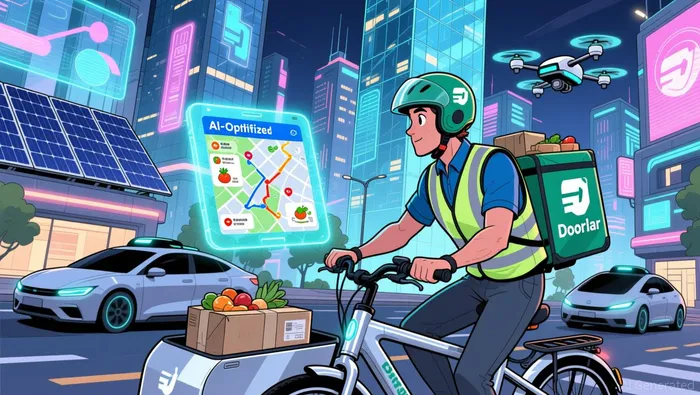 DoorDash's dominance in the U.S. food-delivery market (60% share) is underpinned by a self-reinforcing flywheel of data, AI infrastructure, and operational integration as data indicates. Unlike Uber Eats, which relies on ride-sharing data, DoorDash's localized commerce logistics are tailored to the nuances of delivery, giving it an edge in efficiency and personalization according to market analysis.
Amazon, meanwhile, is leveraging its $4 billion investment in grocery logistics and AI-driven inventory systems to expand same-day delivery to 2,300 cities by 2025 according to reports. Its AI-powered personalization tools, such as the "Interests" feature and Rufus, create a seamless journey from recipe inspiration to delivery as research shows. However, Amazon's focus on scale and inventory optimization contrasts with DoorDash's hyperlocal approach.
Challenges and Future Outlook
Despite its strengths, DoorDash faces headwinds, including the AI talent war and risks associated with deploying cutting-edge technology at scale according to analysis. Algorithmic bias and consumer privacy concerns also loom large. However, the company's aggressive expansion into grocery, convenience, and retail-bolstered by partnerships like the Small Business AI Jam-demonstrates its commitment to addressing these challenges as reports indicate.
Looking ahead, DoorDash's autonomous delivery network, tested in collaboration with Waymo, and its focus on cross-channel loyalty programs signal a vision for the future of local commerce according to financial reports. With Q3 2025 reporting a 25% year-over-year increase in Marketplace Gross Order Volume (GOV) to $25.0 billion according to company data, the company is well-positioned to capitalize on the $1.5 trillion U.S. grocery market.
Conclusion
DoorDash's AI-powered strategies are not just enhancing delivery efficiency but also redefining the grocery delivery experience. By combining proprietary data, advanced AI infrastructure, and strategic partnerships, the company is building a moat that rivals like Amazon and Instacart struggle to replicate. For investors, DoorDash's focus on innovation and market expansion presents a compelling case in the evolving AI-driven commerce landscape.







Comentarios
Aún no hay comentarios