
DOOD's Volatility and Strategic Entry Points Post-Upbit Listing: A 2025 Analysis
In the fast-evolving world of cryptocurrency, exchange listings remain pivotal catalysts for price action, particularly for tokens with strong community-driven narratives. The recent listing of Doodles (DOOD) on Upbit, South Korea's largest exchange, offers a compelling case study in how speculative traders can leverage such events while navigating the maturing market's diminishing "listing effect."
The Upbit Listing: A Gateway to Liquidity
DOOD's listing on Upbit on September 9, 2025, at 4:30 p.m. KST introduced KRW and USDT trading pairs, granting Korean traders direct access to the token via fiat and stablecoin markets, according to Quiknotes. This move was expected to boost liquidity, a critical factor for tokens like DOOD, which relies on community ownership and ecosystem development per CoinCodex. However, the broader market context-characterized by Upbit's aggressive listing strategy (nearly one token per day in September 2025)-has diluted the novelty-driven price surges once typical of such events, as noted by CoinCodex.
Volatility and the "Sell the News" Phenomenon
DOOD's post-listing performance exemplifies the volatile yet short-lived momentum now common in 2025. Within 24 hours, the token's price plummeted by 93.79% on some platforms, according to OKX, while KuCoin reported a 130.27% surge, per CoinCodex. This dichotomy reflects the fragmented nature of crypto markets and the "sell the news" strategy adopted by traders, who capitalize on initial hype before exiting positions. As noted by Coinlineup, tokens like FLOCK have similarly experienced sharp intra-day spikes (e.g., 219%) followed by rapid corrections, signaling a market prioritizing short-term gains over long-term holding.
Liquidity Spikes and Strategic Entry Points
While specific trading volume data for DOOD's first week on Upbit remains undisclosed to some observers (per Quiknotes), the token's 24-hour volume reached $10.48 million by October 1, 2025, according to Gate, underscoring heightened interest. For speculative traders, this liquidity surge presents opportunities to enter positions during post-listing volatility. However, the key lies in timing: entering near the peak of a listing-driven spike risks immediate drawdowns, whereas buying during retracements-especially if the token demonstrates resilience-could yield asymmetric rewards.
Broader Market Dynamics and DOOD's Trajectory
DOOD's price is also influenced by macroeconomic factors, including Bitcoin's performance and the health of the NFT market, observations originally reported by Gate. Despite a 33.73% weekly gain as of October 1, 2025 (Gate), the token remains down 84.27% from its 2024 peak, reflecting a broader bearish trend. Technical indicators suggest further volatility, with some models predicting a 38.44% drop to $0.009696 by November 2025, according to Coinlineup. This volatility, while risky, creates high-reward scenarios for traders who can navigate the noise.
Conclusion: Balancing Risk and Reward
The Upbit listing for DOOD highlights both the potential and pitfalls of leveraging exchange events. While the token's immediate post-listing volatility aligns with the 2025 trend of rapid mean reversion noted by Coinlineup, its underlying community-driven model and ecosystem incentives (CoinCodex) suggest a floor for long-term value. For speculative traders, the optimal strategy involves strict risk management-using stop-loss orders and position sizing to mitigate the impact of sharp corrections-while capitalizing on liquidity spikes during retracements.
As the crypto market matures, the ability to differentiate between fleeting hype and sustainable momentum will become increasingly critical. DOOD's journey post-Upbit listing serves as a microcosm of this challenge, offering lessons for traders navigating the next phase of the crypto cycle. 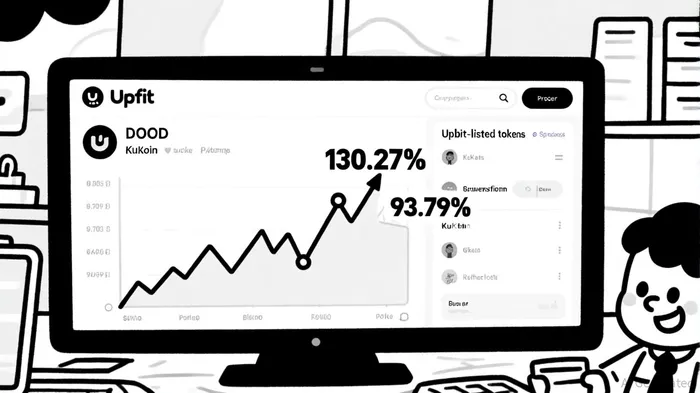






Comentarios
Aún no hay comentarios