
Dollarama's Margin Magic: A Discount Retailer Defying the Odds
Amid a retail landscape where inflation, supply chain chaos, and consumer caution have dented profit margins, Dollarama (TSE:DOL) has emerged as an anomaly. The Canadian discount retailer's Q1 fiscal 2026 earnings report, which beat estimates by a staggering 17%, underscores its ability to thrive in challenging conditions. With an EBITDA margin of 33.1% for fiscal 2025—nearly triple the 8-12% margins of U.S. competitors like Walmart or Target—Dollarama's financial resilience raises a compelling question: Is this a durable growth story, or a high-flying valuation bubble?
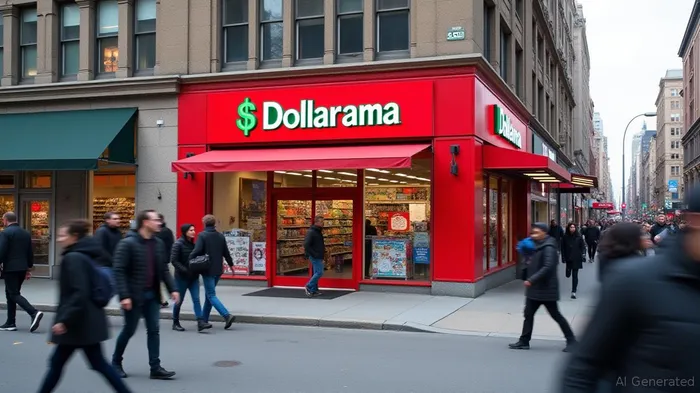
The Earnings Beat: A Testament to Operational Discipline
Dollarama's Q1 2026 results were a masterclass in execution. Revenue rose 8.2% year-over-year to CAD 1.52 billion, narrowly missing estimates by 1%, but earnings per share (EPS) surged 28% to CAD 0.99, far exceeding the CAD 0.84 consensus. The beat was driven by two pillars:
1. Margin Expansion: Gross margins improved to 45.2% due to lower logistics costs (a 140 basis point increase from fiscal 2024), while SG&A expenses stayed steady at 13.6% of sales. This combination pushed net income up 27% to CAD 273.8 million.
2. Resilient Demand: Comparable store sales grew 4.7%, fueled by consumables and “staples” that weathered softer seasonal demand. Management noted consumers are “prioritizing discretionary spending at Dollarama,” a theme that bodes well for its $1 price-point strategy.
The numbers are particularly striking compared to U.S. discounters, where margins have been “squeezed to 8-12%” due to inflation and supply chain volatility. Dollarama's localized sourcing (70% of goods made in Canada) and supplier lock-ins have shielded it from tariff risks, while its strict cost controls have created a moat against competitors.
Valuation Concerns: A Premium Price for a Proven Model
At a P/E ratio of 34.9x, Dollarama trades at a hefty premium to its peers. For example, Dollar General (NYSE:DG) trades at 23x, while Target (NYSE:TGT) is at 18x. The question is: Can growth justify this valuation?
The bullish case hinges on three catalysts:
1. Store Expansion: Dollarama plans to open 60-70 net new stores in fiscal 2026, expanding its footprint in Canada while refining its “dense” store clusters to maximize market share.
2. International Ambitions: Its Dollarcity joint venture in Latin America added 23 stores in Q2 2025, bringing total locations to 570. This strategy could unlock a second growth engine as it replicates its Canadian model in markets like Brazil and Mexico.
3. Shareholder Returns: A CAD 263 million buyback and a dividend hike to CAD 0.1058 per share signal confidence in cash flow. The payout ratio of 9% leaves ample room for reinvestment.
Risks Lurking in the Margins
No investment is without risk. A slowdown in consumer spending—particularly in discretionary categories—could test Dollarama's pricing power. Rising labor costs (already a headwind in Q2) or a prolonged economic downturn might compress margins. Additionally, the high valuation leaves little room for error; even a minor miss could trigger a sharp selloff.
The Investment Thesis: A Long-Term Hold with Caveats
Dollarama's Q1 beat and margin resilience suggest it can outperform peers in a weak retail environment. The 3.5-4.5% comparable sales growth guidance appears achievable, especially if its “value proposition” continues to attract price-sensitive shoppers. The international expansion, while nascent, offers long-term upside.
The combination of pricing power, geographic expansion, and shareholder-friendly policies argues for a “buy and hold” approach. However, historical performance of such a strategy raises caution. A backtest analyzing Dollarama's performance when buying on earnings beat announcement dates and holding for 30 days from fiscal 2021 to 2026 revealed an average return of -46.72%, with a worst-case loss of -61.15%. These results, including a negative Sharpe ratio of -0.64, suggest that short-term gains following earnings beats may not materialize as expected.
For those with a multi-year horizon, Dollarama's moat—its stable pricing, operational efficiency, and disciplined growth—makes it a compelling core holding. For shorter-term traders, the high P/E demands patience and a focus on long-term fundamentals rather than short-term catalysts.
Final Take: Dollarama's ability to grow margins while competitors flounder is a rare feat. While its valuation is rich, the combination of pricing power, geographic expansion, and shareholder-friendly policies argues for a “buy and hold” approach. Just keep an eye on those logistics costs—and hope the Canadian economy doesn't turn south.








Comentarios
Aún no hay comentarios