
Dollar Weakening and Global Portfolio Rebalancing
The Case for a Weaker Dollar
Deutsche Bank's bearish outlook hinges on three pillars: current account deficits, valuation imbalances, and monetary policy divergence. The U.S. current account deficit has widened to unsustainable levels, reflecting a structural inability to fund consumption and investment without external capital inflows. Meanwhile, the dollar's trade-weighted index remains overvalued relative to its fundamentals, creating a gravitational pull toward correction. Compounding this is the Federal Reserve's tightening cycle, which, while supportive of short-term strength, risks exacerbating long-term vulnerabilities by inflating asset bubbles and debt burdens.
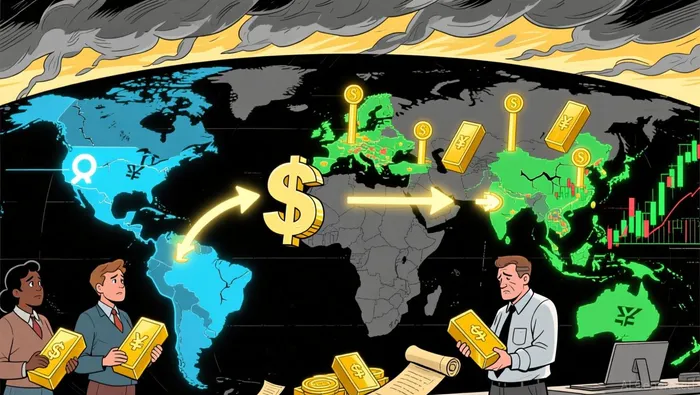
Notably, the pace of the dollar's decline is expected to slow compared to 2025 projections. This suggests a gradual rebalancing rather than a sudden collapse, giving investors time to adjust. However, the cumulative effect of a 6% depreciation over 12 months would still represent a material shift in global capital flows.
Strategic Reallocation: Beyond the Dollar
A weaker dollar inherently favors non-U.S. assets and alternative currencies. Historical precedents show that during periods of dollar weakness, gold, international equities, and emerging-market debt outperform. For example, gold surged past $4,000 per ounce in 2025 as investors flocked to safe-haven assets amid de-dollarization trends. Similarly, emerging-market debt has become increasingly attractive as local-currency bonds gain value for U.S. investors and debt burdens ease for borrowers in weaker dollars.
Central banks are also playing a pivotal role. Emerging-market reserves are shifting toward gold and non-dollar currencies, a trend dubbed "de-dollarization" by institutions like JPMorgan. This shift is not merely reactive but strategic: diversifying away from the dollar reduces exposure to U.S. monetary policy and geopolitical risks. For institutional investors, this means hedging strategies must evolve. Increasing currency hedge ratios and diversifying geographic exposure are now table-stakes measures.
The New Normal: A Dollar in Transition
The dollar's historical "smile" pattern-appreciating during U.S. economic strength or global stress-may be losing its grip. Structural factors like political polarization, declining U.S. institutional credibility, and the rise of alternative investment hubs are reshaping its role. Berenberg notes that the dollar's dominance in global portfolios is undergoing a "structural change," with investors re-evaluating its safety and utility.
This transition is not abrupt. Instead, it is a slow-motion realignment, with capital flows incrementally shifting toward regions offering better risk-adjusted returns. For example, European and Asian equities have outperformed U.S. counterparts in 2025, partly due to the euro and yen's appreciation against the dollar. Investors who recognize this trend early can position themselves to capitalize on the dollar's relative decline.
Conclusion: Rebalancing for the Future
Deutsche Bank's 6% forecast is a wake-up call. While the dollar's weakening will be gradual, its ripple effects on global portfolios are profound. Strategic reallocation must prioritize geographic diversification, currency hedging, and alternative assets like gold and emerging-market debt. As the dollar's hegemony wanes, the winners will be those who adapt-leveraging the dollar's decline to rebalance toward a more resilient and globally diversified portfolio.





Comentarios
Aún no hay comentarios