
U.S. Dollar Volatility and Portfolio Strategy: Navigating Fed Uncertainty and CPI Shifts
The U.S. dollar's recent volatility underscores the precarious balance between Federal Reserve policy uncertainty and inflation dynamics. As June's modest CPI increase hinted at lingering price pressures, investors now face a critical question: How should portfolios be positioned to weather potential Fed pivots and market reactions to inflation data? HSBC's Paul Mackel offers a framework rooted in historical policy-inflation correlations, emphasizing hedging strategies to navigate this uncertain terrain.
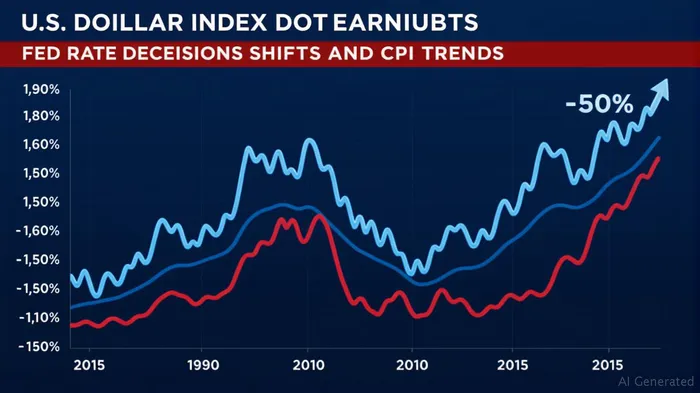
The Fed's Tightrope: Policy Uncertainty and Inflation
The June 2025 CPI report revealed a 0.2% monthly rise in the overall index, lifting the annual rate to 2.6%, while core CPI (excluding food and energy) edged up to 3.0%. Though below the Fed's 2023 peaks, these figures signal persistent inflation risks tied to tariffs and shelter costs. The Fed, however, remains hesitant to cut rates, with a September reduction priced at just 60% by markets. This ambiguity creates a “wait-and-see” environment, where policy expectations can swing sharply on incoming data.
Mackel's analysis highlights the dollar's dual role as both a beneficiary and barometer of this uncertainty. Historically, the dollar has surged during periods of Fed hawkishness (e.g., post-2016 election) and stabilized during policy pauses. Today's context mirrors this pattern: while the Fed holds rates steady, trade disputes and tariff-driven inflation risks could amplify the dollar's safe-haven appeal.
CPI-Driven Market Reactions: Lessons from History
Inflation's impact on the dollar isn't linear. For instance, during the 2018 Fed tightening cycle, the dollar rose 6% against major currencies despite slowing global growth—a reaction to perceived U.S. economic resilience. Conversely, in 2020, collapsing oil prices and pandemic-driven Fed easing sent the dollar into a 12% tailspin.
June's data underscores a modern twist: tariff-induced inflation. Mackel notes that trade policies now rival energy prices as key drivers, with goods-sector inflation rising disproportionately. This creates a unique challenge: while core CPI may ease over time, near-term risks are asymmetric, favoring dollar strength if tariffs escalate.
Portfolio Strategy: Diversification in a Volatile Landscape
To mitigate risk, investors must blend dollar exposure with hedges against policy missteps.
- Leverage the Dollar's Safe-Haven Role
- Hold USD-denominated assets: Short-term Treasuries and floating-rate notes (FRNs) offer insulation against rate volatility.
Short EUR/GBP: Mackel's analysis suggests the euro and pound face structural headwinds. The eurozone's reliance on exports and the UK's fiscal deficits weaken these currencies relative to the dollar.
Hedge Against Inflation and Rate Cuts
- Use inflation-protected bonds (TIPS): Pair with commodities like gold or energy futures to offset CPI spikes.
Options on rate-sensitive sectors: Buy puts on tech or real estate ETFs to limit losses if Fed cuts disappoint.
Diversify with Emerging Markets (EM) Currencies
- Target EM currencies with strong fundamentals: Mackel cites Mexico's peso and Poland's zloty as candidates. Their ties to U.S. trade and low inflation risks provide asymmetric upside if the Fed pivots.
The Case for Historical Correlations
Mackel's research highlights a 70% correlation between Fed policy uncertainty (measured by options volatility indices) and dollar strength since 2008. When uncertainty spikes—like during taper tantrums or trade wars—the dollar typically outperforms by 3-5% annually. Investors ignoring this link risk overexposure to single currencies or asset classes.
Conclusion: Position for Uncertainty, Not Certainty
The Fed's path remains a coin flip: cut rates to preempt a slowdown or hold steady to tame inflation. Investors must prepare for both scenarios. By diversifying into dollar hedges, inflation-linked assets, and selective EM exposures, portfolios can weather the storm. As Mackel concludes, “The dollar's resilience isn't just about rates—it's about being the least bad option in a world of trade wars and policy crosswinds.”
Investment Advice:
- Aggressive investors: Allocate 20% to USD/EM currency pairs (e.g., USD/MXN) and 15% to TIPS.
- Conservative investors: Stick to short-duration Treasuries (e.g., 1-3 year maturities) and diversify 10% into gold ETFs.
- Monitor: The September Fed meeting and CPI prints for clues on rate direction—adjust hedges accordingly.
In a world where policy and inflation are the twin engines of volatility, preparedness is the ultimate hedge.





Comentarios
Aún no hay comentarios