
The U.S. Dollar's Resurgence: Capitalizing on the Weakening Euro and Yen
The U.S. Dollar has entered a new phase of dominance, with the euro and yen under sustained pressure. As of September 28, 2025, the USD/EUR exchange rate stood at 0.8544, while the USD/JPY rate hit 150.61, reflecting a 12% and 15% appreciation against the euro and yen, respectively, compared to early 2025 levels, according to Dai-ichi Life's September 2025 outlook. This resurgence is not a short-term fluctuation but a structural shift driven by divergent macroeconomic trajectories across the U.S., Eurozone, and Japan.
U.S. Macroeconomic Fundamentals: A Magnet for Capital
The Federal Reserve's policy trajectory and inflation dynamics have positioned the dollar as a safe haven. The FOMC SEP forecasts a federal funds rate of 3.6% in Q4 2025, down slightly from 3.9% in June but still above the Eurozone's 2% and Japan's near-zero rates. Meanwhile, core PCE inflation is expected to remain at 3.1% in 2025, a level that, while above the Fed's 2% target, is seen as transitory compared to the Eurozone's sticky 2% headline inflation, according to the SEP. This combination of relatively high rates and controlled inflation has made U.S. assets more attractive to global investors seeking yield.
Eurozone Stagnation: A Perfect Storm
The Eurozone's economic outlook is clouded by structural weaknesses. ECB staff projections forecast real GDP growth of 1.2% for 2025, but J.P. Morgan Research has downgraded its forecast to 0.9% due to U.S. tariff hikes and energy price volatility, according to Dai-ichi Life. Inflation, while stabilizing near the ECB's 2% target, remains a drag on consumer spending. The ECB's key interest rate is expected to remain at 2% through 2026, with J.P. Morgan anticipating a series of rate cuts to 1.5% by mid-2026, per Dai-ichi Life. This dovish stance, coupled with weak growth, has eroded confidence in the euro as a reserve currency.
Japan's Precarious Rebound
Japan's economy, once a beacon of post-pandemic recovery, now faces headwinds. Q3 2025 GDP is projected to contract at an annualized rate of -1.7% due to U.S. tariffs and a slowdown in residential investment, according to the SEP. While the IMF forecasts a rebound to 1.2% growth in 2025, this optimism is tempered by the Bank of Japan's (BoJ) continued accommodative policy. With inflation converging toward the BoJ's 2% target in late 2025, the central bank has shown no urgency to normalize rates, leaving the yen vulnerable to carry-trade unwinds and capital outflows, as noted by Dai-ichi Life.
Strategic Implications for Investors
The dollar's strength offers both opportunities and risks. For investors, hedging against currency risk in euro- and yen-denominated assets is critical. Conversely, increasing exposure to USD-denominated equities and bonds-particularly in sectors like technology and industrials-can capitalize on the dollar's purchasing power. Emerging markets with strong dollar-linked commodity exports (e.g., Brazil, Australia) may also benefit from a weaker euro and yen.
However, caution is warranted. A faster-than-expected Fed rate cut cycle or a surprise Eurozone recovery could reverse the dollar's momentum. Investors should monitor the FOMC's December 2025 meeting and the ECB's response to inflation data in Q1 2026.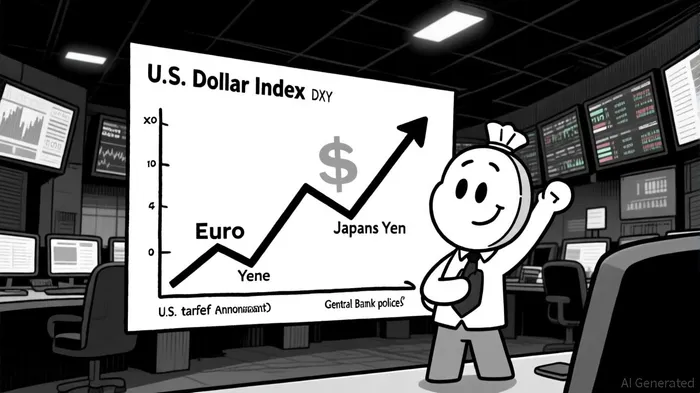







Comentarios
Aún no hay comentarios