
U.S. Dollar Momentum and Central Bank Policy Divergence in 2026
The U.S. dollar's trajectory in 2026 is poised to be shaped by a complex interplay of divergent monetary policies among major central banks. As the Federal Reserve (Fed), European Central Bank (ECB), and Bank of Japan (BoJ) navigate distinct economic realities, their policy choices are creating both headwinds and tailwinds for the USD. This analysis examines the near-term upside potential for the dollar amid evolving policy signals and U.S. economic fundamentals.
Fed's Dovish Stance and Its Implications
The Fed's continued pivot toward easing in late 2025 has been a key driver of dollar weakness. In December 2025, the central bank executed its third consecutive 25-basis-point rate cut, bringing the federal funds rate to 3.25–3.50%, while signaling only one additional cut in 2026. This dovish stance contrasts sharply with the more hawkish or normalization-oriented policies of its global counterparts. The U.S. Dollar Index (DXY) traded near two-month lows around 98.3 in Q4 2025, reflecting the Fed's accommodative stance and weaker-than-expected U.S. economic data.
However, the Fed's easing is not without constraints. Goldman SachsGS-- Research projects U.S. GDP growth to reach 2.6% in 2026, driven by tax cuts and easier financial conditions. Yet, labor market weakness remains a concern, marked by sub-par job growth and declining immigration-driven labor force participation. If inflation continues to moderate, as projected by the Cleveland Fed (core CPI at 2.13% in Q1 2026), the Fed may retain flexibility to cut rates further, potentially supporting the dollar's near-term recovery.
ECB's Hawkish Resilience and Euro Strength
The ECB has maintained a relatively hawkish stance, keeping its key interest rate at 2.00% as of December 2025, despite upward revisions to its 2026 growth forecast (1.2% y/y GDP growth). This policy rigidity, coupled with improved fiscal clarity in France and reduced political risk, has bolstered the euro. The ECB's reluctance to cut rates in 2026-unlike the Fed's projected 50-basis-point reduction-has reinforced the euro's strength against the dollar.
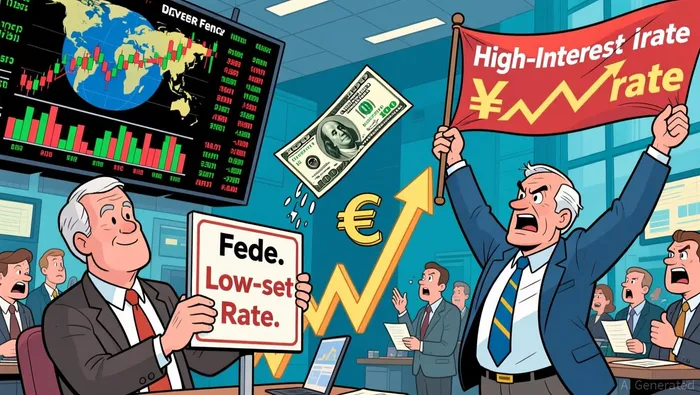
This divergence is critical for the USD. While the Fed's easing has weakened the dollar, the ECB's hawkish stance has limited the magnitude of the dollar's decline. Investors must monitor whether the ECB's inflation target (2.3% y/y core inflation) as of late 2025 forces a policy shift, which could alter the euro-dollar dynamic.
BoJ's Normalization Path and Yen Volatility
Japan's BoJ has embarked on a cautious normalization path, raising its policy rate to 0.75% in December 2025, with further hikes expected to reach 1.25% by year-end 2026. This shift, driven by inflation above 2% and stabilizing wage growth, has strengthened the yen and added to the dollar's challenges. However, the BoJ's focus on avoiding a deflationary spiral and managing high bond yields introduces volatility. The yen's performance will hinge on the BoJ's ability to balance inflation control with financial stability, a factor that could indirectly influence USD momentum.
U.S. Economic Fundamentals: A Mixed Picture
The U.S. economy's near-term prospects are a double-edged sword for the dollar. While Goldman Sachs forecasts 2.6% GDP growth in 2026, Morgan StanleyMS-- projects a more modest 1.8% expansion. The disparity reflects uncertainty around labor market dynamics and the lingering effects of the October 2025 government shutdown. Additionally, core inflation is expected to stabilize at 3.1% in Q1 2026 before declining, suggesting the Fed may not face immediate pressure to tighten.
However, the U.S. dollar's strength is also influenced by global factors. For instance, the dollar's inverse relationship with gold-where weaker USD conditions have pushed gold prices above $4,300 per ounce-highlights the asset's sensitivity to monetary policy divergence. This dynamic underscores the interconnectedness of currency and commodity markets in a low-inflation environment.
Policy Divergence and USD Momentum: A Complex Outlook
The Fed's dovish stance, combined with the ECB's hawkish resilience and the BoJ's normalization, creates a fragmented policy landscape. While the dollar faces downward pressure from U.S. rate cuts, its weakness is partially offset by the stronger euro and yen. This divergence complicates the dollar's near-term trajectory, as investors weigh the relative strength of divergent central bank signals.
For the USD to regain momentum, the Fed would need to either outpace other central banks in rate cuts or demonstrate stronger U.S. economic data. Conversely, if the ECB or BoJ adopt more accommodative stances, the dollar could benefit from a broader shift in global monetary policy.
Investment Implications
Investors should adopt a nuanced approach to USD positioning. Short-term strategies may focus on the dollar's potential to rebound if the Fed's easing outpaces the ECB's and BoJ's normalization. However, long-term exposure should account for the ECB's and BoJ's policy trajectories, which could limit the dollar's upside. Additionally, hedging against gold and other safe-haven assets remains prudent, given the dollar's inverse correlation with these markets.
In conclusion, the U.S. dollar's near-term upside potential in 2026 hinges on the evolving interplay of divergent central bank policies and U.S. economic fundamentals. While the Fed's dovish stance creates headwinds, the ECB's and BoJ's hawkish or normalization paths introduce countervailing forces. Investors must remain agile, balancing macroeconomic trends with central bank signals to navigate this complex environment.







Comentarios
Aún no hay comentarios