
The DOJE ETF: Bridging the Gap Between Meme Culture and Institutional Crypto Investing
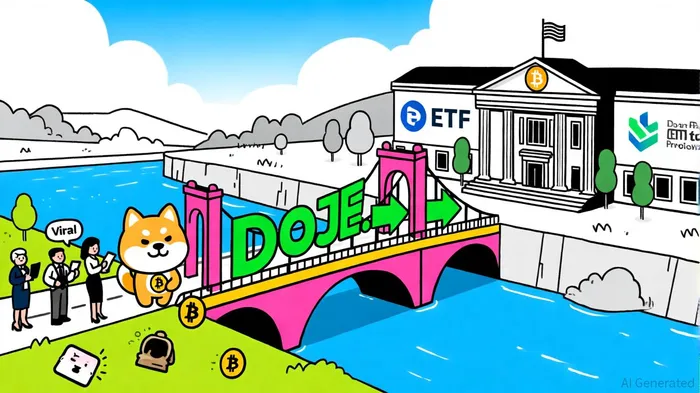
The launch of the REX-Osprey DogecoinDOGE-- ETF (DOJE) on September 11, 2025, marks a pivotal moment in the evolution of cryptocurrency markets. As the first U.S. exchange-traded fund to track a memecoin—specifically Dogecoin (DOGE)—DOJE represents more than just a financial product; it symbolizes the convergence of internet-driven retail enthusiasm and institutional-grade investment frameworks. This article examines how DOJE's innovative structure, regulatory navigation, and alignment with broader market trends position it to bridge the gap between meme-based digital assets and mainstream finance.
A Structural Innovation: Cayman Subsidiaries and Regulatory Navigation
DOJE's structure is a masterclass in regulatory agility. By utilizing a Cayman Islands subsidiary to hold Dogecoin, the ETF circumvents the stringent requirements typically imposed on U.S. spot crypto ETFs [2]. This approach mirrors strategies employed by traditional asset managers to access emerging markets while mitigating jurisdictional risks. The Cayman model allows DOJE to comply with the Investment Company Act of 1940 without directly holding crypto assets onshore, thereby reducing friction with the Securities and Exchange Commission (SEC).
This structural innovation is particularly significant given the SEC's historically adversarial stance toward crypto products. However, recent shifts under the agency's new leadership suggest a recalibration of priorities. As stated by a Phemex analysis, the SEC's delayed rulings on competing proposals—such as Bitwise's spot BitcoinBTC-- ETF—have created a “regulatory vacuum” that DOJE has adeptly exploited [3]. This strategy not only secures approval but also sets a precedent for future memecoin ETFs, potentially normalizing meme-based assets in institutional portfolios.
Meme Coins: From Jokes to Mainstream Financial Instruments
The mainstream adoption of meme coins in 2025 is underpinned by their unique ability to blend humor, virality, and community-driven value creation. According to a report by IntelINTC-- Market Research, the global Meme Coin Development market is projected to grow from $40 million in 2024 to $296 million by 2031, reflecting a 27.8% compound annual growth rate [2]. This surge is driven by a retail investor base that views meme coins as accessible, culturally resonant, and emotionally engaging assets.
Dogecoin, the poster child of this movement, has transcended its origins as a “joke coin” to become a $10 billion market cap asset in 2025 [4]. Its appeal lies in its low barrier to entry, active online communities, and celebrity endorsements—most notably from figures like Elon Musk and, more recently, Donald Trump via the $TRUMP meme coin [3]. These dynamics have created a self-reinforcing cycle: viral attention drives retail buying, which in turn attracts institutional scrutiny and infrastructure development.
Institutional Interest: Whales, Technical Signals, and Market Sentiment
DOJE's impending launch has already triggered measurable institutional interest. Whale addresses—wallets holding large quantities of DOGE—have accumulated approximately 280 million tokens in the past week, signaling confidence in the ETF's potential to catalyze price action [1]. Technical analysts corroborate this optimism, noting a “bullish pennant breakout” pattern that could propel Dogecoin to $0.28–$0.30 if the $0.25 support level holds [1].
This confluence of on-chain activity and technical indicators suggests that DOJE is not merely a retail play but a vehicle for institutional capital to tap into meme-driven liquidity. The low liquidity and high volatility inherent to small-cap meme coins create opportunities for parabolic moves with relatively modest inflows, a dynamic that institutional investors are increasingly willing to exploit [1].
Challenges and Risks: Regulatory Uncertainty and Market Volatility
Despite its promise, DOJE operates in a landscape fraught with risks. The SEC's evolving stance on crypto remains a wildcard; while the agency's recent delays hint at a more accommodating approach, future leadership changes could reverse this trend [3]. Additionally, meme coins are inherently speculative, with valuations often decoupled from traditional metrics. Dogecoin's lack of intrinsic utility—its value is derived almost entirely from community sentiment—makes it vulnerable to sudden shifts in market mood.
Moreover, the integration of meme coins with NFTs and gaming, while enhancing utility, introduces new layers of complexity and regulatory scrutiny [5]. Investors must weigh these risks against the potential for outsized returns, particularly in a macroeconomic environment where meme coins have consistently outperformed broader crypto indices [1].
Conclusion: A New Era for Meme-Driven Finance
The DOJE ETF is more than a financial product—it is a cultural and structural milestone. By leveraging a Cayman-based structure, navigating regulatory ambiguity, and capitalizing on the viral appeal of Dogecoin, DOJE bridges the gap between retail-driven meme culture and institutional-grade investing. While risks remain, the ETF's launch underscores a broader trend: meme-based assets are no longer fringe phenomena but legitimate components of a diversified digital asset portfolio.
As the first U.S. memecoin ETF, DOJE sets the stage for a new era where humor, community, and financial innovation coexist. For investors willing to embrace the volatility, the rewards could be as unpredictable—and as lucrative—as the memes themselves.






Comentarios
Aún no hay comentarios