
Dogecoin's Whale Activity and Price Patterns: A Case for Strategic Entry
Dogecoin's (DOGE) recent on-chain dynamics have ignited renewed debate about its potential as a momentum-driven asset. Whale activity—historically a barometer of institutional and high-net-worth investor sentiment—has shown a mix of bullish and bearish signals, creating a complex tapestry for traders to navigate. By dissecting these patterns alongside technical indicators, a compelling case emerges for strategic entry into DOGEDOGE--, particularly for those attuned to the interplay between whale behavior and market psychology.
Whale Accumulation: A Bullish Narrative
According to on-chain data from Santiment, DogecoinDOGE-- whales—defined as addresses holding between 100 million and 1 billion DOGE—accumulated 2 billion DOGE in just two days in late August 2025, bringing their total holdings to 29.16 billion DOGE[1]. This rapid accumulation, coupled with a separate 158 million DOGE acquisition over weeks by wallets holding 1 million to 10 million DOGE[2], suggests a coordinated effort by large players to capitalize on discounted prices. Such behavior often precedes price surges, as seen in historical bull cycles like 2021, where whale accumulation correlated with retail-driven rallies[3].
However, not all whale activity is uniformly bullish. Wallets holding between 10 million and 100 million DOGE reduced their exposure in August, contributing to selling pressure[4]. This duality underscores the importance of contextualizing whale movements within broader market conditions. For instance, the transfer of 400 million DOGE to Binance in January 2025 triggered short-term anxiety, as it hinted at potential market consolidation[5]. Yet, subsequent analysis revealed that such transfers could also signal strategic positioning for over-the-counter (OTC) trading or DeFi integration[1].
Technical Indicators and Momentum Signals
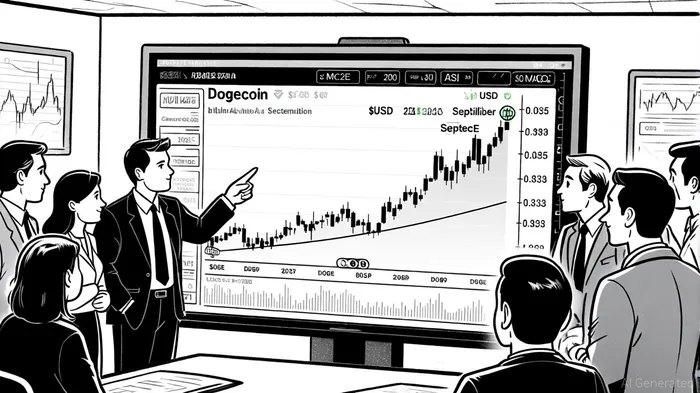
Dogecoin's price action in September 2025 has reinforced the bullish narrative. The coin broke above a long-term descending trendline resistance on September 12, a technical milestone that analysts interpret as a precursor to a potential $0.30 target[6]. This breakout coincided with a 6% weekly rally, pushing DOGE to $0.261—a level that aligns with the ascending channel and cup-and-handle patterns[2].
Key momentum indicators further validate this optimism. The Relative Strength Index (RSI) and Moving Average Convergence Divergence (MACD) have shown divergent signals: while RSI suggests moderate bullish momentum, MACD hints at lingering bearish pressure[4]. This tension reflects the market's struggle between retail optimism and institutional caution. Meanwhile, Bollinger Bands indicate tightening volatility, a pattern often preceding a breakout or breakdown[6]. Traders should monitor the $0.23 and $0.24 support levels, as a breach below these could reignite the downtrend[1].
Institutional Catalysts: The ETF Factor
The launch of the Rex-Osprey DOGE ETF (DOJE) on September 18 has added a new dimension to DOGE's narrative. With $8.7 million in net cash inflows in its first week[6], the ETF has attracted institutional capital while legitimizing DOGE as a tradable asset. This development mirrors the 2021 bull cycle, where ETF-like structures (e.g., Grayscale's GBTC) catalyzed retail adoption[3]. However, the ETF's success hinges on regulatory stability—a wildcard given the SEC's ongoing scrutiny of crypto products[2].
Strategic Entry Considerations
For momentum traders, the current environment presents a nuanced opportunity. Whale accumulation in late August and September, combined with the ETF's inflows, suggests a shift from retail-driven speculation to institutional-grade participation[2]. The key is to balance risk management with the potential for a $0.30–$0.35 price target.
- Entry Points: Aggressive traders may consider entries near the $0.25 support level, while conservative investors should wait for a retest of the $0.285 resistance after the recent consolidation[6].
- Stop-Loss Placement: A stop below $0.23 would mitigate downside risk, given the historical significance of this level[1].
- Position Sizing: Given DOGE's volatility, position sizes should be capped at 5–10% of a portfolio to manage exposure[4].
Conclusion
Dogecoin's whale activity and technical indicators paint a picture of a market at a crossroads. While bearish signals persist—such as reduced network activity and whale de-risking—the accumulation patterns and ETF momentum suggest a potential inflection point. For traders with a medium-risk appetite, strategic entries aligned with key support levels and whale-driven catalysts could yield outsized returns, provided they remain vigilant to regulatory and macroeconomic headwinds.





Comentarios
Aún no hay comentarios