
Why Dogecoin is Not a Sound Long-Term Crypto Investment
In the rapidly evolving world of cryptocurrencies, investors must distinguish between speculative assets and those with robust fundamentals. DogecoinDOGE-- (DOGE), once a viral sensation, has struggled to justify its long-term viability against established players like BitcoinBTC-- (BTC) and EthereumETH-- (ETH). This analysis examines why Dogecoin remains a high-risk, low-utility investment, even as it garners fleeting attention from social media hype and celebrity endorsements.
1. Fundamentals: Scarcity, Utility, and Institutional Adoption
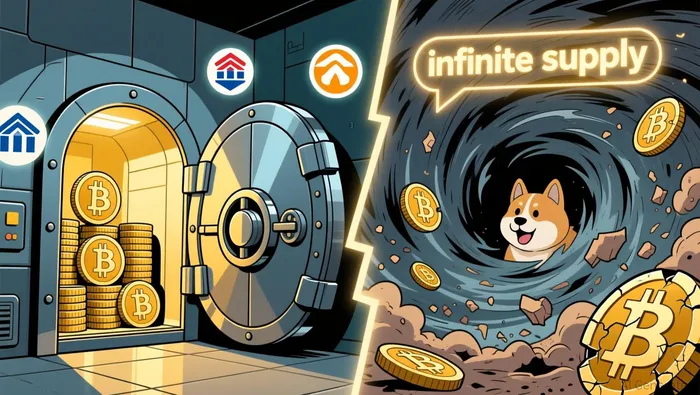
Dogecoin's core weaknesses lie in its lack of scarcity and real-world utility. Unlike Bitcoin, which has a capped supply of 21 million coins, Dogecoin's circulating supply has ballooned to 161.6 billion, eroding its value proposition as a store of value. Bitcoin's scarcity model has been a cornerstone of its institutional adoption, with over 172 public companies now holding BTCBTC-- in their portfolios. By contrast, Dogecoin's infinite supply and absence of tangible use cases leave it vulnerable to depreciation, especially as macroeconomic pressures intensify.
 Ethereum, meanwhile, has evolved into a foundational infrastructure for decentralized finance (DeFi) and smart contracts. Regulatory clarity, such as the U.S. GENIUS Act, has further solidified its role in institutional portfolios. Dogecoin, however, lacks both technological innovation and regulatory alignment, making it a poor candidate for long-term capital allocation.
2. Volatility and Speculative Drivers
Dogecoin's price movements in 2025 have been dictated by speculative forces rather than fundamental metrics. A 5% surge to $0.25 on September 11, 2025, was fueled by social media trends and political narratives, but the coin subsequently plummeted 68% from its one-year high. This erratic behavior contrasts sharply with Bitcoin's relative stability, which has seen growing institutional confidence amid regulatory advancements.
Celebrities like Elon Musk have historically driven short-term spikes in DOGE's price, but these gains are unsustainable. As one report notes, "Dogecoin's value remains heavily tied to virality, not technological underpinnings." In contrast, XRP-another meme-coin rival-has shown stronger utility as a bridge currency in Ripple's cross-border payment systems.
3. Institutional and Regulatory Tailwinds: The Gap Widens
Bitcoin and Ethereum are benefiting from a wave of institutional adoption and regulatory clarity. Bitcoin spot ETFs, already approved in 2025, have opened doors for institutional investors, while Ethereum's smart contract advancements position it as a backbone for tokenization and DeFi. Dogecoin, however, remains in a pending approval phase for similar products, limiting its appeal to large-scale investors.
Regulatory frameworks like the CLARITY Act for Ethereum and the GENIUS Act are creating a favorable environment for established cryptos, whereas Dogecoin's speculative nature makes it a poor fit for institutional portfolios. As Grayscale notes, "Institutional capital is flowing into assets with clear use cases and regulatory alignment-Dogecoin lacks both."
4. Long-Term Projections and Risk Assessment
While some analysts project Dogecoin could reach a $804.4 billion market cap by 2035, such forecasts ignore its structural weaknesses. Bitcoin, by contrast, is expected to surpass its all-time high in 2026, driven by macroeconomic tailwinds and institutional demand. Ethereum's price trajectory is similarly bolstered by its role in stablecoin infrastructure and cross-chain activity.
Dogecoin's reliance on social media virality and celebrity influence makes it inherently unstable. A 2025 market rally driven by Federal Reserve rate cut expectations saw Bitcoin surge past $111,000, while Dogecoin's price remained uncorrelated to broader macroeconomic trends. This disconnect underscores its speculative nature and lack of intrinsic value.
Conclusion: A Cautionary Tale for Investors
Dogecoin's appeal as a memeMEME-- coin may persist in the short term, but its lack of scarcity, utility, and institutional support renders it a poor long-term investment. Investors seeking exposure to crypto should prioritize assets like Bitcoin and Ethereum, which are backed by robust fundamentals, regulatory progress, and real-world adoption. For those considering alternatives to Dogecoin, XRPXRP-- offers a stronger case with its enterprise integrations and cross-border payment use cases. In a market increasingly dominated by institutional players, Dogecoin's speculative profile will likely keep it on the fringes of the crypto ecosystem.






Comentarios
Aún no hay comentarios