
Dogecoin's Price Trajectory: Whale Accumulation and ETF Inflows Signal Institutional Takeoff
The convergence of whale accumulation, institutional ETF inflows, and regulatory evolution is creating a compelling case for DogecoinDOGE-- (DOGE) as a strategic investment ahead of potential reclassification as a large-cap cryptocurrency. While DOGEDOGE-- remains a volatile asset, the interplay between on-chain behavior and institutional adoption suggests a maturing market structure that could catalyze a multi-fold price surge in 2025–2026.
Whale Activity: A Bullish On-Chain Signal
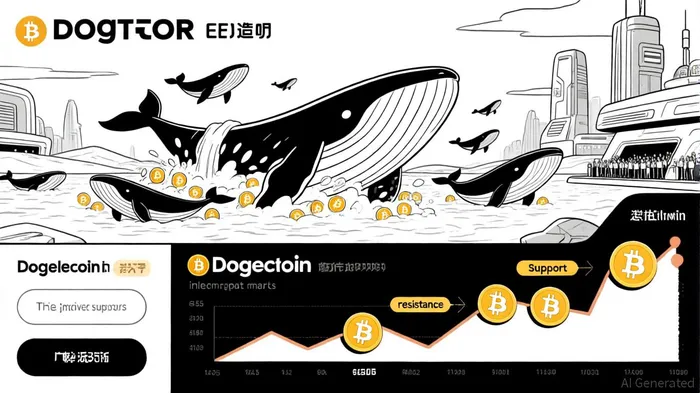
Dogecoin's whale activity in Q3 2025 has been nothing short of extraordinary. Large holders—those controlling 100 million to 1 billion DOGE—have accumulated an additional 2 billion units in recent weeks, bringing their total holdings to 29.16 billion DOGE (approximately 18% of the total supply) [1]. Smaller whale addresses (1 million–10 million DOGE) have added 158 million coins, further tightening liquidity and signaling long-term bullish sentiment [4].
This accumulation has occurred despite a 1% price dip and 25% drop in trading volumes, underscoring the resilience of large investors. For context, historical on-chain data reveals that similar whale-driven accumulation phases have preceded 20%+ price surges within days [1]. The current buildup reduces sell-side pressure, creating a supply squeeze that could drive prices higher once retail and institutional demand re-enters the market.
Institutional players are also deepening their exposure. Thumzup Media Corporation, for instance, invested $2 million to acquire 7.5 million DOGE and expanded into Dogecoin mining operations [3]. Such moves reflect growing confidence in DOGE's utility and scarcity narrative, even as its inflationary supply model (5 billion new coins annually) remains a structural headwind.
ETF Inflows: Institutional Legitimacy and Liquidity Boost
The launch of the first U.S. Dogecoin ETF (DOJE) by Rex-Osprey in September 2025 marked a watershed moment. The fund generated $17 million in inflows on its debut day, signaling robust institutional interest [4]. This follows Grayscale's filing to convert its Dogecoin Trust (GDOG) into a spot ETF on NYSE Arca, which would track the CoinDesk DOGE Reference Rate and provide broader accessibility to investors previously wary of memeMEME-- coins [1].
Other firms, including Bitwise, 21Shares, and Rex Shares, have submitted applications to the SEC, with 21Shares' ETF expected to receive a decision by January 9, 2026 [4]. Analysts estimate an 80% chance of approval for a Dogecoin ETF by early 2026, with potential inflows reaching $1.2 billion in the first month [3]. If realized, this would mirror the institutional inflows seen in BitcoinBTC-- and EthereumETH-- ETFs, which historically drove prices upward by 30–50% post-approval.
The SEC's recent streamlined approval process—reducing review periods from 270 to 75 days—has further accelerated momentum [4]. While the agency delayed decisions on DOGE and XRPXRP-- ETFs until June 2025, citing regulatory scrutiny, the broader shift toward generic listing standards for crypto ETFs suggests a more accommodating framework for large-cap assets [4].
Regulatory Reclassification: A Catalyst for Mainstream Adoption
Dogecoin's potential reclassification as a commodity rather than a security is gaining traction. The Commodity Futures Trading Commission (CFTC) reclassified DOGE under the CLARITY Act, allowing banks to offer custody services and reducing barriers for institutional investment [2]. This aligns with the SEC's 2025 guidance, which emphasizes tokens' utility and decentralization as key factors in determining securities status [5].
While DOGE's meme-driven origins and centralized marketing efforts (e.g., Elon Musk's social media influence) complicate its classification, its growing real-world utility—such as potential adoption on X (formerly Twitter) for microtransactions—strengthens its case for commodity status [2]. A successful reclassification would further legitimize DOGE as an investment-grade asset, attracting pension funds, hedge funds, and retail investors through ETFs.
Strategic Entry: Balancing Risks and Rewards
Despite the bullish fundamentals, risks persist. DOGE's inflationary supply model introduces structural dilution, and its price remains highly volatile (daily swings of 8.23% in Q2 2025) [2]. Additionally, macroeconomic headwinds—such as U.S. interest rate uncertainty or a broader crypto market correction—could dampen momentum.
However, the current landscape offers a compelling risk-reward profile. Whale accumulation has historically preceded sharp rallies, and ETF inflows are set to increase liquidity. With key resistance at $0.29 and support at $0.26, a breakout above $0.29 could trigger a 2x price surge to $0.50–$0.60, with long-term targets of $1.00 if ETFs gain approval [3].
For investors, the optimal entry point lies in strategic accumulation ahead of potential reclassification. The interplay between whale-driven scarcity, institutional inflows, and regulatory clarity suggests that DOGE is transitioning from a speculative meme coin to a legitimized asset class—a shift that could redefine its price trajectory in the coming months.






Comentarios
Aún no hay comentarios