
Dogecoin's Price Trajectory: ETF-Driven Institutional Adoption and Market Sentiment
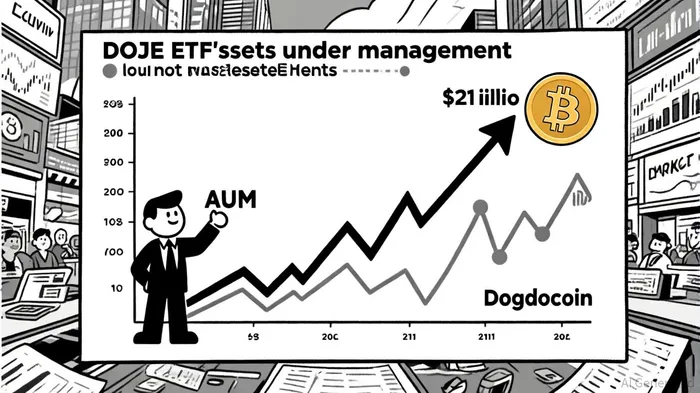
The launch of the REX-Osprey DOGEDOGE-- ETF (DOJE) on September 18, 2025, marked a watershed moment for DogecoinDOGE-- (DOGE) and the broader cryptocurrency market. As the first U.S.-listed spot ETF offering direct exposure to Dogecoin, DOJE's debut generated $17 million in trading volume on its first day, signaling robust retail and institutional interest [2]. By September 26, 2025, the ETF had crossed $21 million in assets under management (AUM), despite a challenging macroeconomic environment and Dogecoin's 2% price dip in the 24 hours following the launch [4]. This trajectory underscores a critical shift in market dynamics: Dogecoin is no longer a speculative memeMEME-- coin but a legitimate asset class attracting regulated institutional capital.
ETF-Driven Institutional Adoption: A New Paradigm
The DOJE ETF's rapid AUM growth reflects a broader trend of institutional adoption in the crypto space. While BitcoinBTC-- and EthereumETH-- ETFs have dominated headlines, DOJE's success demonstrates that altcoins are now being evaluated through the same institutional lens. The ETF's 1.5% expense ratio—higher than Bitcoin and Ethereum ETFs—highlights the risks associated with Dogecoin's volatility and lower liquidity [2]. Yet, the fact that investors are willing to pay a premium for regulated exposure suggests growing confidence in the asset's utility and governance framework.
Institutional participation is further evidenced by the ETF's structure. DOJE operates under the Investment Company Act of 1940 and uses a Cayman subsidiary to hold Dogecoin, navigating U.S. regulatory complexities without direct custody of the asset [5]. This framework appeals to traditional investors seeking compliance with securities laws while accessing a high-growth, meme-driven market. Analysts note that sustained inflows into DOJE could catalyze a feedback loop: increased institutional demand may stabilize Dogecoin's price, attracting further capital and reinforcing its legitimacy [3].
Market Sentiment and Price Trajectory
Dogecoin's price movement post-DOJE launch reveals a nuanced interplay between short-term volatility and long-term optimism. While the 2% dip in the first 24 hours was attributed to profit-taking and regulatory uncertainty [4], on-chain data indicates accumulation by long-term holders. This suggests that the ETF's launch has shifted market sentiment from speculative trading to strategic investment.
The DOJE ETF's AUM growth also correlates with Dogecoin's price recovery. By September 26, DOGE had rebounded to $0.2963, a 38% increase over the preceding week [6]. This surge coincided with DOJE's $21 million AUM milestone, illustrating how ETF-driven demand can decouple altcoin prices from broader market trends. The ETF's role as a regulated vehicle for Dogecoin exposure has reduced barriers for institutional investors, who previously avoided the asset due to liquidity concerns and regulatory ambiguity [5].
Broader Implications for Crypto Legitimacy
DOJE's success is a harbinger of broader crypto legitimacy. The SEC's recent generic listing standards for crypto spot ETFs enabled DOJE's approval, paving the way for similar products from firms like Grayscale, Bitwise, and 21Shares [4]. This regulatory clarity is critical for mainstream adoption, as it signals that crypto assets can coexist with traditional financial systems.
Moreover, DOJE's performance highlights the growing appetite for diversified crypto exposure. While Bitcoin and Ethereum ETFs dominate headlines, altcoin ETFs like DOJE offer investors a way to capitalize on niche markets with higher growth potential. This diversification is particularly appealing in a low-yield environment, where investors seek assets with asymmetric upside.
A Compelling Case for Near-Term Bullish Positioning
For investors, the DOJE ETF's trajectory presents a compelling case for near-term bullish positioning in Dogecoin. The ETF's AUM growth, coupled with Dogecoin's price recovery, indicates that the market is beginning to price in institutional demand. Historical precedents—such as Bitcoin's post-ETF rally—suggest that sustained inflows into DOJE could drive DOGE's price higher, especially if additional Dogecoin ETFs gain approval.
However, risks remain. Dogecoin's volatility and the ETF's high expense ratio could deter conservative investors. Additionally, macroeconomic factors like interest rate hikes or regulatory shifts could dampen enthusiasm. That said, the DOJE ETF's launch has already altered the narrative around Dogecoin, transforming it from a meme coin to a regulated asset with institutional backing.
Conclusion
The DOJE ETF's rapid AUM growth and Dogecoin's subsequent price recovery signal a pivotal moment in crypto history. By bridging the gap between meme-driven speculation and institutional-grade investment, DOJE has demonstrated that altcoins can achieve legitimacy through regulated innovation. For investors, this trend offers a unique opportunity to participate in a market that is both high-growth and increasingly resilient. As the crypto ecosystem evolves, Dogecoin's journey—from internet joke to ETF-listed asset—serves as a testament to the transformative power of institutional adoption.






Comentarios
Aún no hay comentarios