
Dogecoin's Price Trajectory: Decoding Accumulation Dynamics and ETF Catalysts
The Accumulation Play: On-Chain Signals Point to Institutional Confidence
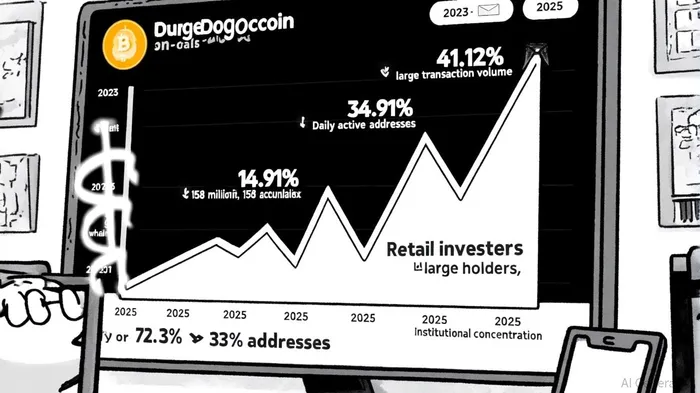
Dogecoin's on-chain activity in 2025 reveals a compelling narrative of accumulation and adoption. Large transaction volume surged by 41.12% in the past month, signaling strategic moves by major holders—often interpreted as a precursor to price action [1]. Simultaneously, daily active addresses rose 34.91%, reflecting growing retail participation and network utility [1]. Whale accumulation has been particularly striking: over 1 billion DOGEDOGE-- were added to large wallets in the past month, with total holdings now exceeding 25.97 billion DOGE [2]. This concentration, while raising red flags for decentralization purists, suggests institutional positioning for a potential upside.
The retail base remains robust, with 72.3% of all DogecoinDOGE-- addresses holding less than 10,000 DOGE [2]. This dynamic creates a unique equilibrium: retail demand fuels grassroots adoption, while whale accumulation hints at a looming supply squeeze. Historical patterns indicate that such accumulation phases often precede bull cycles, as short-term holders (STHs) begin to accumulate ahead of price inflection points [3].
ETF Catalysts: Regulatory Hurdles and Institutional Inflows
The U.S. Securities and Exchange Commission (SEC) has been both a gatekeeper and a wildcard for Dogecoin's institutional future. The Rex-Osprey Dogecoin Trust (DOJE), launched on September 18, 2025, marked the first U.S. Dogecoin ETF under the streamlined 1940 Act framework, bypassing traditional approval hurdles [4]. While DOJE's derivative-based structure limits direct liquidity effects on the spot price, its $17 million first-day trading volume signaled strong institutional curiosity [4].
However, regulatory uncertainty persists. The SEC delayed Bitwise's Dogecoin ETF application until November 2025, citing concerns over volatility and market manipulation [5]. This cautious approach reflects broader skepticism toward meme coins, yet the mere existence of pending applications from Bitwise, Grayscale, and 21Shares underscores growing institutional interest [5]. Analysts project four to five Dogecoin ETFs by year-end, which could collectively enhance liquidity and stabilize price swings [4].
Historical Precedents: ETF Approvals and Price Surges
The BitcoinBTC-- and EthereumETH-- ETF approvals of 2024 offer a blueprint for Dogecoin's potential trajectory. Institutional inflows into Bitcoin ETFs alone added $20 billion in liquidity, propelling BTCBTC-- to all-time highs [6]. For Dogecoin, the stakes are higher: its market cap is a fraction of Bitcoin's, making it more susceptible to ETF-driven volatility. If DOJE attracts even 10% of Bitcoin ETF inflows, DOGE could breach $0.10 by year-end, with $0.34–$0.50 targets emerging in 2026 [4].
Yet challenges remain. Derivative-based ETFs like DOJE do not directly increase demand for spot DOGE, capping immediate price momentum. Additionally, high expense ratios (1.5% for DOJE) may deter cost-sensitive investors [4]. The true test will be whether subsequent ETFs adopt a physical-backed model, directly purchasing DOGE and creating a supply-demand imbalance.
The Road Ahead: Accumulation Meets Regulation
Dogecoin's price trajectory hinges on two forces: whale accumulation and ETF-driven institutional adoption. On-chain metrics suggest a market primed for a breakout, with whales and STHs aligning behind a long-term bullish narrative [3]. Meanwhile, the SEC's regulatory pendulum swings between innovation and caution, with ETF approvals likely to catalyze a shift from meme-coin stigma to institutional legitimacy.
For investors, the key is to balance optimism with pragmatism. While DOGE's retail base and social media-driven hype remain its lifeblood, the emergence of regulated investment vehicles could transform its volatility into a feature, not a bug. As one analyst put it, “Dogecoin is no longer just a joke—it's a test case for how the SEC will handle the next generation of crypto assets” [4].






Comentarios
Aún no hay comentarios