
Dogecoin Price Prediction: Decoding Institutional Buying Amid Upcoming Mining Halving
The cryptocurrency market in 2025 has witnessed a seismic shift in sentiment toward DogecoinDOGE-- (DOGE), driven by a confluence of institutional accumulation, speculative fervor, and protocol-level changes. While Bitcoin's halving event dominates mainstream narratives, Dogecoin's unique trajectory—shaped by a proposed block reward reduction and growing institutional interest—has positioned it as a compelling case study in sentiment-driven price dynamics.
Institutional Buying: A New Era for DOGE
Institutional participation in Dogecoin has surged in 2025, with major players signaling confidence in its long-term viability. CleanCore Solutions, a publicly traded company, expanded its DOGEDOGE-- holdings to over 500 million tokens, a move analysts interpret as a strategic bet on the asset's utility and price potential [1]. This accumulation coincides with broader market optimism, as prediction markets now assign an 80% probability to the approval of a U.S.-listed Dogecoin ETF, a milestone that could unlock billions in institutional capital [2].
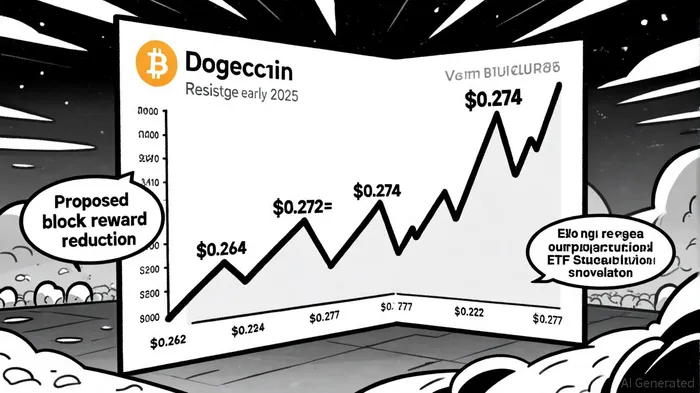
The surge in institutional buying is notNOT-- merely speculative. Dogecoin's recent price rally—up over 29% in early 2025—has been accompanied by a tripling of trading volume, suggesting coordinated accumulation rather than retail-driven hype [2]. Technical indicators further reinforce this narrative: consolidation above $0.264 has set the stage for a potential test of the $0.272–$0.277 range, with analysts eyeing a $1 price target if institutional inflows persist [5].
Historical data reveals that DOGE's price behavior around resistance levels has historically favored buyers. Since 2022, there have been 13 instances where DOGE tested major resistance levels, with the asset outperforming a buy-and-hold benchmark in both frequency and magnitude. On average, DOGE delivered a cumulative return of approximately 63% over 30 days post-test, compared to just 5% for the benchmark. Win rates remained above 60% on most days, peaking above 75% during the first 12 days after the event [6]. These findings suggest that institutional buying and technical momentum may create a self-reinforcing cycle, where resistance levels act as catalysts for further price appreciation.
The “Halving” Conundrum: Protocol Changes as a Price Catalyst
Unlike BitcoinBTC--, Dogecoin lacks a built-in halving mechanism. However, a proposed GitHub initiative (Discussion #3776) seeks to reduce block rewards from 10,000 to 1,000 DOGE per block, slashing annual issuance from 5 billion to 500 million tokens [1]. This adjustment, if implemented, would mimic the inflationary tightening seen in Bitcoin's halving cycles, potentially triggering a re-rating of DOGE's value proposition.
The proposal's implications are twofold. First, it aims to align Dogecoin with broader blockchain trends of sustainable inflation models, addressing concerns about its infinite supply [1]. Second, it could disrupt miner economics: lower block rewards may force smaller operations to exit the network unless the DOGE price compensates for reduced earnings [4]. This dynamic mirrors Bitcoin's post-halving volatility, where supply constraints often precede price surges.
Critically, the proposed change is not a hard fork but a soft transition requiring community consensus. While developers and Elon Musk have endorsed fee-reduction initiatives (lowering transaction costs from 1 DOGE to 0.01 DOGE), the block reward adjustment remains pending [3]. This uncertainty introduces a layer of risk, as adoption hinges on whether miners and node operators accept the new parameters.
Technical Upgrades: From MemeMEME-- to Monetary Infrastructure
Beyond institutional buying and supply-side changes, Dogecoin's technical roadmap is reshaping its narrative. The integration of zero-knowledge proof (ZKP) technology, announced in late 2025, promises enhanced privacy and scalability, positioning DOGE as a viable platform for DeFi and identity verification [2]. Simultaneously, fee reductions—targeting 0.01 DOGE per transaction—aim to cement its role in everyday commerce, such as microtransactions for coffee or tipping [3].
These upgrades are not merely aspirational. Dogecoin's merge mining with LitecoinLTC-- (using the Scrypt algorithm) has already attracted industrial-scale miners, while alternative mining methods (e.g., Bitcoin mining with DOGE payouts) have emerged to offset rising energy costs [4]. For most retail users, however, mining remains uneconomical, shifting the focus to institutional and protocol-driven value creation.
Risks and Realities
Despite the bullish momentum, Dogecoin's inflationary supply model remains a double-edged sword. Even with the proposed 500 million annual issuance, DOGE's inflation rate (0.33%) is significantly higher than Bitcoin's post-halving 1.8% [1]. This could deter value investors prioritizing scarcity, though proponents argue that the reduced issuance still represents a meaningful step toward scarcity.
Moreover, the asset's price is highly exposed to broader market volatility. A correction in risk assets or regulatory headwinds could swiftly reverse the current optimism. Analysts caution that while institutional buying and protocol upgrades provide a strong foundation, DOGE's $1 target hinges on sustained adoption and infrastructure improvements [4].
Conclusion: A Meme Coin's Metamorphosis
Dogecoin's 2025 trajectory reflects a broader shift in the cryptocurrency landscape: from speculative memes to institutional-grade assets. The interplay of institutional accumulation, protocol-level changes, and technical upgrades has created a self-reinforcing cycle of demand and utility. While the absence of a traditional halving introduces uncertainty, the proposed block reward reduction and fee cuts are functionally analogous to Bitcoin's scarcity-driven events.
For investors, the key question is whether these developments can sustain DOGE's momentum beyond the current hype cycle. If institutional buying continues and the community adopts the proposed changes, Dogecoin may yet transcend its origins as a joke coin and establish itself as a serious contender in the monetary infrastructure space.






Comentarios
Aún no hay comentarios