
Dogecoin's Institutional Inflection Point: Technical Catalysts and ETF-Driven Momentum in 2025
Dogecoin (DOGE) has long been a symbol of crypto's chaotic charm, but 2025 marks a pivotal shift toward institutional legitimacy. With the launch of the first U.S. spot DogecoinDOGE-- ETF (DOJE) and a surge in whale accumulation, the memeMEME-- coin is now navigating a landscape where technical indicators and institutional capital converge. This analysis examines the interplay of technical catalysts, institutional buying signals, and momentum strategies shaping DOGE's trajectory.
Technical Catalysts: Consolidation and Breakout Potential
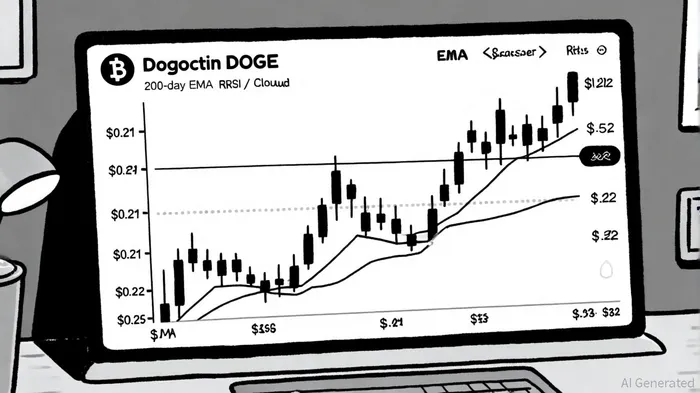
Dogecoin is currently consolidating within a $0.21–$0.22 range, supported by a 150% spike in trading volume and a market cap of $31.69 billion [1]. Key technical indicators suggest a critical juncture:
- Relative Strength Index (RSI): At 45, the RSI remains neutral, avoiding overbought/oversold extremes but hinting at potential rebounds [1].
- Moving Averages: The price recently crossed above the 200-day EMA, a bullish signal for long-term buyers [2].
- Ichimoku Cloud: The Tenkan-sen (conversion line) has crossed above the Kijun-sen (base line) on the 4-hour chart, reinforcing short-term bullish momentum. The Chikou Span (lagging span) remains above the price curve, further supporting upward bias [3].
If DOGEDOGE-- holds the $0.21 support level, it could target $0.34 resistance, with a longer-term projection near $0.75 under favorable conditions like ETF approval [1]. However, a breakdown below $0.21 could trigger a pullback to $0.13, prolonging consolidation.
Institutional Buying: ETFs and Whale Accumulation
The September 18, 2025, launch of the DOJE ETF—managed by Rex Financial and Osprey Funds—has been a game-changer. This ETF, which holds at least 80% of its assets in Dogecoin or related instruments, recorded $17 million in trading volume on its debut [4]. Its 1.5% expense ratio, while higher than BitcoinBTC-- and EthereumETH-- ETFs, reflects the niche nature of Dogecoin and the regulatory hurdles overcome to bring it to market [4].
Institutional interest is further evidenced by CleanCore Solutions' accumulation of 500 million DOGE tokens ($125 million), paired with partnerships to integrate Dogecoin into payment systems [2]. These moves signal growing confidence in DOGE's utility beyond speculative trading.
Momentum Strategies: EMA and Ichimoku-Driven Entries
Momentum traders are leveraging EMA crossovers and Ichimoku signals to capitalize on DOGE's volatility. The 50-day and 200-day EMA lines currently act as dynamic support/resistance levels, with immediate support at $0.11996 and resistance at $0.20355 [3]. A breakout above $0.273 could validate the uptrend, while a failure to hold this level might trigger a retest of $0.21.
The Ichimoku Cloud's bullish setup—trading above the Kumo (cloud) and a positive Tenkan-Kijun crossover—suggests continued buyer dominance. However, the ADX (Average Directional Index) remains below 20, indicating a weak trend and the need for stronger volume to confirm a breakout [3].
Risks and Considerations
Despite bullish signals, risks persist:
- Regulatory Uncertainty: While the SEC's new generic listing standards have fast-tracked ETF approvals, future policy shifts could disrupt momentum [4].
- Competition: Emerging meme coins like Shiba InuSHIB-- and Dogelon Mars pose threats to DOGE's market share [5].
- Supply Dynamics: Dogecoin's unlimited supply remains a fundamental headwind, contrasting with Bitcoin's scarcity model [5].
Conclusion
Dogecoin stands at a crossroads. Technical indicators and institutional adoption suggest a potential breakout, but execution will depend on holding key support levels and navigating regulatory risks. For traders, a disciplined approach—using EMA crossovers and Ichimoku signals to time entries—could capitalize on DOGE's volatility. Meanwhile, the DOJE ETF's performance will be a litmus test for broader institutional acceptance. As the line between meme and mainstream blurs, Dogecoin's journey in 2025 could redefine altcoin investing.






Comentarios
Aún no hay comentarios