
Is Dogecoin's Institutional Adoption the Key to Long-Term Legitimacy?
Dogecoin (DOGE) has long been dismissed as a “meme coin,” its value tethered to social media hype and celebrity endorsements. Yet, 2025 has witnessed a seismic shift: institutional adoption and regulatory clarity are reshaping its narrative. The question now is whether these developments can transform DOGEDOGE-- into a legitimate, sustainable asset or if its inherent volatility and structural limitations will undermine its potential.
Institutional Adoption: A New Foundation
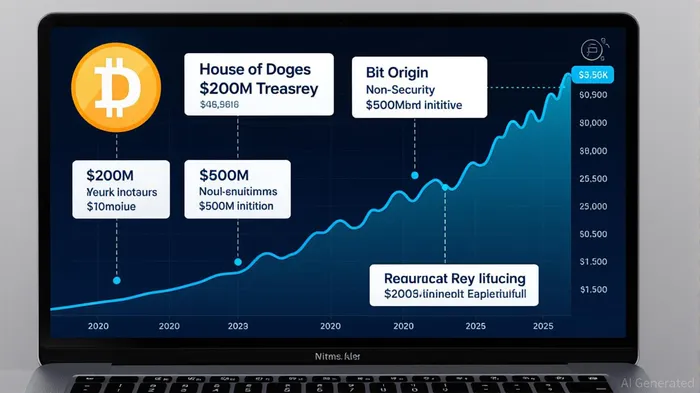
The House of Doge’s $200 million treasury, spearheaded by Elon Musk’s attorney Alex Spiro, marks a pivotal step in institutionalizing DOGE. By offering indirect exposure through a publicly traded company, this initiative reduces custody and regulatory risks, making DOGE more palatable to institutional investors [1]. Similarly, Bit Origin’s $500 million DogecoinDOGE-- treasury underscores growing confidence in the token’s utility, particularly as a medium for real-world transactions [2]. These moves mirror Bitcoin’s institutional ascent in 2024, where ETF approvals catalyzed billions in inflows.
Regulatory clarity has further accelerated adoption. The U.S. SEC’s 2025 ruling classifying DOGE as a non-security, coupled with the CFTC’s commodity designation, has lowered barriers for asset managers. Grayscale and Bitwise’s pending DOGE ETF applications—projected to gain approval by late 2025 with a 60–70% probability—could unlock billions in institutional capital [3]. Such developments align with Bitcoin’s trajectory, where regulatory certainty reduced its annualized volatility from 60% in 2015 to 30% by 2025 [4].
Price Sustainability and Volatility: A Delicate Balance
While institutional purchases and whale accumulation have stabilized DOGE’s price, its volatility remains a double-edged sword. Whale accumulation of over 2.3 billion tokens and $100 million in institutional purchases since July 2025 have created a price floor, mitigating retail-driven swings [1]. However, DOGE’s infinite supply model and lack of smart contract capabilities—unlike Ethereum’s deflationary supply or Solana’s high-performance infrastructure—pose structural risks [5].
Comparative analysis reveals stark contrasts. Bitcoin’s institutional adoption and regulatory clarity have transformed it into a high-beta asset with volatility akin to tech stocks. In contrast, DOGE’s annualized volatility of 128% in 2025 [6] reflects its reliance on social media sentiment and macroeconomic factors. For instance, a 200% rally in November 2024 was followed by a 65% correction by August 2025, underscoring its susceptibility to speculative cycles [7].
Challenges and Opportunities
Dogecoin’s path to legitimacy is not without hurdles. Its infinite supply model, unlike Bitcoin’s capped 21 million, raises concerns about long-term value retention. Additionally, the absence of protocol-level innovation—such as Solana’s 65,000 TPS or Ethereum’s staking yields—limits its appeal to yield-seeking investors [5].
Yet, DOGE’s real-world integrations offer a unique edge. Partnerships with X (formerly Twitter) and AMCAMC-- Theatres, coupled with green mining initiatives, align with ESG priorities and broaden its utility [1]. The potential approval of a DOGE ETF could further legitimize it as a mainstream asset, potentially pushing its price to $0.29–$0.80 by year-end 2025 [2].
Conclusion: A Legitimate Asset or a Speculative Mirage?
Dogecoin’s institutional adoption and regulatory clarity are undeniably transformative. However, its long-term legitimacy hinges on overcoming volatility and structural limitations. While BitcoinBTC-- and SolanaSOL-- have leveraged institutional interest to achieve price stability and utility, DOGE’s reliance on social media virality and speculative demand leaves it vulnerable.
For investors, the key lies in balancing optimism with caution. If DOGE’s ecosystem continues to evolve—through DeFi integration, improved infrastructure, and sustained institutional inflows—it could carve out a niche as a utility-driven asset. But until then, its journey remains a high-risk, high-reward proposition.
Source:
[1] The Institutionalization of Dogecoin: A Legitimate Asset [https://www.ainvest.com/news/institutionalization-dogecoin-legitimate-asset-class-making-2508/]
[2] The Institutionalization of Dogecoin: A Strategic Play on [https://www.ainvest.com/news/institutionalization-dogecoin-strategic-play-memecoin-legitimacy-investor-appetite-2508/]
[3] Regulatory Clarity and Institutional Adoption: The Catalysts [https://www.ainvest.com/news/regulatory-clarity-institutional-adoption-catalysts-dogecoin-long-term-price-appreciation-2508/]
[4] The impact of regulation on cryptocurrency market volatility [https://www.sciencedirect.com/science/article/abs/pii/S031359262300200X]
[5] Solana vs. Dogecoin: Evaluating Institutional Adoption and [https://www.ainvest.com/news/solana-dogecoin-evaluating-institutional-adoption-long-term-viability-2025-2508/]
[6] Dogecoin 2025: Opportunities, Risks & Trading Guide [https://phemex.com/blogs/dogecoin-2025-trading-opportunities-risks]
[7] Can Dogecoin Survive the Post-2025 Crypto Market [https://www.ainvest.com/news/dogecoin-survive-post-2025-crypto-market-assessing-long-term-viability-meme-coins-2508-71]






Comentarios
Aún no hay comentarios