
Dogecoin's Institutional Adoption and ETF-Driven Price Surge: Strategic Implications of the REX-Osprey DOJE ETF Launch for Investors
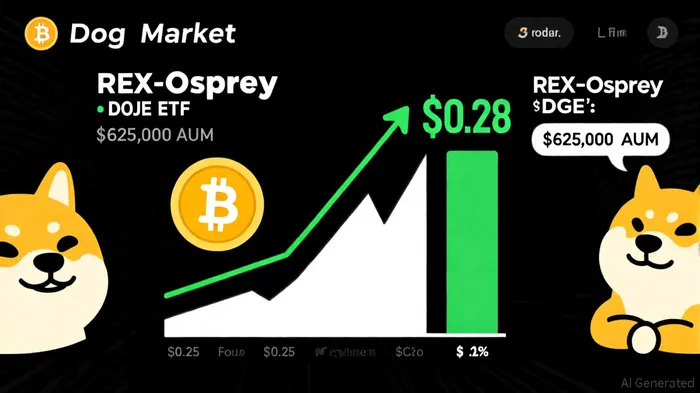
The launch of the REX-Osprey DOGEDOGE-- ETF (DOJE) on September 18, 2025, marks a pivotal moment in the institutionalization of memeMEME-- coins. As the first U.S.-listed ETF to offer direct exposure to DogecoinDOGE-- (DOGE), DOJE has notNOT-- only redefined access to the cryptocurrency but also catalyzed a 12% price surge in DOGE within days of its debut[2]. This development underscores a broader shift in how institutional and retail investors are navigating the evolving crypto landscape, leveraging structured products to mitigate regulatory and operational risks while capitalizing on speculative opportunities.
Regulatory Innovation and Structural Design
DOJE's structure under the Investment Company Act of 1940, combined with a Cayman Islands subsidiary to hold DOGE positions, represents a strategic workaround to U.S. regulatory constraints[1]. By allocating at least 80% of its assets to DOGE or related instruments like futures and swaps, the ETF provides a regulated vehicle for investors to gain exposure to a cryptocurrency that originated as a joke but has since attracted a cult-like following. The fund's 1.5% expense ratio and cold storage of DOGE holdings further enhance its appeal to risk-averse investors seeking transparency[1].
This regulatory innovation aligns with the broader trend of crypto ETF approvals, following the success of BitcoinBTC-- and EthereumETH-- ETFs in 2024 and 2025[6]. Analysts argue that DOJE's launch signals a maturation of the crypto market, where institutional-grade infrastructure is increasingly bridging the gap between speculative assets and mainstream finance[5].
Market Impact and Investor Sentiment
The immediate market response to DOJE's launch was striking. DOGE's price climbed to $0.28, a 12% increase, driven by heightened demand from both retail and institutional participants[4]. On-chain data revealed a 15% surge in transaction volumes and whale activity, while social media mentions of DOGE spiked by 25%[2]. These metrics highlight the ETF's role in amplifying liquidity and legitimizing DOGE as an investable asset class.
Retail investors, in particular, have embraced DOJE as a low-barrier entry point into crypto. With an initial net asset value (NAV) of $25 and $625,000 in assets under management (AUM) at launch[1], the ETF democratizes access to DOGE without requiring users to navigate the complexities of cryptocurrency exchanges. Meanwhile, institutional investors are leveraging DOJE to hedge against market volatility or diversify portfolios with a high-beta asset[5].
Strategic Implications for Investors
For retail investors, DOJE offers a regulated, liquid alternative to direct crypto ownership. The ETF's structure reduces counterparty risks and simplifies compliance with U.S. tax reporting requirements, which are notoriously complex for individual crypto holdings[1]. However, the 1.5% expense ratio may deter cost-sensitive investors, particularly in a low-interest-rate environment where returns must outpace fees[3].
Institutional investors, on the other hand, are using DOJE to capitalize on DOGE's growing institutional adoption. The fund's cold storage model and adherence to 1940 Act governance standards address concerns about custody and regulatory scrutiny[1]. Additionally, DOJE's success builds on the momentum of REX-Osprey's SolanaSOL-- staking ETF (SSK), which amassed $275 million in AUM[4], demonstrating the firm's ability to scale crypto-focused products.
Future Outlook and Risks
While DOJE's launch has been a resounding success, its long-term viability depends on sustained investor demand and regulatory stability. Analysts predict that the ETF could generate $2.5 million in trading volume on its first day[2], but this figure must be sustained to justify its expense ratio. Risks include regulatory pushback, market volatility, and competition from other crypto ETFs.
The broader market is also watching closely. If DOJE achieves $1 billion in AUM—a threshold often linked to ETF sustainability—it could pave the way for similar products in other meme coins or altcoins[5]. This would further cement the role of ETFs in mainstream crypto adoption, mirroring the trajectory of Bitcoin and Ethereum.
Conclusion
The REX-Osprey DOJE ETF represents more than a novel investment vehicle; it is a harbinger of how institutional infrastructure is reshaping the crypto market. By providing a regulated, liquid, and accessible pathway to DOGE, DOJE has not only driven a price surge but also redefined the strategic calculus for both retail and institutional investors. As the market evolves, the success of DOJE will likely influence regulatory frameworks and investor behavior, solidifying Dogecoin's place in the mainstream financial ecosystem.






Comentarios
Aún no hay comentarios