
Dogecoin's Bullish Momentum and the Memecoin Index: Assessing Investment Merit in a Risk-On Climate
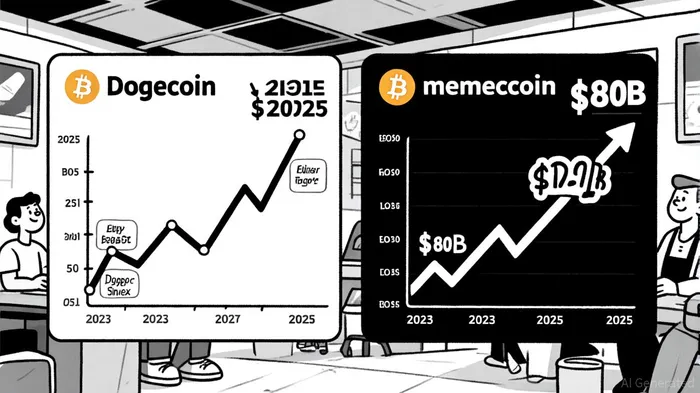
The cryptocurrency market in 2025 has witnessed a paradigm shift in risk appetite, with memecoins emerging as both a barometer and catalyst for speculative fervor. DogecoinDOGE-- (DOGE), the flagship memecoinMEME--, now trades in a critical consolidation phase just below $0.28—a level that has tested supply multiple times, signaling weakening resistance and a potential breakout toward $0.34[1]. This technical structure, coupled with a broader memecoin index surging toward $80 billion in market capitalization, raises compelling questions about the investment merit of these assets in a risk-on environment.
Dogecoin's Technical Foundation: A Case for Cautionary Optimism
Dogecoin's price action in 2025 reflects a textbook accumulation phase. Higher lows and consistent volume inflows have reinforced a bullish bias, with the Ichimoku cloud forming a robust support zone around $0.24770[4]. The Kijun-sen line, currently at $0.24770, acts as a dynamic support, while the Kumo cloud provides a broader safety net. Crucially, the Ichimoku score of +4 across multiple timeframes underscores a strong uptrend[4].
Institutional validation has further bolstered this narrative. The launch of the first U.S. Dogecoin ETF (DOJE) in early 2025 triggered record inflows, with open interest in DOGEDOGE-- futures reaching $6 billion—the highest since January 2025[2]. Analysts argue that a clean breakout above $0.28 could catalyze a move toward $0.34 and, eventually, $0.54, a level that would redefine Dogecoin's role in the crypto ecosystem[2]. However, this optimism is tempered by structural risks. A drop below $0.26 could invalidate the bullish case, while competition from emerging memecoins offering DeFi utility and higher yield opportunities poses a long-term threat[4].
Historical backtesting of this breakout strategy reveals critical insights. Since 2022, only one qualifying breakout above $0.28 has occurred, resulting in a modest positive return but with a weak Sharpe ratio of approximately 0.15 and a peak drawdown of ~18%[2]. These results highlight the strategy's limited sample size and high volatility, underscoring the importance of risk controls such as stop-loss or take-profit levels to mitigate potential losses[2].
The Memecoin Index: A Sector-Wide Rally or a Bubble Waiting to Burst?
The memecoin index's ascent from $20 billion in 2023 to $80 billion in 2025 reflects a broader shift in investor sentiment. Tokens like PepePEPE-- (PEPE) and DogwifhatWIF-- (WIF) have demonstrated extreme volatility, with PEPE surging 7,000% in 17 days in 2023 and WIFWIF-- reaching a $4.5 billion market cap post-Binance listing[1]. This volatility is driven by social media hype and FOMO, but recent developments suggest a maturation of the sector.
Scalable blockchain infrastructure, such as SolanaSOL-- and Base, has reduced transaction costs and increased throughput, enabling high-frequency trading[3]. Platforms like Pump.fun and Moonshot have further democratized access, attracting retail investors with user-friendly interfaces. In Q3 2025, on-chain data revealed a rebound in memecoin activity, with Shiba InuSHIB-- (SHIB) seeing a surge in active traders—a sign of renewed retail engagement[1]. However, this resurgence is shadowed by caution. Trading volumes collapsed by over 90% in early 2025 following the LIBRA scandal and regulatory scrutiny[3], highlighting the sector's susceptibility to external shocks.
Risk-On Dynamics: Macroeconomic Tailwinds and Institutional Involvement
The current risk-on environment, characterized by lower interest rates and reduced inflation, has amplified speculative flows into memecoins. As global economic conditions improve, investors are increasingly allocating capital to high-risk, high-reward assets[2]. This trend is further amplified by the proliferation of scalable blockchain networks and the emergence of sophisticated trading patterns from institutional players[3].
Notably, on-chain analysis reveals obscured wallets and strategic trading activity, suggesting that institutions are beginning to recognize memecoins' strategic value despite public skepticism[2]. However, the average memecoin position lasts only 13.4 days, underscoring the dominance of short-term speculation[2]. This dynamic positions memecoins as a unique outlet for risk appetite but raises concerns about sustainability.
Risks and Structural Challenges
While the technical and macroeconomic outlooks are bullish, several risks loom large. First, Dogecoin's proposed block reward reduction from 10,000 to 1,000 DOGE annually could impact miner incentives and network security, though it may enhance long-term scarcity[4]. Second, regulatory uncertainty remains a wildcard. The LIBRA scandal and subsequent enforcement actions have demonstrated how swiftly sentiment can shift in response to compliance risks[3].
Moreover, the rise of utility-driven memecoins—those integrating DeFi protocols or metaverse applications—threatens Dogecoin's dominance. These projects offer not just speculative appeal but functional use cases, potentially diverting capital from traditional memecoins[4].
Conclusion: Balancing Hype and Fundamentals
Dogecoin's bullish technical structure and the memecoin index's momentum present a compelling case for risk-on investors. However, the sector's inherent volatility, regulatory exposure, and competitive landscape demand a cautious approach. For those willing to navigate these risks, the current environment offers an opportunity to capitalize on a market that is both speculative and structurally evolving.
As the line between internet humor and financial innovation blurs, investors must weigh the potential for exponential gains against the reality of sudden corrections. In this high-stakes arena, due diligence and risk management remain paramount.






Comentarios
Aún no hay comentarios