
Dogecoin 2025: Political Controversy, Corporate Adoption, and the Road to 2026 Utility
In 2025, DogecoinDOGE-- (DOGE) has navigated a turbulent landscape marked by political entanglements, regulatory scrutiny, and a shifting narrative from speculative hype to real-world utility. Once a meme-based cryptocurrency propelled by social media fervor, DOGEDOGE-- now faces the dual challenges of distancing itself from its association with Elon Musk and proving its viability as a functional digital asset. This analysis examines how political controversies, corporate adoption, and ecosystem innovations are reshaping DOGE's identity-and whether it can deliver long-term value in a post-Musk era.
Political Controversies and the Shadow of Musk
Dogecoin's 2025 trajectory was inextricably linked to Elon Musk's Department of Government Efficiency (DOGE), a Trump administration initiative aimed at reducing federal spending. Musk's public role as the face of DOGE-a name and acronym that coincidentally mirrored the cryptocurrency-created confusion among the public and investors. When the Dogecoin logo briefly appeared on the DOGE website, the price surged, only to plummet after the logo was removed amid backlash and legal challenges accusing the initiative of operating as an illegal federal advisory committee.
This conflation of Musk's political project with the cryptocurrency exposed DOGE to regulatory and reputational risks. While the U.S. Securities and Exchange Commission (SEC) did not classify Dogecoin as a security-a decision that initially buoyed market sentiment-regulatory uncertainty persisted. The SEC's extended review of the Bitwise Dogecoin ETF and Grayscale Hedera ETF underscored the agency's cautious approach, leaving investors in limbo. Meanwhile, stricter KYC/AML policies on major exchanges reduced accessibility for traders in certain regions, further complicating DOGE's market dynamics.
Corporate Adoption: From Speculation to Utility
Despite these challenges, 2025 saw significant strides in Dogecoin's corporate adoption. The Dogecoin Foundation announced partnerships with major brands to integrate the cryptocurrency into everyday transactions, including payments for sporting events, restaurant chains, and even school cafeterias. These initiatives align with a broader strategy to transform DOGE from a speculative asset into a practical medium of exchange.
Institutional confidence also grew, with companies like CleanCore Solutions holding over 710 million DOGE tokens-valued at $180+ million-as part of their treasury reserves according to recent reports. Such moves signal a shift toward viewing Dogecoin as a store of value and a hedge against traditional financial volatility. However, these developments have yet to translate into price appreciation, as DOGE remains the only top-10 cryptocurrency by market cap without a new all-time high during the recent bull run according to market analysis.
Ecosystem Innovations: Layer-2 Solutions and DeFi Integration 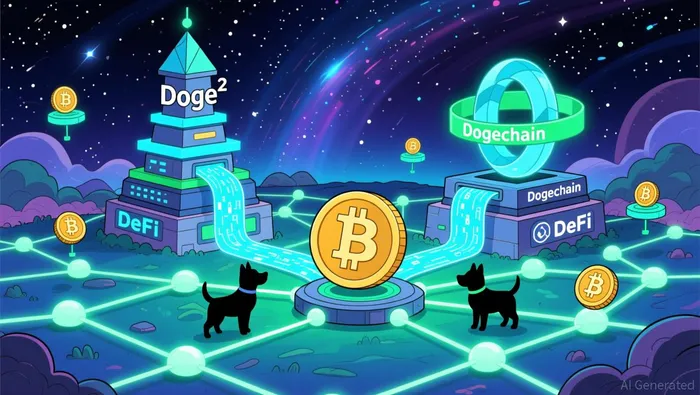
Layer-2 solutions like Doge² and the Dogechain platform introduced features such as zero-knowledge proofs and smart contract support via zkEVM technology, enabling faster, cheaper transactions and expanding the coin's utility in decentralized finance (DeFi). These advancements position DOGE to compete with EthereumETH-- and other smart contract platforms, though adoption remains nascent.
Strategic mergers, such as the $225 million union between House of Doge and Brag House Holdings, further institutionalized the ecosystem. This merger, aimed at securing a Nasdaq listing by 2026, could democratize access to DOGE for a broader investor base. Such developments suggest that the foundation is prioritizing long-term infrastructure over short-term speculation-a critical shift for a project once defined by viral tweets and celebrity endorsements.
The Post-Musk Era: Can DOGE Survive Without Hype?
Elon Musk's influence on Dogecoin has been both a blessing and a curse. While his X (formerly Twitter) platform historically drove price surges-such as when a new payment icon speculation sent DOGE to multi-year highs in 2025 according to market reports-reliance on social media hype is unsustainable. The Dogecoin Foundation has acknowledged this, emphasizing that real-world adoption and utility, rather than celebrity-driven narratives, will determine the coin's future.
This transition is not without risks. Regulatory headwinds, market volatility, and competition from more established blockchains remain significant hurdles. However, the ecosystem's focus on scalability, DeFi integration, and corporate partnerships suggests a maturing project. If these efforts gain traction, DOGE could carve out a niche as a low-cost, high-speed payment solution-a use case that aligns with its original design as a "joke" coin but now holds tangible value.
Conclusion: A Cautious Case for 2026
Dogecoin's 2025 struggles-marked by political entanglements and regulatory uncertainty-highlight the challenges of transitioning from a meme coin to a mainstream asset. Yet, the progress in corporate adoption, technical innovation, and institutional confidence offers a compelling counter-narrative. While the road to 2026 is fraught with risks, the ecosystem's focus on utility over speculation may yet validate DOGE's long-term potential.
For investors, the key question is whether these developments can outpace the volatility of the past. If Dogecoin succeeds in establishing itself as a practical, scalable payment network-and if its Nasdaq listing materializes-2026 could mark a turning point. Until then, DOGE remains a high-risk, high-reward proposition, where the line between hype and substance continues to blur.







Comentarios
Aún no hay comentarios