
DOGE's Stagnation and the Rise of Noomez as a Strategic Presale Alternative
The memeMEME-- coin market in 2025 is a study in contrasts. On one side, DogecoinDOGE-- (DOGE), the OG meme coin, struggles with stagnation and bearish technical signals. On the other, newer projects like Noomez ($NNZ) are capturing investor attention with structured presales and deflationary mechanics. This divergence reflects a broader trend: capital reallocation within the meme coin space, as investors seek alternatives to traditional meme assets.
DOGE's Stagnation: A Bearish Technical and On-Chain Landscape
Dogecoin's price has languished near $0.15–$0.17 in late 2025, a far cry from its earlier highs. Technical indicators paint a grim picture: a death cross formation and weak on-chain holder behavior signal prolonged bearishness. If buyers fail to step in, some analysts warn of a 40% drop toward $0.095 according to market analysis. Whale activity has further exacerbated concerns. Large holders with 10 million to 100 million DOGEDOGE-- sold $730 million worth of their holdings since October 2025, while mid-tier whales' accumulation efforts lack coordination, stalling price recovery according to data. Derivatives data underscores this bearishness: short liquidation leverage stands at $776.75 million, dwarfing longs at $151.77 million.
Despite these challenges, DOGE retains cultural durability. Its 5 million active wallets and Reddit community keep it relevant, and its low-fee, fast transaction model supports microtransactions. However, broader market dynamics-macroeconomic uncertainty, regulatory scrutiny, and competition from newer meme coins-have dampened its appeal. Tokens like Shiba Inu (SHIB), PEPE, and BONK are siphoning attention and capital, with SHIB's deflationary burns and Shibarium layer-2 solution, PEPE's high-beta volatility, and BONK's Solana-based efficiency all offering distinct value propositions.
Noomez's Rise: A Structured Presale Alternative
Enter Noomez ($NNZ), a 28-stage deflationary presale project that has raised $42,163.80 as of Stage 5 progress, attracting 184 holders. Unlike DOGE's organic growth, Noomez's model is engineered for transparency and scarcity. Each stage increases the token price incrementally from $0.00001 to $0.0028, with unsold tokens burned to reduce supply. This structured approach, combined with real-time burn tracking via the Noom Gauge, creates a sense of urgency and predictability.
Investor incentives further differentiate Noomez. Staking rewards of up to 66% APY and a 10% referral bonus appeal to risk-averse traders seeking yield in a volatile market. Analysts describe it as a "safe haven" within the meme coin sector, contrasting with DOGE's open-market volatility. By September 2025, Noomez had already surpassed Stage 3, raising $25,334.17 with 141 holders, signaling growing traction.
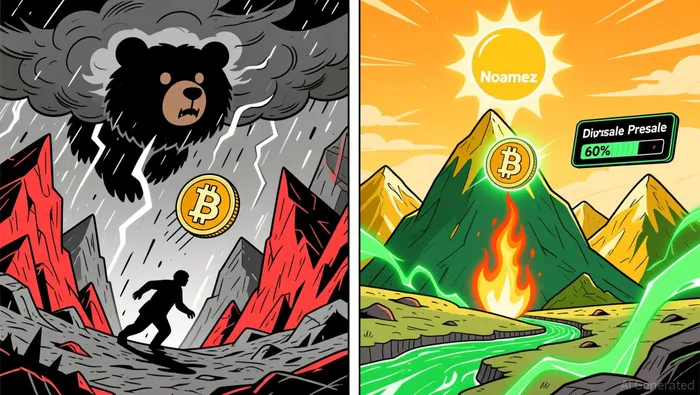
Capital Reallocation: From Stagnation to Structured Growth
The shift in capital from DOGE to Noomez reflects a broader investor preference for projects with verifiable on-chain mechanics and utility-driven narratives. While DOGE's long-term price forecasts remain optimistic-averaging $0.55 by 2030-these depend on speculative factors like payment integrations. Noomez, by contrast, offers a fixed-price presale with limited downside, attracting traders who prioritize structured growth over cultural nostalgia according to market analysis.
This reallocation is also driven by market dynamics. DOGE's inflationary model, issuing 5.2 billion new coins annually, contrasts with Noomez's deflationary burns, which reduce supply and create scarcity. Additionally, Noomez's Solana-like efficiency (via its presale structure) mirrors BONK's appeal, positioning it as a hybrid of innovation and accessibility.
Conclusion: The Future of Meme Coin Capital Flows
As 2025 progresses, the meme coin market is evolving from a "hype-driven" asset class to one that demands technical rigor and utility. DOGE's stagnation highlights the risks of relying on cultural momentum alone, while Noomez's presale model exemplifies how structured innovation can attract capital in a competitive landscape. For investors, the lesson is clear: capital reallocation is not just about chasing the next big thing-it's about aligning with projects that address the shortcomings of their predecessors.






Comentarios
Aún no hay comentarios