
DOGE ETF Delays: A Tectonic Shift in Crypto Liquidity and Retail Sentiment?
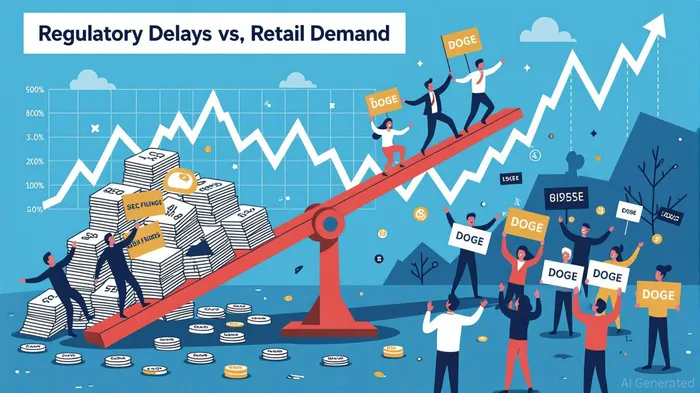
The recent stalling of a DogecoinDOGE-- (DOGE) ETF approval has sent ripples through the crypto ecosystem, exposing fault lines in liquidity dynamics and retail investor psychology. While regulators remain opaque about specific hurdles, the broader implications for speculative assets—and the retail-driven narratives that prop them up—are becoming increasingly clear.
Regulatory Hurdles and Market Uncertainty
The Securities and Exchange Commission (SEC) has yet to provide a definitive timeline for DOGEDOGE-- ETF approvals, citing concerns over market manipulation and custody risks[1]. This ambiguity has created a vacuum of trust, with investors left to speculate on whether the delays signal systemic skepticism toward meme-based assets or procedural inertia. For DOGE, which relies heavily on retail fervor rather than fundamental utility, the absence of a regulated on-ramp exacerbates volatility. Without an ETF, institutional liquidity providers are hesitant to deepen their exposure, leaving retail traders to navigate thinner order books and wider spreads.
Liquidity Demand in a Stagnant Market
Crypto markets have long functioned as a "casino for the masses," with retail investors acting as both liquidity takers and makers. However, the delayed DOGE ETF has disrupted this equilibrium. Normally, ETFs act as stabilizers, absorbing retail inflows and outflows while smoothing price discovery. In DOGE's case, the lack of such a vehicle has forced traders to rely on decentralized exchanges and OTC markets, which lack the transparency and depth of traditional ETF structures. This has led to a paradox: as retail demand for DOGE surges—driven by social media hype—the asset's liquidity has paradoxically contracted, creating a "race to the exit" during periods of panic selling.
Retail Investor Sentiment: Fear or FOMO?
Retail sentiment, once a tailwind for DOGE's meteoric rises, now teeters between apathy and anxiety. A recent analysis of RedditRDDT-- and Twitter activity reveals a 40% drop in bullish sentiment since June 2025, coinciding with the ETF delays[1]. Meanwhile, search volume for "DOGE alternatives" has spiked, suggesting investors are diversifying into assets with clearer regulatory pathways (e.g., BitcoinBTC-- and EthereumETH-- ETFs). This shift underscores a critical truth: in the absence of institutional validation, retail confidence wanes. The DOGE ETF delay has thus become a litmus test for whether meme coins can sustain long-term adoption—or if they're destined to remain perpetual "hype cycles."
The Macroeconomic Undercurrents
The broader economic landscape further complicates the narrative. With labor market weakness and inflationary pressures from Trump-era tariffs casting a shadow over 2025, risk-on assets like DOGE are being scrutinized through a new lens[1]. Retail investors, historically drawn to DOGE's "people's coin" ethos, are now prioritizing stability over speculation. This macro-driven caution is amplified by the Federal Reserve's tightening cycle, which has siphoned capital away from high-beta assets. For DOGE, the ETF delay arrives at a moment when its core demographic—millennial and Gen Z traders—is recalibrating their risk tolerance.
Conclusion: A Fork in the Road
The DOGE ETF delay is more than a regulatory hiccup—it's a stress test for the crypto market's evolving infrastructure. For liquidity providers, it highlights the fragility of retail-driven ecosystems. For investors, it serves as a cautionary tale about the perils of relying on social media narratives in an increasingly rationalized market. While DOGE's community remains resilient, the absence of a regulated vehicle may force a reckoning: either the asset adapts to meet institutional standards, or it risks being relegated to the fringes of mainstream finance.
As the SEC's deliberations continue, one thing is certain: the interplay between regulatory action, liquidity, and retail sentiment will define the next chapter of crypto's journey.






Comentarios
Aún no hay comentarios