
The DOGE Dilemma: Assessing Financial Transparency in Musk's Governance Overhaul and Its Impact on Governance-Tech Investing
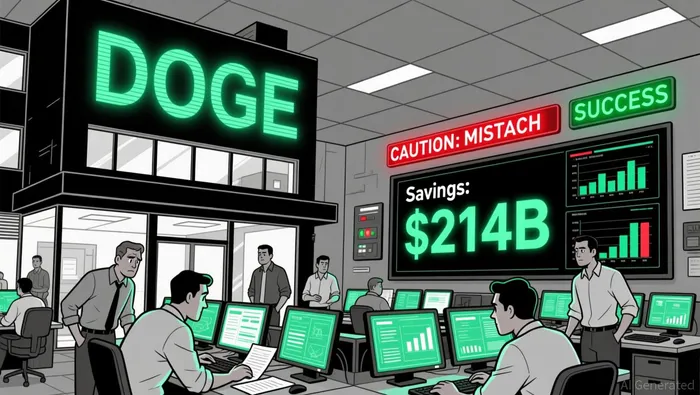
Elon Musk's Department of Government Efficiency (DOGE) has become a lightning rod for debate in both political and investment circles. Launched with the audacious goal of slashing federal spending, DOGE claims to have saved $214 billion through measures like contract cancellations, asset sales, and workforce reductions. However, these figures have been met with skepticism from independent analysts, media outlets, and even Musk himself. For governance-tech investors, the implications are clear: bold claims of efficiency must be rigorously scrutinized to separate ambition from reality.
The Savings Claims: Ambition vs. Reality
DOGE's flagship "wall of receipts" showcases savings that appear staggering at first glance. Yet, as data from NPR and BBC Verify reveals, these numbers often rely on methodological shortcuts. For instance, DOGE's claimed $2.9 billion savings from a single contract cancellation was found to overstate actual savings by over 90%, with BBC estimating the real figure at just $153 million. Similarly, NPR's analysis of DOGE's broader claims found documented savings of only $2 billion against an initial $55 billion target.
Musk himself has tempered expectations, admitting the initiative was only "somewhat successful" and that he would not pursue a similar role in the future. This self-critique underscores the tension between aspirational goals and the complexities of bureaucratic reform.
Methodological Flaws and Third-Party Scrutiny
The core issue lies in how DOGEDOGE-- calculates savings. Critics argue that the department often uses maximum potential savings-based on contract values-rather than actual amounts spent or saved. This approach, while technically defensible, creates a misleading narrative. For example, canceling a $1 billion contract does not necessarily mean $1 billion was saved; it could mean the agency was already overspending or the contract was non-essential.
Independent analyses further complicate the picture. The Partnership for Public Service estimates that DOGE's cost-cutting measures could cost taxpayers up to $135 billion this fiscal year due to rehiring expenses, lost productivity, and paid leave. These hidden costs highlight a critical risk for investors: governance-tech projects that prioritize speed over nuance may generate short-term headlines but fail to deliver long-term value.
Implications for Governance-Tech Investors
For investors in governance-tech-a sector focused on leveraging technology to improve public administration-the DOGE saga offers both cautionary lessons and strategic opportunities.
Transparency is Non-Negotiable: DOGE's credibility crisis stems from opaque methodologies and a lack of third-party validation. Investors should prioritize projects that publish granular data, undergo independent audits, and engage with public accountability mechanisms.
Sustainability Over Spectacle: While Musk's high-profile role has drawn attention to governance efficiency, the initiative's mixed results suggest that systemic change requires more than charismatic leadership. Successful governance-tech ventures will likely focus on incremental, verifiable improvements rather than grandiose promises.
Risk of Overreach: DOGE's reliance on aggressive savings targets mirrors a common pitfall in tech-driven governance: the belief that efficiency can be engineered without understanding institutional complexity. Investors must assess whether a project's approach accounts for the human and procedural realities of government.
Conclusion
DOGE's financial claims, while ambitious, reveal the challenges of applying a tech-driven ethos to governance. For investors, the takeaway is clear: governance-tech is not a silver bullet. It demands rigorous due diligence, a commitment to transparency, and a willingness to navigate the messy realities of public administration. As the sector evolves, projects that balance innovation with accountability-rather than relying on celebrity endorsements or inflated metrics-will likely emerge as the true drivers of progress.






Comentarios
Aún no hay comentarios