
DocuSign's Q2 Earnings Surge and Strategic Buyback Signal Undervaluation in a High-Growth SaaS Sector
In the rapidly evolving SaaS landscape, identifying undervalued yet resilient players requires a nuanced understanding of both macroeconomic trends and company-specific fundamentals. DocuSignDOCU-- (DOCU) has emerged as a standout candidate in this regard, with its Q2 2026 earnings report and aggressive share repurchase strategy underscoring its potential as a compelling value play.
A Resilient Earnings Performance in a Competitive Sector
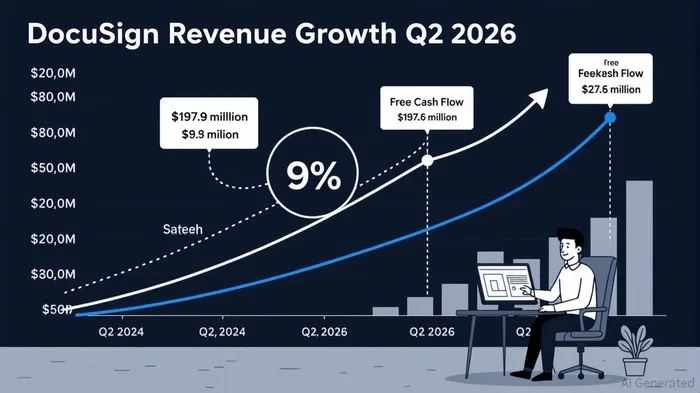
DocuSign’s fiscal second-quarter 2026 results, reported on July 31, 2025, demonstrated robust growth amid a maturing SaaS market. Total revenue reached $800.6 million, reflecting a 9% year-over-year increase and surpassing the Zacks Consensus Estimate by 2.78% [1]. Earnings per share (EPS) of $0.92 exceeded expectations by 9.52%, highlighting the company’s ability to deliver profitability even as it scales [2]. Billings grew 13% year-over-year to $818.0 million, signaling strong demand for its Intelligent Agreement Management (IAM) platform, which now accounts for a significant portion of direct deal volume [4].
These results are particularly noteworthy given the broader SaaS sector’s challenges with slowing growth and margin compression. DocuSign’s non-GAAP operating margin of 30% and free cash flow of $217.6 million (up 10% year-over-year) [1] underscore its operational efficiency, a critical differentiator in a market where many peers struggle to balance growth with profitability.
Strategic Buybacks: A Vote of Confidence in Shareholder Value
DocuSign’s recent share repurchase program further reinforces its value proposition. In June 2025, the company authorized an additional $1.0 billion in buybacks, bringing the remaining authorization to $1.4 billion [2]. During Q2 alone, it repurchased $201.5 million worth of shares, with $1.2 billion still available as of July 31, 2025 [3]. These actions signal management’s conviction that the stock is undervalued, particularly given its current price-to-earnings (P/E) ratio of 17.1x, which is significantly below the industry average of 25–30x for software companies [1].
Comparisons to peers like ServiceNowNOW-- (P/E of 48.31) and DatadogDDOG-- (P/E of 67.53) highlight DocuSign’s attractive valuation [3]. While high-growth SaaS stocks often trade at premium multiples, DocuSign’s combination of recurring revenue (98% of total revenue from subscriptions) and disciplined cost management positions it to justify a lower P/E while still delivering strong returns.
Valuation Metrics in Context: A SaaS Stock with Room to Run
DocuSign’s price-to-sales (P/S) ratio of 5.30 [1] appears elevated compared to the software industry median of 2.54 [3]. However, this metric must be interpreted through the lens of the SaaS sector’s explosive growth. With the global SaaS market projected to reach $1.25 trillion by 2034 at a 13% compound annual growth rate (CAGR) [3], investors are willing to pay a premium for companies with durable competitive advantages. DocuSign’s leadership in contract lifecycle management (CLM)—recently recognized as a leader in the 2025 IDC MarketScape for AI-enabled CLM applications [1]—provides such an advantage.
Moreover, the company’s balance sheet offers flexibility for reinvestment and shareholder returns. With $1.09 billion in net cash [2] and free cash flow of $920 million in 2025 [2], DocuSign is well-positioned to fund innovation in its IAM platform while maintaining a strong buyback program.
The Case for a Value Play in a High-Growth Sector
The SaaS sector’s expansion is accelerating, driven by digital transformation and the shift to cloud-based solutions. By 2025, over 85% of business applications are expected to be SaaS-based [4], and enterprises now manage an average of 275 SaaS applications [1]. DocuSign’s focus on automating agreement processes—a critical pain point for businesses—aligns with these trends.
Critically, the company’s valuation appears to discount its long-term potential. At a P/E of 17.1x and a P/S of 5.3x, DocuSign trades at a discount to peers while maintaining a strong growth trajectory. Its Q3 2026 guidance of $804–$808 million in revenue and $785–$795 million in billings [1] further supports its ability to meet—and potentially exceed—market expectations.
Conclusion
DocuSign’s Q2 earnings and strategic buybacks present a compelling case for investors seeking a SaaS value play. While its P/S ratio may appear high, the company’s profitability, operational efficiency, and leadership in a high-growth niche justify its valuation. As the SaaS sector continues to expand, DocuSign’s disciplined approach to capital allocation and innovation positions it to outperform peers and deliver long-term shareholder value.
**Source:[1] Docusign Announces Second Quarter Fiscal 2026 Financial Results [https://investor.docusign.com/investors/press-releases/press-release-details/2025/Docusign-Announces-Second-Quarter-Fiscal-2026-Financial-Results/default.aspx][2] DocuSign, Inc. (DOCU) - AIpha [https://aipha.io/docu_docusign_inc/][3] 9 Subscription-Based SaaS Stocks With High Retention [https://www.tikr.com/blog/9-subscription-based-saas-stocks-with-high-retention][4] SaaS statistics for 2025: Growth, adoption, and market trends [https://www.hostinger.com/tutorials/saas-statistics]





Comentarios
Aún no hay comentarios