
DJT's Fusion Power Merger: A Strategic Pivot for Energy-Driven AI Growth?
The $6 billion all-stock merger between Trump MediaDJT-- & Technology Group (DJT) and TAE Technologies has ignited a firestorm of speculation about the future of energy and artificial intelligence. At first glance, the deal appears to be a moonshot: a politically charged social media platform merging with a cutting-edge fusion energy startup. But beneath the headlines lies a complex interplay of technological ambition, market dynamics, and geopolitical stakes. For investors, the question is whether this union represents a viable long-term play or a speculative gamble cloaked in hype.
The Merger: A High-Stakes Bet on Fusion and AI
The merger creates one of the world's first publicly traded fusion energy companies, combining DJT's access to capital and public market infrastructure with TAE's 1,600-patent-strong fusion technology portfolio. The new entity, led by co-CEOs Devin Nunes (DJT) and Michl Binderbauer (TAE), aims to build the world's first utility-scale fusion power plant by 2026, with a target output of 50 megawatts-scaling to 350–500 megawatts in subsequent plants according to reports. This timeline is aggressive, even by fusion industry standards, where most competitors (e.g., Commonwealth Fusion Systems, Helion Energy) are targeting commercialization by the early 2030s according to industry analysis.
TAE's technical approach-using a Field-Reversed Configuration (FRC) to achieve plasma temperatures exceeding 75 million °C-has been validated by third-party analyses, including a report by Futurum Group, which highlights fusion's critical role in meeting AI's surging energy demands. The U.S. Department of Energy (DOE) has also elevated fusion to a "national strategic priority", underscoring the geopolitical urgency to outpace China's advancements in the field.
AI's Energy Appetite: A Tailwind or a Mirage?
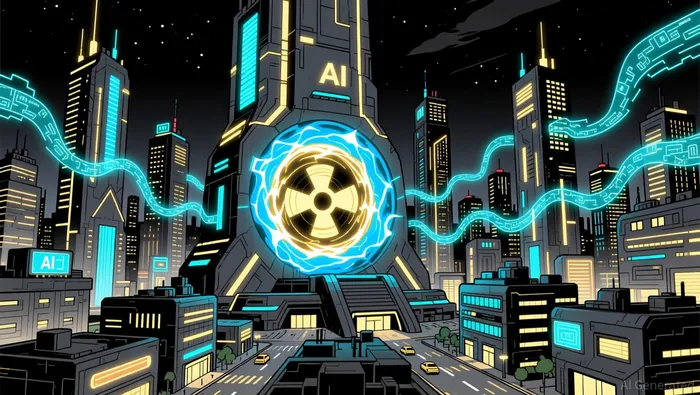
The merger's stated rationale hinges on addressing AI's exponential energy consumption. According to industry estimates, AI infrastructure could add 130 gigawatts of new electricity demand in the U.S. alone by 2030-equivalent to 12% of current peak load according to Futurum Group research. TAE's roadmap explicitly ties its fusion plants to powering AI data centers, a sector where energy costs already account for 30–50% of operational expenses according to company press releases.
However, this argument assumes that AI's growth trajectory remains unimpeded-a big ask in an era of regulatory scrutiny and economic volatility. For instance, the European Union's AI Act and U.S. antitrust investigations could slow AI adoption, reducing the urgency for new energy solutions. Moreover, TAE's competitors are also vying for this market, with companies like Helion Energy claiming to have achieved net energy gain in their fusion reactors according to industry reports.
Financial Realities: DJT's Stock Price and the "Trump Premium"
DJT's stock has been a rollercoaster, plummeting 75% from its January 2025 highs amid questions about its ability to monetize Truth Social according to market analysis. The merger's all-stock structure means TAE shareholders will own 50% of the combined entity, effectively betting on DJT's ability to stabilize its business. This raises a critical question: Can DJT's political brand and media assets justify a $6 billion valuation in a post-merger context?
The answer hinges on two factors:
1. Trump's Influence: As the largest shareholder (41% of shares held in a trust managed by his eldest son), Donald Trump's political actions could sway investor sentiment. However, this also introduces regulatory and reputational risks, particularly if the SEC or DOJ scrutinizes the trust's governance according to CNBC reporting.
2. TAE's Execution: TAE's $1.3 billion in private capital from Google, Chevron, and Goldman Sachs provides a strong foundation, but scaling fusion to utility-scale remains unproven. The $300 million upfront investment from DJTDJT-- is a down payment, not a guarantee according to market analysis.
Risk Factors: Technical, Regulatory, and Market
The merger's success depends on overcoming three major hurdles:
- Technical: Fusion energy is still in the experimental phase. TAE's FRC approach has shown promise, but transitioning from lab-scale to commercial power plants requires overcoming engineering challenges and cost overruns.
- Regulatory: The U.S. Nuclear Regulatory Commission (NRC) has yet to establish a clear framework for fusion licensing, creating uncertainty for the 2026 plant timeline according to market analysis.
- Market: Even if TAE succeeds technically, it must compete with cheaper alternatives like renewables and hydrogen. The AI sector's willingness to pay a premium for fusion energy remains untested.
Analysts from Futurum Group and the Fusion Industry Association acknowledge these risks but argue that the strategic alignment with AI demand justifies the bet. However, DJT's own financials tell a different story: its market cap of $3.01 billion and one-year return of -65% reflect deep skepticism about its ability to pivot beyond its politically polarized user base according to market analysis.
The Verdict: A High-Risk, High-Reward Proposition
For long-term investors, the DJT-TAE merger is a binary bet. If TAE can deliver on its fusion roadmap and AI's energy demands materialize as projected, the combined entity could become a cornerstone of the clean energy transition. However, this outcome requires perfect execution across technical, regulatory, and market dimensions-none of which are guaranteed.
Conversely, if TAE falters or AI adoption slows, DJT's stock could continue its freefall, dragging the merged entity into irrelevance. The "Trump premium" may offer short-term volatility, but it does little to address the core issue: DJT's lack of a sustainable business model.
In the end, this merger is less about energy and more about a desperate attempt to rebrand DJT as a "tech" company. Whether that rebranding succeeds will depend on forces far beyond the control of either CEO.





Comentarios
Aún no hay comentarios