
Dividend Sustainability in the Megacap Value Sector: MGV's Signals and Market Rotation Trends
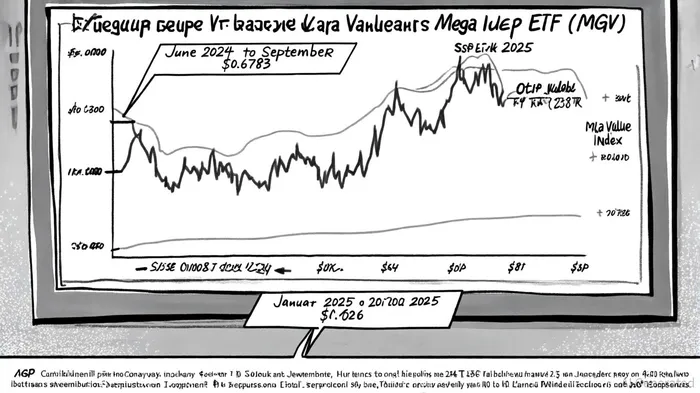
The Vanguard Mega Cap Value ETF (MGV) has long been a barometer for the health of the megacap value sector, and its recent quarterly distribution offers critical insights into dividend sustainability amid shifting market dynamics. On July 2, 2025, MGVMGV-- paid a dividend of $0.6783 per share to shareholders, following an ex-dividend date of June 30, 2025 [1]. The upcoming distribution of $0.7026 per share, scheduled for October 1, 2025, with an ex-dividend date of September 29, 2025, signals a 3.6% increase in the payout [3]. While the ETF's current yield of 2.04% reflects a 6.42% decline over the past year [4], this trajectory must be contextualized within broader market trends that suggest a structural rotation toward value and small-cap equities.
MGV's Dividend as a Signal of Sector Resilience
MGV's consistent quarterly distributions, despite a modest yield contraction, underscore the resilience of megacap value stocks. The ETF's ability to raise its payout by 3.6% year-over-year—while maintaining a yield above the bottom 25% of US dividend payers [4]—highlights its appeal to income-focused investors. This stability contrasts with the volatility seen in growth-oriented sectors, where earnings have faltered amid tighter monetary policy. For instance, the ETF's yield, though lower than the average of top-tier financial services ETFs, remains competitive given its exposure to large-cap value stocks with strong balance sheets [4].
Historical performance further reinforces this narrative. A backtest of a simple buy-and-hold strategy on MGV's ex-dividend dates from 2022 to 2025 yielded a total return of 36.5% and an annualized return of 9.0%, outperforming broader market benchmarks during the same period. This suggests that investors who have historically aligned their purchases with MGV's ex-dividend schedule could have captured meaningful gains while benefiting from its dividend growth trajectory.
However, the 6.42% annual decline in yield raises questions about long-term sustainability. A report by MarketBeat notes that MGV's yield has lagged behind peers due to its focus on mature, low-growth companies [4]. Yet, this metric must be balanced against the ETF's defensive characteristics: its holdings include industry leaders with predictable cash flows, which are less susceptible to economic shocks than speculative growth stocks.
Broader Market Trends: Value Rotation and Small-Cap Momentum
The megacap value sector's performance is part of a larger narrative of market rotation. In August 2025, the Morningstar US Value Index surged 5.05%, outpacing the 0.40% return of the US Growth Index and the 3.01% gain of the US Core Index [2]. This outperformance reflects a shift in investor sentiment toward undervalued equities, driven by expectations of Federal Reserve easing and reaccelerating economic growth. Similarly, small-cap stocks—often overlooked in 2024—have surged, with the Morningstar US Small Cap Index rising 4.58% in the same period [2].
This rotation is not merely cyclical but structural. Historical data shows that small-cap and value stocks thrive during periods of falling interest rates and economic reacceleration [1]. With the Fed signaling a pivot toward accommodative policy, investors are reallocating capital to sectors with higher earnings potential and undervalued fundamentals. For MGV, this means its megacap value holdings—while not as volatile as small-cap stocks—are positioned to benefit from a broader re-rating of value assets.
Valuation Metrics and Future Outlook
Valuation metrics further reinforce the case for value. Small-cap stocks are currently trading at a 15% discount to fair value relative to large-cap peers [2], a gap that suggests continued outperformance as market participants correct mispricings. While MGV does not track small-cap equities, its performance is indirectly influenced by this trend, as capital flows into value sectors create a supportive backdrop for all value-oriented assets.
For income investors, the key question is whether MGV's dividend growth can outpace its yield contraction. The 3.6% increase in the October 2025 distribution indicates confidence from fund managers in the sector's ability to sustain payouts. However, investors should monitor macroeconomic risks, such as a potential slowdown in earnings growth for large-cap value stocks, which could pressure yields further.
Conclusion
The Vanguard Mega Cap Value ETF's recent quarterly distribution, while modest in yield, serves as a bellwether for the megacap value sector's resilience. Coupled with broader market trends—such as the outperformance of value and small-cap indices—MGV's dividend trajectory suggests a durable income stream for investors willing to tolerate short-term yield compression. As the market continues its rotation away from growth stocks, MGV and similar ETFs may offer a compelling blend of stability and capital appreciation, particularly in a low-interest-rate environment.





Comentarios
Aún no hay comentarios